ENEnglish
 LTLietuviškai
 DEDeutsch
 FRFrançais
 RUРусский
 ESEspañol
 PLPolski
 ITItaliano
 UKУкраїнська
 CSČeština
 PTPortuguês
 JA日本語
JA日本語 LVLatviešu valoda
 ETEesti
 HUMagyar
 IDBahasa Indonesia
 TRTürkçe
 HIहिन्दी
 ELΕλληνικά
 ARالعربية
 THไทย
THไทย VITiếng Việt
 RORomână
 MSBahasa Melayu
 BNবাংলা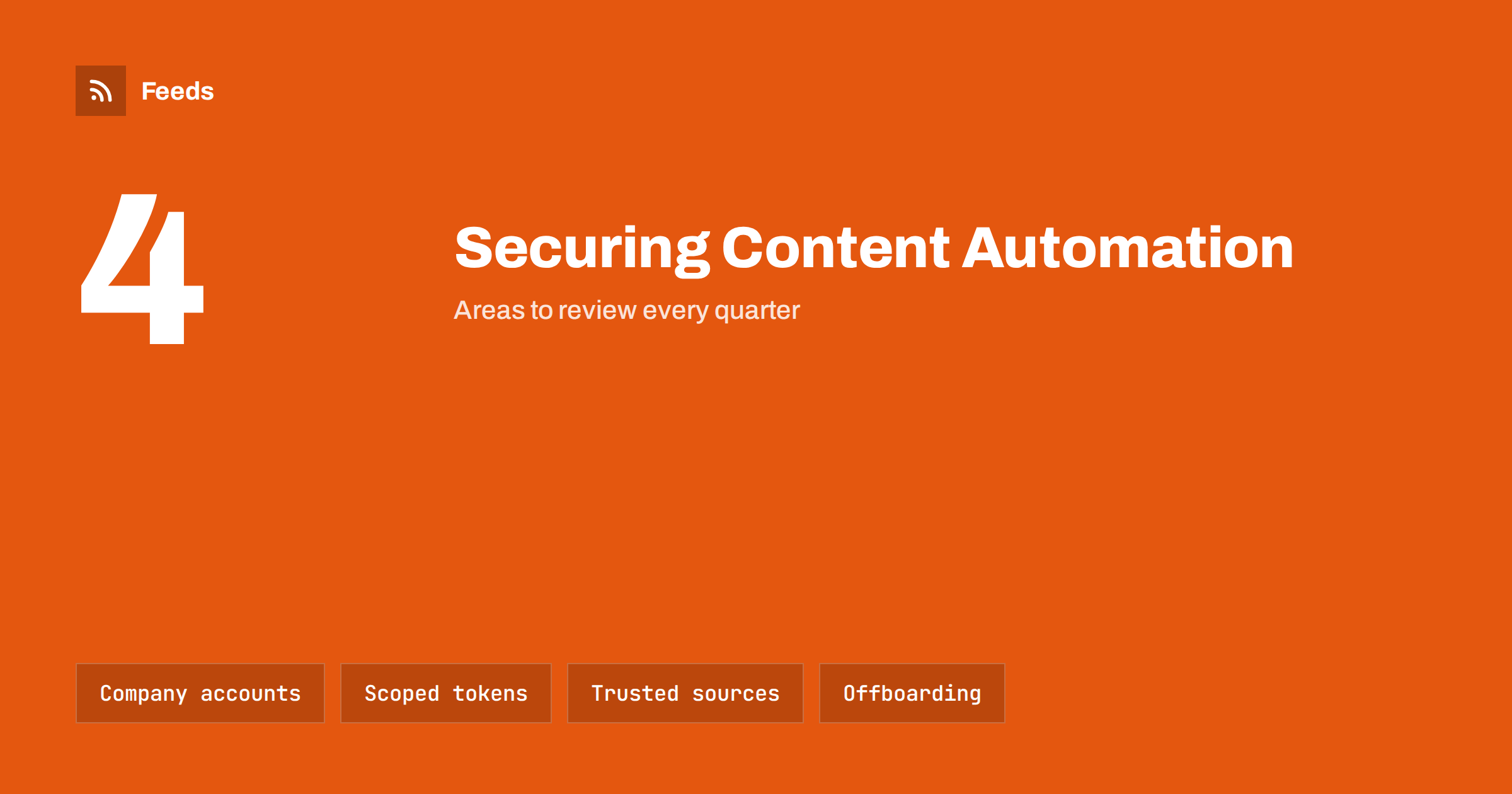
Short answer: Content automation is only as safe as the accounts and sources behind it. Connect tools through company-owned accounts with two-factor authentication, grant each tool only the permissions it needs, keep API keys and tokens out of shared documents, and make sure every source feed that can trigger a post is one you trust or filter. Review connections every quarter and remove access the day someone leaves.
Why automation deserves its own security review
A manual post needs a person to log in and press publish. An automated workflow does that for you, around the clock, with stored credentials. That convenience changes the risk profile in three ways.
- Standing access. Automation tools hold tokens that can post to your pages and profiles at any time, often for months, without anyone logging in.
- Hidden ownership. Workflows are frequently set up by one marketer or freelancer on a personal account. When that person leaves, nobody knows what is connected or how to change it.
- Untrusted input. Feed-driven automation publishes whatever the source contains. If the source is compromised, renamed or simply changes its content, your channels publish the result.
None of this means automation is unsafe. It means that the setup deserves the same care you would give to a shared password for your company’s main social account, because in practice that is what it is.
Start with an inventory of every connection
You cannot secure what you cannot see. List every automation that publishes or sends anything on your behalf:
- The tool or platform, such as a posting service, a workflow tool or a newsletter platform.
- The account it runs under and who has the login.
- Every destination it can post to: pages, profiles, channels, email lists, team chats.
- Every source that can trigger it: RSS feeds, product feeds, forms, webhooks, spreadsheets.
- The permissions granted when the connection was authorised.
- The owner: the person responsible for keeping it working and safe.
Keep the inventory in one place that the whole team can find, and update it whenever a workflow is added, changed or retired. A list that is six months out of date gives a false sense of control.
This list is also the backbone of good documentation. Agencies that manage many clients will find the process in content automation for agencies useful, because the number of connections grows fast.
Accounts: company-owned, shared safely, protected
The single most common problem is automation tied to a personal account. Fix it with a few rules:
- Use company-owned accounts for automation tools, registered to a role address such as marketing@ rather than a person’s inbox, so access survives staff changes.
- Use the platforms’ business roles. Social networks let you grant people and apps access to a page or company profile through business management tools. That is safer than sharing the password of the account that owns the page.
- Turn on two-factor authentication everywhere it is available: the automation tool, the social accounts and the email account that can reset them.
- Store shared credentials in a password manager with access control and an audit trail, never in a spreadsheet, chat message or shared document.
- Keep at least two admins on every important account, so one person being unavailable does not lock you out.
Tokens and API keys: treat them like passwords
When you click “connect” in an automation tool, the network usually issues an access token. Tokens are what actually let the tool post. Some expire after a set period and must be renewed; others last until revoked. A few habits keep them under control:
- Authorise from the right account. The token inherits the permissions of whoever authorised it. A token created by a departed employee may stop working, or keep working when it should not.
- Grant the smallest scope. If the tool only needs to publish to one page, do not grant access to every page and ad account you manage.
- Never paste API keys into post templates, feed URLs or tickets. Keep them in the tool’s credential store.
- Rotate keys when someone with access leaves, when a key may have been exposed, and on a regular schedule for high-value accounts.
- Revoke unused connections. Every social network has a page listing connected apps. Remove anything that is no longer used.
Expired tokens are also one of the usual reasons automated posting silently stops; diagnosing RSS automation that stopped posting covers how to spot that quickly.
Least privilege for people and tools
Least privilege means giving each person and tool exactly the access their job requires, and no more. In content automation that looks like this:
| Who or what | Needs | Should not have |
|---|---|---|
| Posting tool | Publish to selected pages and profiles | Ad accounts, billing, admin roles |
| Content editor | Edit templates, approve queued posts | Connect or remove accounts |
| Freelancer or agency | Access to the client’s workflows only | Access to other clients or owner accounts |
| Workflow tool | Read the source feed, call the posting tool | Full access to the website or CMS |
| Team chat bot | Post to one channel | Read all messages in the workspace |
Check the permission screen carefully every time you connect something. Many tools ask for broad access by default because it is convenient for them, not because the workflow needs it.
Trust your sources, not just your accounts
Feed-driven automation has a risk that is easy to overlook: the source. If you auto-post from a partner’s news page, a supplier’s blog or a public feed, then whoever controls that source indirectly controls what appears on your channels. Things that can go wrong include a hacked partner site publishing spam, a domain that expires and is bought by someone else, a source that starts publishing off-topic content, or a feed that suddenly re-sends old items.
Reduce the risk with a few safeguards:
- Prefer sources you control for fully automatic publishing, such as your own blog or shop.
- Filter third-party sources so only items containing relevant words are posted. Keyword filters, explained in setting up keyword alerts with RSS filters, turn an open source into a narrow one.
- Use an approval queue for sources you do not control. The trade-offs are covered in full auto versus an approval queue.
- Protect against duplicates and floods. Limit how many items can post per run, so a source that re-sends its whole archive cannot flood your followers. See how to stop duplicate automated posts.
- Watch for layout changes. If a feed is generated from a page, a redesign can change what it picks up.
Offboarding and regular reviews
Most automation security incidents are not dramatic hacks. They are forgotten access. Put two routines in place:
- Offboarding checklist. When an employee, freelancer or agency leaves: remove them from business roles, change shared passwords, rotate any keys they could see, re-authorise connections they created from a company account, and update the owner column of your inventory.
- Quarterly review. Walk through the inventory. Remove unused workflows and connected apps, confirm two-factor authentication is still on, check that every source is still the one you expect, and read a sample of recent automated posts to confirm nothing odd has been published.
Also decide in advance what to do if something goes wrong: who can pause all automation, how to disconnect a tool from a page quickly, and who communicates with followers if an unwanted post goes out. Writing that down takes ten minutes and saves a stressful hour later.
Where Feeds fits in a safe setup
Feeds sits on the source side of the workflow. It reads public pages and stores from the outside, like a visitor, so it needs no login, plugin or API key on the source website. It can merge several sources into one feed, remove duplicates automatically, and keep only items with (or without) your keywords, which narrows what a downstream posting tool can publish. You see a preview of the items before a feed is created, and on paid plans you get an alert if a feed stops finding items. You can try it on the free plan.
Related reading
- Content automation checklist: 30 checks before you go live
- 12 content automation mistakes and how to avoid them
- Zapier vs Make vs IFTTT vs n8n for RSS automation
The bottom line
Secure content automation comes down to ownership and scope. Run tools under company-owned accounts with two-factor authentication, grant only the permissions each workflow needs, keep tokens and keys in proper credential stores, and trust or filter every source that can trigger a post. Keep an inventory, review it quarterly and offboard people the day they leave. With those habits, automation saves time without becoming a back door into your channels.
FAQ
Is it safe to connect social media accounts to automation tools?
Generally yes, if you use reputable tools, authorise them from company-owned accounts with two-factor authentication, and grant only the permissions needed. Review connected apps regularly and revoke anything unused.
What happens to automations when the person who set them up leaves?
Connections authorised from that person’s account may stop working, or keep working without anyone knowing. Re-authorise them from a company account, change shared passwords and rotate keys as part of offboarding.
Can a compromised RSS feed post spam to my social accounts?
Yes, if your automation publishes everything from that feed. Use sources you control for fully automatic posting, and apply keyword filters, item limits or an approval queue to third-party sources.
How often should I review automation access?
A quarterly review works for most small teams, plus an immediate check whenever someone with access leaves. The review should cover accounts, connected apps, permissions, sources and a sample of recent posts.
Where should API keys for automation be stored?
In the automation tool’s own credential store or a password manager with access control. Never put keys in post templates, spreadsheets, chat messages or shared documents.