ENEnglish
 LTLietuviškai
 DEDeutsch
 FRFrançais
 RUРусский
 ESEspañol
 PLPolski
 ITItaliano
 UKУкраїнська
 CSČeština
 PTPortuguês
 JA日本語
JA日本語 LVLatviešu valoda
 ETEesti
 HUMagyar
 IDBahasa Indonesia
 TRTürkçe
 HIहिन्दी
 ELΕλληνικά
 ARالعربية
 THไทย
THไทย VITiếng Việt
 RORomână
 MSBahasa Melayu
 BNবাংলা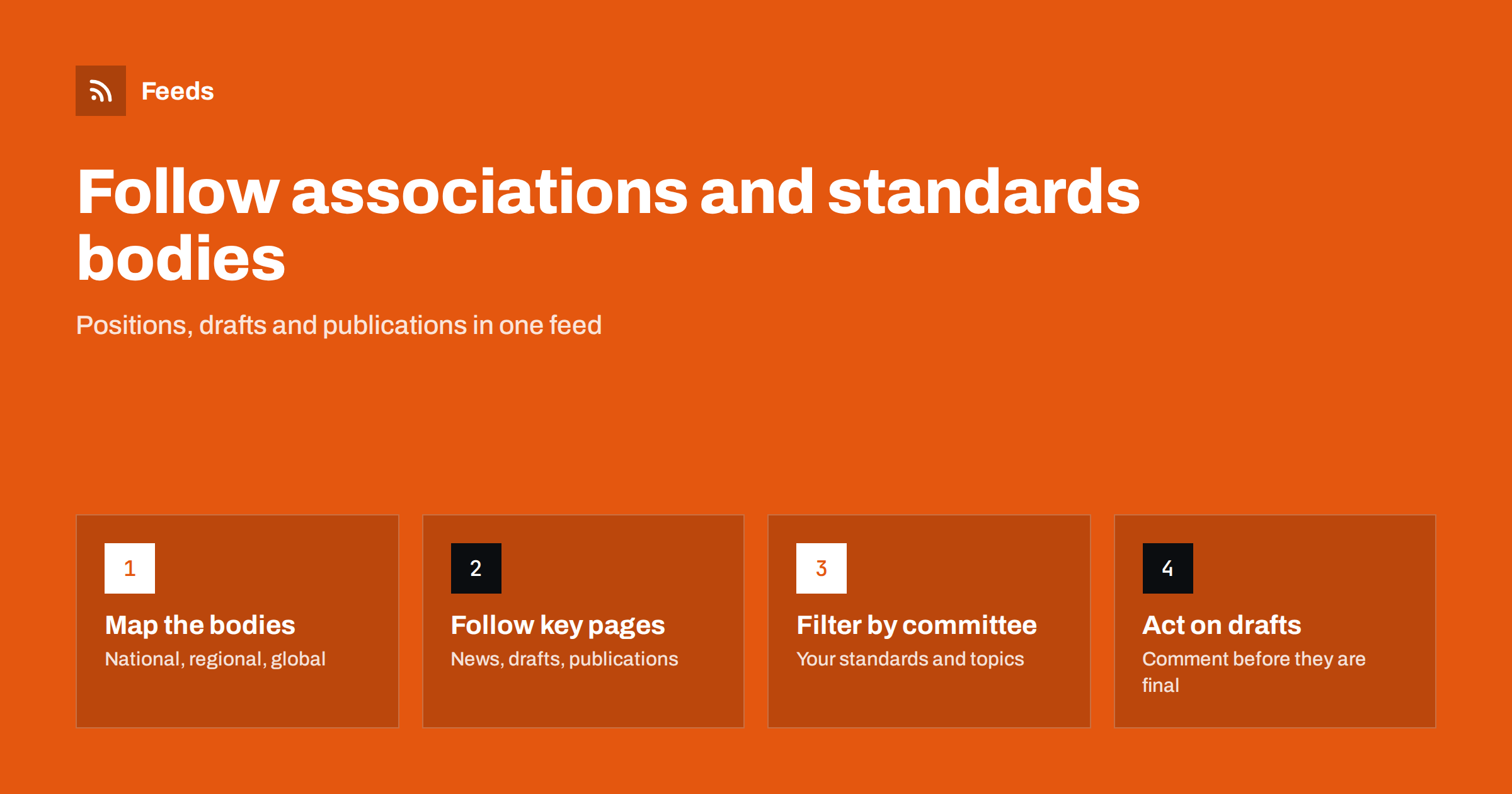
Short answer: List the industry associations and standards bodies relevant to your sector, then follow the pages where they publish news, position papers, draft standards open for comment, new publications and events. Most of these pages have no feeds, so create feeds from their list pages, merge them, and filter for the standards, committees and topics that affect you. Route drafts open for comment to your technical experts early, while there is still time to influence them.
Industry associations lobby on behalf of their members, publish market data and position papers, and organize the events where your industry meets. Standards bodies write the technical requirements that products and services must meet, often long before regulators reference them. Both shape the environment your business operates in, and both publish their work on websites that are rarely designed to be followed. For many companies, news from these bodies arrives late, through a member newsletter or a customer’s question. Feeds make it arrive on the day it is published.
This matters most for smaller companies. Large firms often have staff sitting on standards committees and association working groups, so they hear about changes from the inside. Smaller firms rarely have that capacity, but they are affected by the same standards and positions. Following the public output of these bodies closes much of that gap at little cost.
What these bodies publish
| Body | What to follow | Why it matters |
|---|---|---|
| Industry associations | News, position papers, consultation responses, market reports, events | Sector priorities, lobbying positions, data and networking |
| National standards bodies | Drafts for public comment, new and revised standards, news | Technical requirements you may have to meet |
| Regional and international standards organizations | Work programmes, new publications, news | Requirements that later become national standards |
| Certification and testing bodies | Scheme updates, news | Changes to certification you hold or need |
| Professional bodies | Guidance, codes of practice, news | Expectations for practitioners in your field |
Step 1: Map the relevant bodies
Start with the associations you are a member of or that represent your sector, then add the standards bodies whose standards your products or services follow. Your technical and quality teams usually know which standards matter; ask them for the list, including the committees that maintain each standard. Add regional or international bodies where your standards originate, since national versions often follow them.
Write the list down with, for each body, the pages you will follow and the internal owner. Standards feeds usually belong to engineering or quality, association feeds to management or public affairs. Clear ownership prevents the common situation where everyone assumes someone else is watching.
Also include associations in adjacent sectors that affect you, such as your customers’ or suppliers’ associations. Their positions and publications often signal changes that will reach you later, sometimes years before they appear in contracts or regulations.
Step 2: Find the pages worth following
For each body, look for these list pages:
- News or press: announcements, positions, events.
- Publications: reports, guidance, market data.
- Consultations or public comment: drafts open for comment, with deadlines.
- New standards or catalogue updates: lists of recently published or revised standards, often filterable by sector or committee.
- Events: conferences, working group meetings and webinars.
Pages that can be filtered by committee, sector or topic, with the filter in the address, are especially useful, because they let you follow only what concerns you.
Check whether a page lists items in the HTML before relying on it. Some standards catalogues are built as search applications that load results with scripts; in that case, try the body’s news page, a “latest publications” page or a printable list instead. Associations’ websites are usually simpler and convert to feeds without trouble.
Step 3: Create feeds and merge them
A few bodies offer feeds or email alerts for news or new publications; most list pages have neither. Create feeds from them with a page-to-feed tool, checking each preview to confirm that items are individual announcements, publications or drafts with their own links. Merge the feeds into two streams: one for news and positions, and one for standards and drafts, since they are read by different people.
Standards catalogues are sometimes large search applications rather than simple lists. Look for a “recently published” or “new this month” page, or a search filtered by committee and sorted by date with a stable address. If none exists, the body’s news page often announces important new standards and drafts, and can serve as a fallback source.
Step 4: Filter by standard, committee and topic
Standards bodies publish across all industries, so filtering is essential for their feeds. Use:
- The reference numbers of standards you follow, in the forms they appear in titles.
- Committee names or numbers.
- Technical terms from your field.
- Words that signal action, such as draft, enquiry, public comment, revision, withdrawn.
For association news, filters are usually unnecessary if you follow only your sector’s associations; read everything.
Keep a list of the standard numbers you follow in the same document as your source list. When a standard is replaced by a new number, which happens when standards are consolidated or adopted from international versions, update the filter immediately, or new drafts may slip past unnoticed.
Step 5: Act on drafts and positions
The value of following these bodies lies in acting early:
- Drafts for comment: send them to the relevant technical expert with the comment deadline. Comments on drafts are the main way companies influence standards.
- New or revised standards: assess whether products, processes or documentation need to change, and by when.
- Association positions and consultations: decide whether to contribute through the association, especially if you are a member.
- Events and working groups: consider participating, which gives earlier and deeper insight than any feed, and lets you meet the people who draft the documents you will later have to follow.
Record each relevant item, decision and deadline in a shared register, alongside your regulatory monitoring. Over time, the register shows how standards affecting your products evolve, which is useful for product planning and for answering customer questions about compliance.
A worked example
A manufacturer of electrical equipment follows its national industry association, a European trade association for its sector, the national standards body’s “drafts for public comment” and “new publications” pages filtered by the two committees that maintain its product standards, and a testing body’s scheme news. None of these pages has a feed, so the quality manager generates feeds for all of them and merges them into two streams.
When a revised product safety standard appears as a draft for public comment, the feed shows it on the day it is published. The company’s engineers review it, identify a proposed test that would be difficult to meet with the current design, and submit comments through the national committee. They also start design work early, so that when the revised standard is published, the product is ready. Meanwhile, the association feed shows that the trade association has published a position on the same revision, which the company’s management reads before a members’ meeting and uses to align its own comments.
Common mistakes
- Relying on member newsletters alone. They are useful but periodic and selective.
- Following only national bodies. Many standards originate regionally or internationally.
- Missing comment deadlines. Drafts are open for a limited time. Record deadlines immediately.
- Filtering with everyday words. Standards are identified by numbers and formal titles. Filter with those.
- Silent feeds. Standards catalogues and association websites are redesigned periodically. Check that feeds still find items.
- Reading without routing. A draft seen by the wrong person is as good as unseen. Send each item to its owner.
How Feeds helps
Feeds turns association news pages, publication lists and standards catalogue pages into RSS feeds when they have none, using existing feeds where available and showing a preview before anything is created. You can merge several bodies into one feed and keep only items with your standard numbers, committee names or topics, with duplicates removed automatically. Feeds refresh on their own, and paid plans alert you if a feed stops finding items. See the plans.
Related reading
- How to Track Government and Regulator Updates with RSS
- How to Get Alerts When a Website Publishes New Reports or PDFs
- How to Never Miss a Call for Speakers or Papers Again
The bottom line
Associations and standards bodies shape the rules and priorities of your industry, often well before regulators act. Map the bodies that matter, follow their news, publications and draft pages as feeds, filter standards feeds by reference numbers and committees, and route drafts to experts in time to comment. Early awareness turns standards changes from surprises into planned work.
FAQ
How can I follow new standards in my industry?
Follow the standards body’s pages for new publications and drafts for public comment, filtered by the committees and standard numbers that apply to you. Create feeds from these pages if they have none.
Why follow drafts for public comment?
Drafts show what is likely to change and give you a chance to comment before the standard is final. They also give you time to prepare.
Do industry associations publish RSS feeds?
Some do, but many only publish news and publications on plain web pages. Those pages can be turned into feeds with a page-to-feed tool.
How should I filter standards feeds?
Use standard reference numbers, committee names or numbers, and technical terms, plus words like draft or revision. Everyday words rarely match formal titles.
Is following associations useful if we are not members?
Yes. Their public positions, reports and events reveal the direction of your sector, although members get more detail and a say in positions.