ENEnglish
 LTLietuviškai
 DEDeutsch
 FRFrançais
 RUРусский
 ESEspañol
 PLPolski
 ITItaliano
 UKУкраїнська
 CSČeština
 PTPortuguês
 JA日本語
 LVLatviešu valoda
 ETEesti
 HUMagyar
 IDBahasa Indonesia
 TRTürkçe
 HIहिन्दी
 ELΕλληνικά
 ARالعربية
 THไทย
 VITiếng Việt
 RORomână
 MSBahasa Melayu
 BNবাংলা
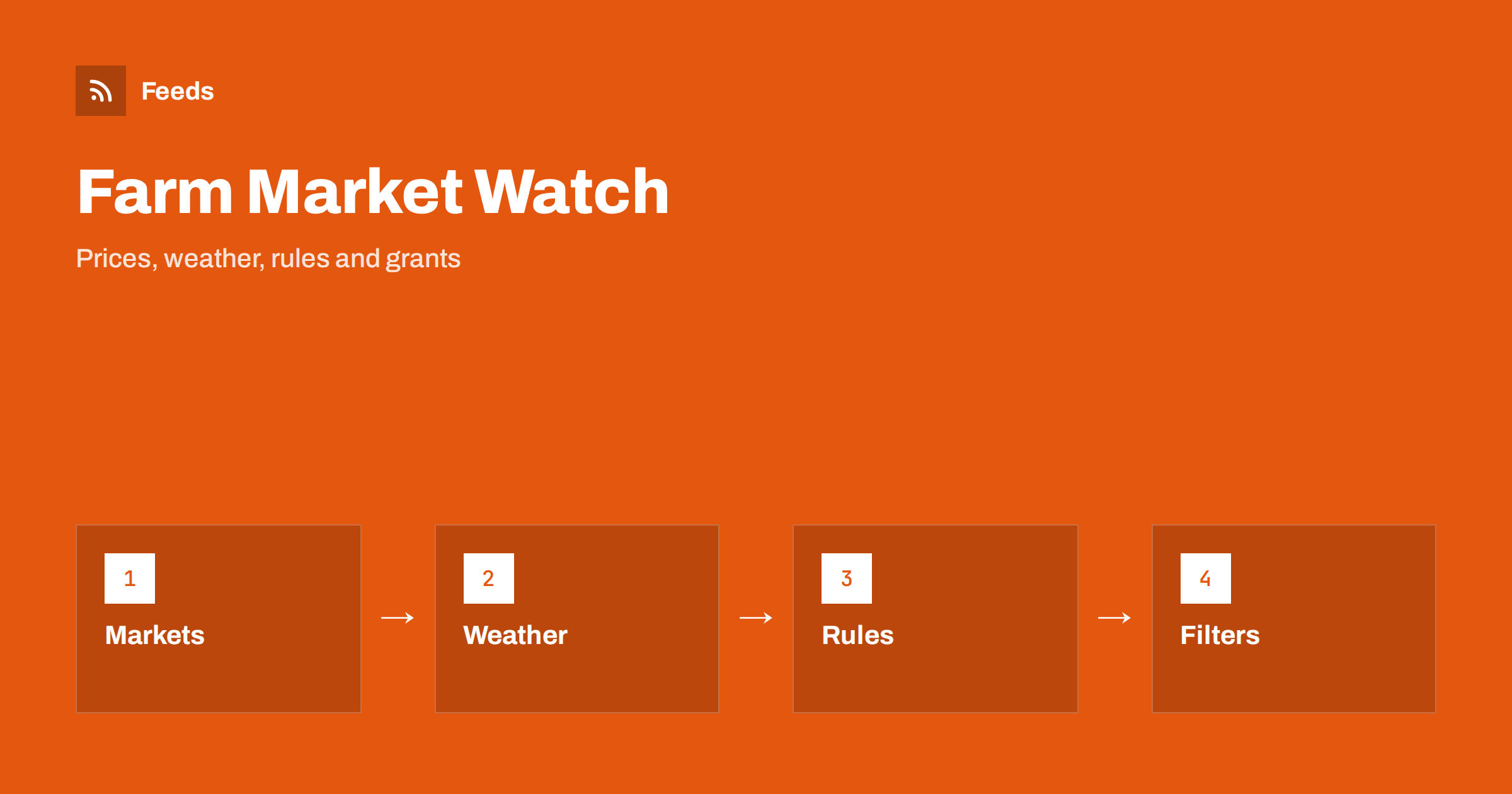
Short answer: Agriculture runs on information that changes constantly: market reports, input prices, weather warnings, regulations, subsidy deadlines and news from suppliers and buyers. RSS lets farmers, advisers, cooperatives and food businesses collect the official and trade sources they trust into one reader, filter them by crop, livestock type or region, and read only what affects their decisions. A feed brings the information to you faster, but it does not tell you when to sell, plant or buy; those decisions still depend on your own numbers, contracts and professional advice.
Why farm news is easy to miss
Information relevant to a farm is spread over many places. Agricultural ministries publish rules and deadlines, statistical offices publish production and price data, weather services issue warnings, producer organisations post market commentary and merchants announce prices. Trade magazines add their own stories, and local newspapers report on regional events. Few people have time to check all of these pages every day, especially during planting and harvest.
Missing an item can be costly: a changed deadline for a support scheme, a new restriction on a pesticide, a market report that signals a price shift or a warning about a disease in the region. Putting these sources into one reader reduces the risk of overlooking something and cuts the time spent opening bookmarks. The general method is covered in how to monitor websites for new content automatically.
Choose sources by decision, not by topic
Start by listing the decisions you make during the year and the information each needs. Deciding what to plant needs price outlooks, input costs and weather patterns. Deciding when to sell needs market reports and price series. Applying for support needs scheme rules and deadlines. Managing risk needs warnings about weather, disease and pests. Each decision should have two or three reliable sources, preferably official or well-established.
Official sources include the agriculture ministry, the paying agency for subsidies, the statistical office, the weather service and the food safety authority. Trade sources include producer and cooperative associations, extension services, university research groups and specialised magazines. Prefer sources that publish original data over sites that rewrite them. For official bodies, see how to track government and regulator updates with RSS.
Turn pages into feeds
Many agricultural bodies offer RSS feeds, but not all of them, and the feeds that exist often cover every announcement, from major rule changes to event invitations. If a feed is missing or too broad, you can create one from the exact page that lists what you need, such as the news page for a particular scheme or the market reports page for a commodity. Check the preview to make sure that real items with titles and dates are listed.
Use stable pages on the organisation’s own domain, and make a note of where each feed comes from so that you can replace it if the site is redesigned. Methods for finding feeds are described in how to find the RSS feed of any website, and for following one part of a site in how to follow just one section or category of a website.
Filter by crop, livestock and region
A merged reader of agricultural news can grow quickly, so filtering matters. Keywords for your enterprise, such as wheat, barley, dairy, pigs, orchards or greenhouse, keep what you need. Add regional words and the names of schemes you use. Exclude topics that never concern you, for example crops you do not grow. Review the filter during the first weeks and adjust it, because titles in the sector can be general or use local names.
Keep a separate group for urgent items, such as animal disease warnings, weather alerts and deadline changes, and a second group for background reading, such as research and opinion. Read the first group daily and the second weekly. The mechanics are explained in merging multiple RSS feeds into one clean feed and RSS keyword alerts, and the way to keep volume under control in how to reduce RSS alert noise.
Weather and risk warnings
Weather is the most time-sensitive information in farming. National weather services publish forecasts and warnings for frost, storms, heavy rain, heat and drought, and some offer feeds by region. Add them to your reader and filter by your area. Warnings are published with a validity period, so check the dates and the time zone, and compare with the nearest local forecast before deciding.
Alongside weather, follow notices about animal and plant diseases, pests and food safety from the competent authorities. A feed is a delivery tool, not a replacement for official instructions; if an authority issues a restriction or a requirement, follow the full text on its page. A related method is described in weather and natural hazard alerts with RSS for businesses.
Markets, prices and statistics
Price information is useful only if you know where it comes from. Official statistics, exchange data, cooperative price lists and trade reports can differ in timing, quality, units and location. Note whether a price is at the farm gate, delivered or at an exchange, which currency and unit it uses and which period it covers. Mixing sources without checking is a common cause of wrong conclusions.
Do not trade or make binding decisions on a single report. Use the feed to notice that something changed, then check the underlying data and your own costs. Statistical releases usually follow a calendar; add the dates to your own calendar and use alerts for new statistics and open data releases to be told when they appear. For longer-term price data, copy figures into a spreadsheet so you can compare years, as in importing feeds into Google Sheets.
Grants, deadlines and regulation
Subsidy schemes, environmental programmes and rural development grants have strict deadlines and conditions. Missing a date can mean losing a year of support. Follow the paying agency, the ministry and advisory services that explain applications, and write each deadline in your calendar with a reminder a few weeks before. Read the official rules; summaries in news articles are often simplified or out of date. The approach for funding news is similar to how to follow grant and funding announcements with RSS.
Regulation changes affect inputs, animal welfare, record keeping, labelling and sustainability reporting. When you find an item that affects you, note the effective date and what you must do, and share it with the people who need to act. If you are unsure how a rule applies to your farm, ask your adviser or the competent authority.
Share it and keep a weekly routine
Farms rarely work alone. Agronomists, accountants, vets, drivers and family members all need parts of the same information. Instead of forwarding links, send relevant items to a shared channel or a simple weekly summary. A feed can post into a chat tool for the team; see how to send RSS feed updates to a Slack channel for the method.
Agree who reads what. One person might watch weather and disease warnings, another markets and a third grants. A short weekly summary, with three to five items and a line on what each means, is more useful than a long list. Keep the source link in every item so that anyone can check the original.
A busy farm can follow this in about fifteen minutes a day and half an hour a week. Daily: check the urgent group for weather, disease and deadline items. Weekly: read market and price reports, record the key figures and glance at the background group. Monthly: review the sources and filters, remove those that bring noise and add anything you missed.
During planting and harvest, narrow the reader to urgent items only and return to the full set afterwards. A reading routine for staying on top of volume is in how to organize your RSS reader so it never overwhelms you.
How RSS Feed Creator helps
RSS Feed Creator turns the news page, reports page or notices page of a ministry, weather service or farm organisation into a clean RSS feed, even when the site has no feed of its own. It reads titles, images, summaries and dates, uses an existing feed when there is one, and shows a preview of the items before the feed is created. You can merge several sources into one feed (up to 10 on paid plans), keep only the items that contain your keywords and have duplicates removed automatically, which suits a themed watch on crops, markets and schemes. Feeds refresh every 3 hours on the free plan and every 30 minutes on paid plans, and paid plans send an alert when a page changes and a feed stops finding items. The free plan allows up to 20 items per feed, and the details are on the pricing page.
Related reading
- Content Automation for Farms and Local Food Producers
- How to Monitor Suppliers and Partners for Early Risk Signals
- Local News Monitoring: Follow Your Town’s Sources with RSS
The bottom line
Following agriculture and farm market news with RSS means choosing sources by the decisions you make, turning their pages into feeds, merging and filtering by crop, livestock and region, and reading the urgent group daily. Check prices and rules against the original source, keep deadlines in a calendar and share a short summary with your advisers. The feed saves time and reduces missed deadlines; judgement about what to do stays with you.
الأسئلة الشائعة
Which sources should a farmer follow first?
The agriculture ministry or paying agency, the weather service, the statistical office and one or two producer organisations. Add trade magazines later and drop sources that only repeat others.
What if my ministry has no RSS feed?
A page-to-feed tool can read the list of news items on the page and build a feed. Check the preview to confirm that it shows real items with titles and dates.
Can I rely on a feed for weather warnings?
Use it to be notified, then open the official warning for validity, area and instructions. A feed is a delivery tool and can lag behind the source.
How do I keep price data comparable?
Record the source, unit, currency, location and period for each figure, and avoid mixing farm-gate, delivered and exchange prices in one table.
How do I avoid missing subsidy deadlines?
Follow the paying agency and advisory services, put every deadline in your calendar with an early reminder and read the official rules rather than a summary.