ENEnglish
 LTLietuviškai
 DEDeutsch
 FRFrançais
 RUРусский
 ESEspañol
 PLPolski
 ITItaliano
 UKУкраїнська
 CSČeština
 PTPortuguês
 JA日本語
JA日本語 LVLatviešu valoda
 ETEesti
 HUMagyar
 IDBahasa Indonesia
 TRTürkçe
 HIहिन्दी
 ELΕλληνικά
 ARالعربية
 THไทย
THไทย VITiếng Việt
 RORomână
 MSBahasa Melayu
 BNবাংলা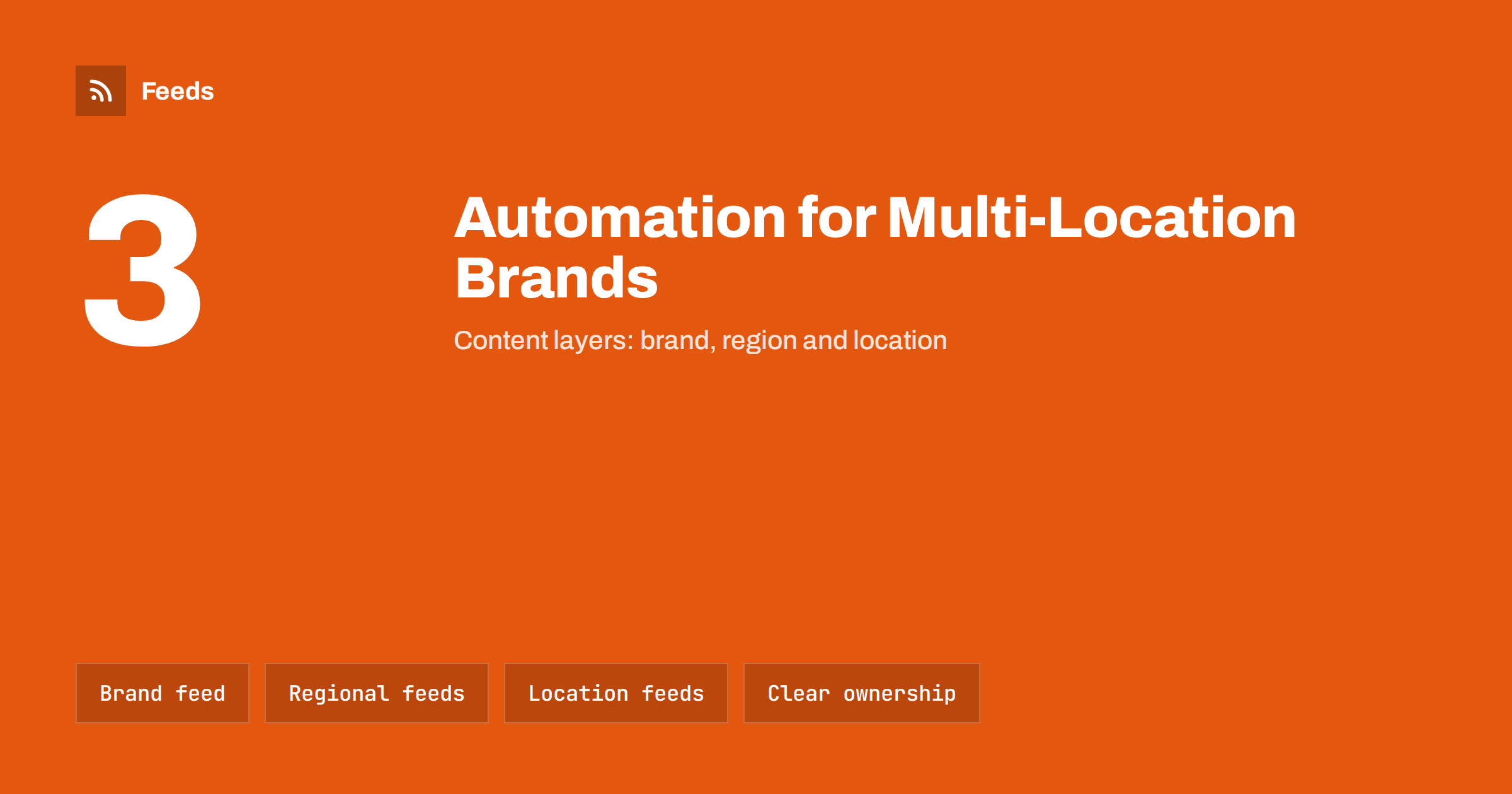
Short answer: franchises and multi-location brands can automate content by treating it as three layers: brand-wide content every location should share, regional content for a group of locations, and local content for one location. Publish each layer as a feed, route it to the right social pages, newsletters and screens with location tags or keyword filters, and let local managers add their own posts on top. Central templates and approval rules keep the brand consistent, while automation removes the copy-and-paste work that otherwise falls on every location manager.
The multi-location content problem
A brand with ten, fifty or five hundred locations faces the same challenge over and over. Head office produces content: campaign announcements, blog articles, new products, seasonal offers. Each location has its own social pages, local listings and sometimes its own newsletter. The central content should appear on local channels, but it rarely does consistently.
Some location managers repost everything within the hour; others never do. Some edit the text and accidentally change prices or legal wording. Meanwhile, genuinely local content, such as a new team member, a local event or a store closure for renovation, has no structured home at all. The result is a patchy brand presence and a lot of manual work spread across many people.
The problem grows with every location. Ten managers each spending twenty minutes a week reposting central content is already more than three hours of work per week; at a hundred locations it becomes a part-time job spread across people who were hired to run a gym, a clinic or a restaurant, not to manage social media. It also produces the inconsistency head office worries about most: outdated offers left on some pages, missing campaigns on others.
Automation does not solve every part of this, but it solves the distribution: getting the right content to the right channel for each location, reliably and in the approved form.
Three layers of content
| Layer | Examples | Who creates it | Where it goes |
|---|---|---|---|
| Brand | Campaigns, blog articles, new products, company news | Head office marketing | Brand channels and all location channels |
| Region | Regional offers, events, language versions, regional news | Regional marketing or master franchisee | Locations in that region |
| Location | Opening hours changes, local events, team news, local offers | Location manager | That location’s channels only |
Some content crosses layers. A national campaign may need a regional version with different dates, or a local version with the location’s own offer. Treat each version as its own item in the right layer rather than editing one item for several audiences; that keeps routing rules simple and avoids a local change leaking into brand channels.
Writing this table down for your organisation is the most valuable step. It forces decisions about who creates what, who approves it and where it may appear, and it becomes the basis for every automation rule.
Publish each layer as a feed
Automation tools route content from feeds, so each layer needs one:
- Brand feed: usually the main blog or news feed of the brand website, or a dedicated category such as “For all locations”.
- Regional feeds: a category or tag per region on the brand site, or the news page of a regional site.
- Location feeds: the news or events section of each location page, if your website has one. Many multi-location websites give each location a page with its own updates, which can be published as a feed or turned into one.
Consistent tagging is essential. If every post carries tags such as the region and, where relevant, the location, you can build all the feeds from one website without separate systems. Where tags are missing, keyword filters on titles, such as a city name, are a reasonable fallback; see keyword filters for RSS feeds for how to design them.
Route content to each location’s channels
With feeds in place, each location’s channels can receive a combination of layers. A location’s Facebook page, for example, might receive:
- brand content, filtered to exclude items marked “not for local pages”;
- content for its region;
- its own local updates.
Some tools can post several feeds to one page; others work best with a single combined feed per location. In the second case, merge the relevant feeds into one per location, as described in how to merge multiple RSS feeds. Either way, each location page gets a steady, relevant stream without anyone copying posts by hand.
Timing matters when dozens of pages post the same brand item. Staggering posts or limiting how many automated posts each page publishes per day keeps local pages from looking like copies of each other. The trade-offs are discussed in how often automated feeds should post.
Templates with local details
Central content becomes much more effective when it carries a local touch. Post templates per location can add:
- the location name or city, for example “Now at our Riverside store”;
- a local link with tracking parameters that identify the location;
- local hashtags or the language of the region;
- a short local call to action, such as booking at that location.
Keep the core text untouched: prices, offer conditions and legal wording should come from the brand item exactly as written. Templates add context around the content, not changes inside it. General guidance on templates applies here too; see writing post templates for automated social feeds.
Approvals and brand safety
Multi-location brands carry more reputational risk than a single shop: one wrong post can appear on hundreds of pages at once. Decide which routes run fully automatically and which need approval:
- Brand content to brand channels: usually full automation, because it has already been approved centrally.
- Brand content to location channels: full automation with an exclusion rule for items not meant for local pages.
- Local content to local channels: often an approval queue at first, handled by a regional marketer, until the location has shown that its updates are reliable.
- Anything with prices, promotions or legal terms: approval, unless it comes from the central system unchanged.
The general choice between these modes is explained in full auto vs approval queue. Also keep an emergency “pause all” option: if a campaign has to be withdrawn, you need to stop every route in one step.
Access, ownership and changes over time
Multi-location networks change constantly: locations open and close, managers change, franchisees join and leave. Automation needs a clear owner and a simple register:
- a list of every location’s channels, with who has admin access;
- which feeds and rules each location uses;
- who approves local content;
- what happens when a location closes, such as pausing its routes and updating its page.
Keep connections to social accounts under company-controlled access rather than personal logins of individual managers, so that routes keep working when people leave. Review the register every quarter.
When a new location opens, the register becomes a checklist: create its channels, connect the brand and regional feeds, add a location feed once it has local updates, and assign an approver. A new location then has an active presence from its first day instead of empty pages.
Measuring results across locations
Tracking parameters that include the location let you compare how brand content performs on different local pages and which locations add valuable local content. Useful questions:
- Which locations receive the most visits and bookings from automated posts?
- Do local posts perform better than brand posts on local pages? Usually they do, which is an argument for encouraging local content.
- Are some pages overloaded with automated posts and losing engagement?
For a structured approach to evaluating results, see how to measure whether content automation is worth it.
How Feeds helps
Multi-location setups need many feeds, and not every website section provides one. Feeds creates RSS from any public page, such as a location’s news or events page, and uses existing feeds where they exist. You can merge the brand, regional and local sources into one feed per location, and keep only items with or without specific words, for example a region name or a “not for local pages” marker. Duplicates are removed automatically, and feeds refresh by themselves, ready for social posting, newsletter or chat tools. Paid plans include more feeds and more sources per feed; see the plans.
Related reading
- Content Automation for Agencies Managing Many Clients
- Content Automation for Local Businesses: A Simple Plan
- Automating Multilingual Content Distribution with Feeds
The bottom line
For franchises and multi-location brands, content automation is mostly about structure. Separate brand, regional and local content, publish each layer as a feed, route combinations of them to every location’s channels, add local details through templates, and keep approvals where the risk is highest. With clear ownership and a simple register, every location gets a consistent, relevant presence without daily copy-and-paste work.
الأسئلة الشائعة
How can a franchise share central content on every location’s social page?
Publish the central content as a feed, then connect it, together with regional and local feeds, to each location’s page through a posting tool. Filters keep out items not meant for local pages.
Should every location post exactly the same content?
No. Brand content can be shared everywhere, but staggered timing, local templates and genuine local posts keep each page from looking like a copy and usually perform better.
How do we stop a wrong post from appearing on all location pages?
Approve brand content centrally before it is published, keep approval queues for risky routes, and make sure you can pause all automated routes in one step if a campaign must be withdrawn.
What if location pages on our website have no RSS feeds?
Use categories or tags per location if your CMS supports them, or create feeds from the public location news or events pages with a page-to-feed tool.
Who should own automation in a multi-location brand?
Usually central marketing, with regional marketers approving local content. Keep a register of channels, feeds, rules and access, and review it every quarter.