 ENEnglish
 LTLietuviškai
 DEDeutsch
 FRFrançais
 RUРусский
 ESEspañol
 PLPolski
 ITItaliano
 UKУкраїнська
 CSČeština
 PTPortuguês
 JA日本語
JA日本語 LVLatviešu valoda
 ETEesti
 HUMagyar
 IDBahasa Indonesia
 TRTürkçe
 HIहिन्दी
 ELΕλληνικά
 ARالعربية
 THไทย
THไทย VITiếng Việt
 RORomână
 MSBahasa Melayu
 BNবাংলা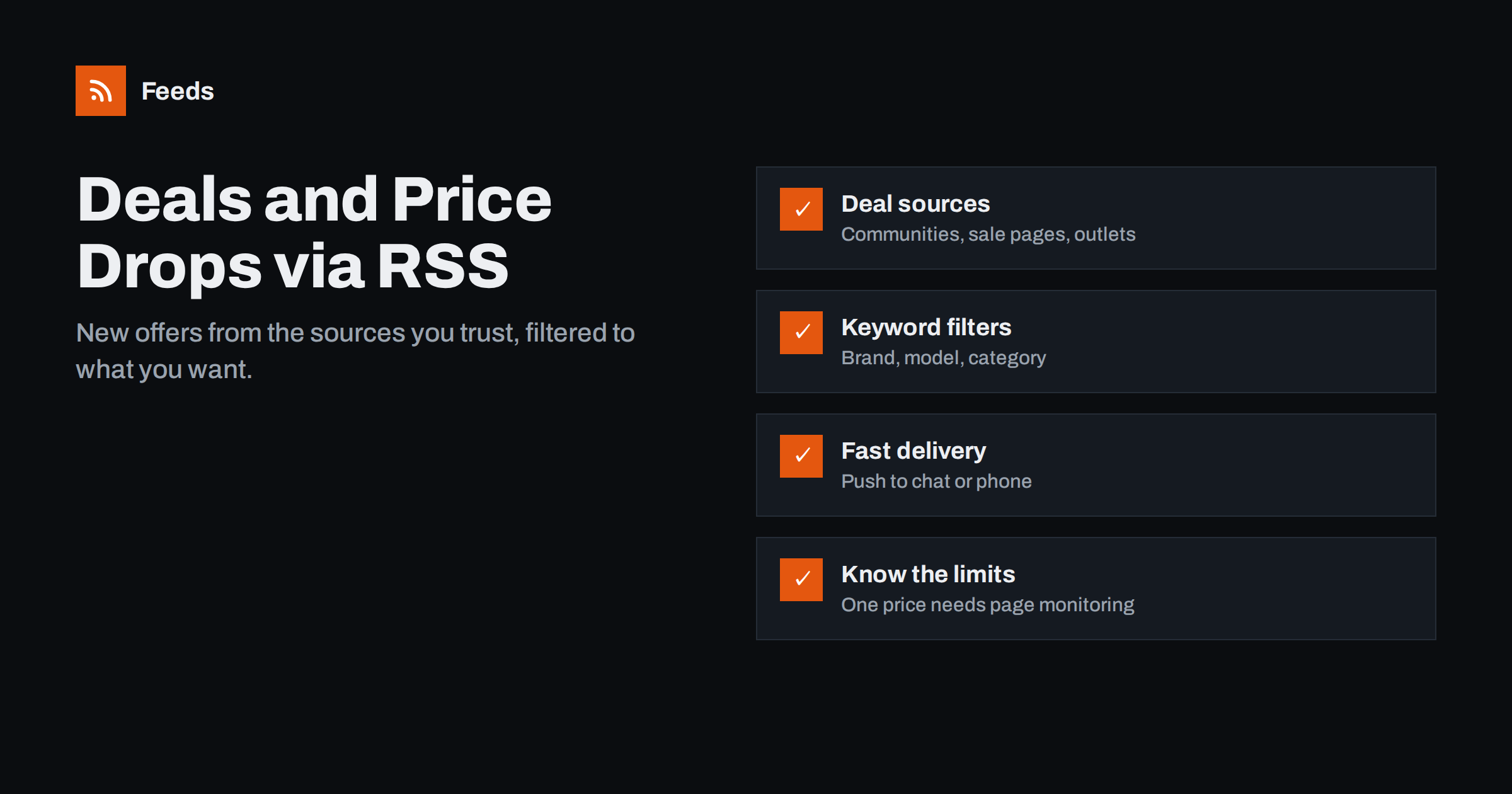
Short answer: RSS is a good way to catch new deals as they are posted: follow deal communities that offer feeds, turn shops’ sale, clearance and outlet pages into feeds, merge them into one stream and keep only items that mention the brands or models you care about. Send the result to a reader, chat app or phone for quick alerts. For price changes on one specific product page, RSS is the wrong tool; use page change monitoring or the shop’s own price alert instead.
What kind of deal alert do you need?
People say “price alerts” but mean different things. It helps to be clear, because each need has a different best tool:
- New offers in a category. “Tell me about new laptop deals” or “new discounted running shoes”. Deals appear as new items on a list, which is exactly what RSS handles well.
- New products on sale at a specific shop. “Tell me when something new appears in this store’s clearance section.” Again a list, so again a job for a feed.
- A price drop on one product. “Tell me when this exact camera costs less than a certain amount.” Nothing new appears; an existing number changes. That is page change monitoring, explained in page change monitoring vs RSS feeds.
- Business purchasing. Buyers who follow supplier promotions, wholesale clearances or auction listings usually need the first two types, often across many suppliers.
This article focuses on the first two and shows where the third fits in.
Source 1: deal communities and aggregators
Many deal-sharing communities and bargain sites publish RSS feeds, sometimes for the whole site, often per category or even per search. They are useful because members find and vet offers from many shops, and popular deals are voted up quickly.
- Look for an RSS icon on category pages, in the page footer, or in the page source as an autodiscovery link.
- Prefer category or search feeds over the front page; the front page of a large deal site is far too busy.
- Check whether the feed shows all new deals or only “hot” ones. Hot feeds are quieter but slower; everything feeds are fast but noisy.
Also look at how a community’s feed describes each deal. The best feeds put the product, the price and the shop in the title, so you can judge an offer from the alert alone without opening every link. Feeds that only show vague titles such as “Great deal today!” are harder to filter and slower to use.
Regional deal communities are often better than global ones, because offers depend on country, currency and shipping. Follow the ones that serve your market.
Source 2: shop sale, outlet and clearance pages
Shops rarely offer RSS for their sale sections, but those pages are lists of products that change as items are added. That makes them good candidates for a feed created from the page:
- Open the shop’s sale, outlet, clearance or “last chance” page for the category you want.
- Sort by newest if the page allows it, and copy the resulting URL.
- Create a feed from the page with a page-to-feed tool and check the preview: each product should become an item with its name, link and image.
- Add the feed to your reader or alert channel.
Some sale pages load more products as you scroll or hide items behind filters that are applied by scripts. If the preview shows only a few products or none, try the category’s plain URL, a “sort by newest” variant, or the second view the shop offers, such as a list layout. Pages that render their product list in ordinary HTML give the most reliable feeds.
The same approach works for “new arrivals” pages, which is how many businesses track new products on competitor stores. For a shop’s internal search results, such as “sale” plus a brand name, see the technique of turning a results page into a feed; it works whenever the search terms appear in the page URL.
Filter hard: keywords make deal feeds usable
Raw deal feeds are overwhelming. A single category on a busy deal site can produce dozens of items a day. Filters turn that into a handful of relevant alerts:
- Include words: brands, model names or product types, such as “espresso”, “ThinkPad” or “trail shoes”.
- Exclude words: things you never want, such as “refurbished”, “case”, “cable” or “subscription”.
- Combine sources first, then filter. Merge the deal community feed and several shop sale feeds into one feed, then apply one set of rules.
How to design keyword rules that catch what you need without drowning you is covered in setting up keyword alerts with RSS feed filters, and reducing noise in RSS alerts helps when the feed is still too busy.
Speed: deals do not wait
Good deals expire or sell out quickly, so delivery speed matters more than for news. Three factors decide how fast you hear about an offer:
- How often the feed is refreshed by the source or the feed service.
- How often your reader or automation checks the feed. Many readers check every 15 to 60 minutes; some let you set a faster interval for important feeds.
- Where the alert lands. A reader you open once a day is too slow. A chat channel or phone notification is better for time-sensitive deals.
Sending a filtered deal feed to a private chat channel works well; see posting an RSS feed to Telegram or posting RSS items to Discord. Be realistic: for the most competitive limited drops, even minutes can be too slow, and no polling-based alert can guarantee you will be first.
Single-product price drops: the right tools
When you want to know whether one specific product gets cheaper, use one of these instead of RSS:
| Tool | Good for | Limitation |
|---|---|---|
| Shop’s own price or wishlist alerts | One shop, one product | Only where the shop offers it |
| Price comparison sites with alerts | One product across many shops | Only products the site tracks |
| Page change monitoring | Any public product page | Needs careful selection of the price area |
| RSS from sale pages | New deals in a category | Does not watch one product’s price |
Many people combine them: a filtered RSS stream for discovering deals in a category, plus a few price alerts for specific products they already decided to buy.
Staying safe and sensible
- Check the shop. A price that looks too good may come from an unknown seller. Deal communities help here, because members comment on suspicious offers.
- Compare the “was” price. Discounts are sometimes calculated from inflated reference prices. Judge the price, not the percentage.
- Keep refresh rates modest. Checking a shop’s page every few minutes rarely helps and puts load on the site. A refresh every 30 minutes to a few hours suits most deal hunting.
- Respect the rules. Follow each site’s terms, and use feeds for alerts that link back to the offer, not for copying listings elsewhere.
Examples of deal feeds that work
- A home office buyer merges two deal communities’ computing categories, filtered for “monitor” and “dock”, excluding “refurbished”.
- A small café follows the clearance pages of three equipment suppliers and receives new items in a team chat.
- A parent follows the outlet section of two children’s clothing shops in one feed, filtered by size-related words.
- A hobby photographer watches a used equipment page of a camera shop, filtered for one lens mount.
Each example uses the same pattern: a few trusted sources, merged, filtered, and delivered where the person will see it quickly.
How Feeds helps
Feeds turns public list pages, such as sale, outlet, clearance and new-arrival pages, into clean RSS by finding the items on the page and reading titles, images, summaries and dates; if a site already has a feed, that feed is used. You can merge several sources into one feed, keep only items with or without your words, and duplicates are removed automatically. The feed refreshes on its own and works in any RSS reader, chat integration or alert tool, and paid plans alert you if a feed stops finding items after a page redesign. Create a feed from a sale page and check the preview first.
Related reading
- How to Merge Multiple RSS Feeds into One Clean Feed
- How Often Do RSS Feeds Update? Refresh Intervals Explained
- How to Monitor Websites for New Content Automatically
The bottom line
RSS is an efficient way to discover new deals: follow deal community feeds, turn shop sale and clearance pages into feeds, merge them, filter by brand and product, and deliver alerts somewhere you will see them quickly. For a price drop on one particular product, use a price alert or page change monitoring instead.
الأسئلة الشائعة
Can RSS tell me when a product’s price drops?
Not reliably for one specific product, because RSS signals new items rather than changed prices. Use the shop’s price alert, a price comparison site or page change monitoring for that.
Which pages make good deal feeds?
Sale, outlet, clearance and new-arrival pages sorted by newest, plus category or search feeds from deal communities. They are lists where new offers appear at the top.
How do I avoid being flooded with deals?
Merge your sources into one feed and apply keyword filters: include the brands and product types you want and exclude words like refurbished or accessory.
How fast will I hear about a new deal?
It depends on how often the feed and your reader refresh, often somewhere between 15 minutes and a few hours. Send important feeds to a chat or phone notification for the fastest delivery.
Is it acceptable to monitor shops’ sale pages?
Reading public pages at a modest rate is similar to a person visiting them, but follow each site’s terms. Use feeds for alerts that link back to the original offer.


