ENEnglish
 LTLietuviškai
 DEDeutsch
 FRFrançais
 RUРусский
 ESEspañol
 PLPolski
 ITItaliano
 UKУкраїнська
 CSČeština
 PTPortuguês
 JA日本語
 LVLatviešu valoda
 ETEesti
 HUMagyar
 IDBahasa Indonesia
 TRTürkçe
 HIहिन्दी
 ELΕλληνικά
 ARالعربية
 THไทย
 VITiếng Việt
 RORomână
 MSBahasa Melayu
 BNবাংলা
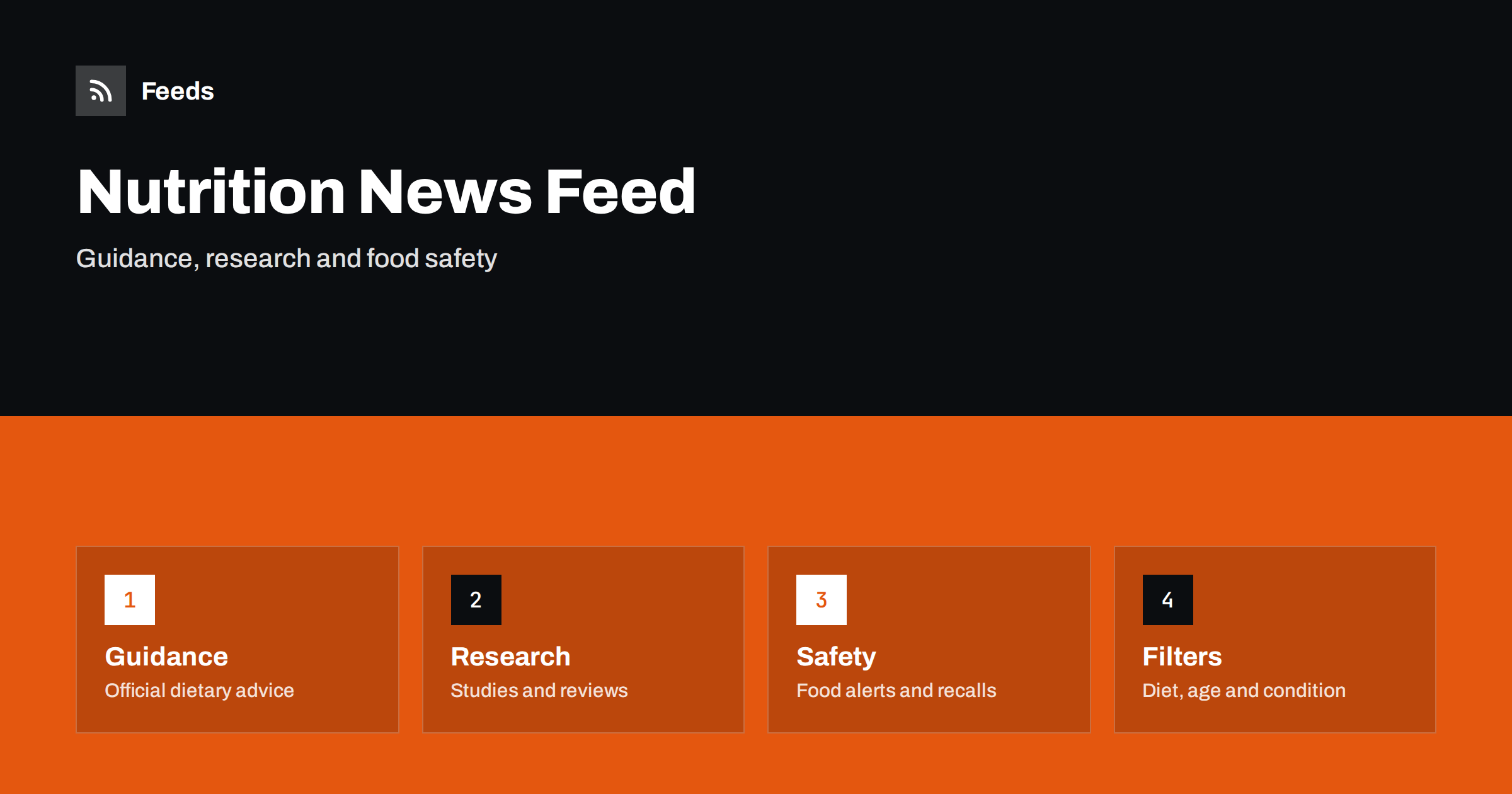
Short answer: Nutrition news is full of contradictions, so the best approach is to start with primary sources. RSS lets you follow health agencies, food safety bodies, dietitian associations, journals and universities in one reader, filter them by topic such as protein, sugar, pregnancy or sport, and read items in order. Treat headlines as pointers, read the original guidance and remember that general information does not replace advice from a qualified professional.
Why nutrition advice feels confusing
Few subjects produce as many headlines as food. One week a food is said to protect your health and the next week it is blamed for harm. Many of these stories come from single studies, small samples or observations that cannot prove cause and effect. Add to this the influence of marketing, trends and social media personalities, and it is easy to feel lost.
A feed-based routine slows the pace. You choose the sources, you see everything that they publish and you decide what to read in depth. The method is the same as in what is an RSS feed, applied to a field in which accuracy matters. The goal is not to follow every study but to notice when official guidance changes and to read the evidence behind big claims.
Read the summary documents first. Full guidelines can run to hundreds of pages, but most agencies publish a short version with the main points, plus infographics and examples for families. Keep the full document for reference and use the short one for daily decisions. When an agency changes its advice, read the explanation of why: it usually describes the new evidence, which is far more instructive than the headline.
Official guidance and agencies
National health services, public health agencies and food authorities publish dietary guidelines, nutrient recommendations, food labelling rules and advice for groups such as children, pregnant women and older adults. These documents are updated rarely, but when they change, the news affects schools, hospitals, food producers and families. Following the news pages of these bodies helps you learn about updates on the day.
International organizations publish global recommendations, and national bodies adapt them to local conditions, so look at both. Many of these sites have no feed, and a page-to-feed tool can read their news lists, as explained in how to create an RSS feed for a website without RSS. For other official bodies, how to track government and regulator updates with RSS offers a general method.
Systematic reviews and meta-analyses combine many studies and usually give the most balanced picture, though they too depend on the quality of the studies they include. When a new single study contradicts a body of earlier work, wait for replication before you change your habits. Science moves slowly, and a feed helps you see this pattern over months instead of reacting to each week.
Research and evidence
Studies on nutrition vary a great deal in quality. Randomised trials, large long-term cohort studies and systematic reviews carry more weight than a small survey or a laboratory experiment. Journals and university press pages are the best places to find them. Add a few journals in nutrition and public health, and follow the press office of research institutions.
When you open a study, check the number of participants, the length of follow-up, what was measured and who funded the work. Look at whether the result is a change in a health outcome or only in a laboratory marker. How to follow academic journals and research with RSS alerts explains how to set this up, and fact-checking with RSS and primary sources shows how to go from a headline to the original.
Pay attention to allergen alerts in particular. A product may be recalled because an allergen such as milk, nuts or gluten was not declared on the label, which is serious for anyone with an allergy. If you run a cafe, a school canteen or a food shop, add a routine: check the feed each morning, compare notices with your stock and record what you did.
Food safety alerts and recalls
A practical use of feeds is food safety. Authorities publish recalls for products contaminated with bacteria, allergens that are not on the label, foreign objects or incorrect labelling. A feed from these pages shows a recall on the day it appears. If you have an allergy or cook for children, this can protect your family.
Filter by the product types and allergens that concern you, and by the brands you buy. A recall notice usually lists the product name, size, batch code and what to do. Keep the notice and follow its instructions. How to track product recalls and safety notices with RSS shows how to build such a feed. Restaurants and shops can use the same method to stay compliant.
Special groups and conditions
Nutrition needs change with age, pregnancy, sport and medical conditions. Instead of one big list, create folders for the groups you care about. A parent may follow guidance on infant feeding and school meals, an athlete may follow sports nutrition bodies, and a person with diabetes or an allergy may follow patient associations and clinical societies.
Be careful with advice about medical conditions. General news can help you understand a subject, but a diet for a condition should be set with a doctor or dietitian. Use the feed to prepare questions for your appointment, not to replace it. If you work in healthcare, clinical guidance updates with RSS describes how teams keep up with changes.
Look also at the language of numbers. Relative risk can sound large when the absolute risk is tiny, and a food said to double a risk may change it from one in a million to two in a million. Good sources report both. If a page gives only the dramatic figure, treat it with caution.
Spotting weak claims
Some patterns signal weak information. Be cautious when a page promises quick results, uses words such as “detox” or “miracle”, relies on one expert without sources, sells a supplement in the same article or presents testimonials instead of data. Check whether the claim comes from a study of humans and not only of cells or animals, and whether the amounts used in the study are realistic.
Keep a note of sources that often exaggerate. If a site repeatedly publishes alarming headlines that do not match its own content, remove it from your feeds. The aim is a small set of reliable sources. How to reduce noise in RSS alerts without missing anything helps keep the list under control.
Cooking skills matter as much as knowledge. Simple techniques such as roasting vegetables, cooking a pot of beans or preparing a batch of soup make healthy eating easier. A feed from a trusted cooking teacher can deliver one short lesson a week, which is an easier habit than a big plan.
Recipes, cooking and daily life
Nutrition is also practical: what to cook on a Tuesday evening, how to plan meals for a week, how to read a label and how to shop on a budget. Recipe blogs and food writers publish this content, and many have feeds. RSS feeds for recipe sites and food bloggers explains how to follow them. Choose creators who share ingredients and methods clearly, state portions and do not moralise.
Combine the two worlds. Use official guidance to set the framework and recipe feeds to fill it with ideas you enjoy. A weekly note with three meals to try is a simple way to turn information into habit.
Sharing nutrition information responsibly
Schools, gyms, workplaces and community groups often share nutrition tips. Share official guidance with a link, avoid statements that sound like medical advice and do not shame people for what they eat. If you share automatically, keep an approval step so that a questionable item does not slip through, as in full auto vs approval queue. For businesses, avoid health claims that are not allowed in your market; labelling and advertising rules for food are strict in many places.
How RSS Feed Creator helps
RSS Feed Creator turns health agency, food authority, dietitian association and university pages into clean RSS feeds, even when the site has no feed of its own. It reads titles, images, summaries and dates, uses an existing feed when there is one, and shows a preview of the items before the feed is created. You can merge several sources into one feed (up to 10 sources), keep only the items that contain your keywords and have duplicates removed automatically, which suits a reliable reading list on one subject. Feeds refresh every 3 hours on the free plan and every 30 minutes on paid plans. The free plan allows up to 20 items per feed, and the details are on the pricing page.
Related reading
- How to Track Product Recalls and Safety Notices with RSS
- RSS Feeds for Recipe Sites and Food Bloggers: Follow and Publish
- How to Follow Academic Journals and Research with RSS Alerts
The bottom line
RSS helps you follow nutrition and dietary guidance through primary sources. Start with health agencies and food safety bodies, add journals and dietitian associations, filter by topic and check the original evidence before you change your habits. A feed informs you, and a qualified professional guides decisions about your own health.
الأسئلة الشائعة
Which sources should I trust for dietary guidance?
National health services, public health agencies, food authorities and professional dietitian associations.
How do I handle contradicting headlines?
Open the original study or guidance, check the sample, the length and the outcome, and compare with official advice.
Can RSS alert me to food recalls?
Yes. Follow the recall page of your food authority and filter by product types, allergens and brands.
Does a feed replace advice from a dietitian?
No. A feed gives general information. For medical conditions or special diets, consult a doctor or dietitian.
How many sources are enough?
Ten to fifteen good sources are enough for most people, organized in folders for guidance, research and safety.