ENEnglish
 LTLietuviškai
 DEDeutsch
 FRFrançais
 RUРусский
 ESEspañol
 PLPolski
 ITItaliano
 UKУкраїнська
 CSČeština
 PTPortuguês
 JA日本語
JA日本語 LVLatviešu valoda
 ETEesti
 HUMagyar
 IDBahasa Indonesia
 TRTürkçe
 HIहिन्दी
 ELΕλληνικά
 ARالعربية
 THไทย
THไทย VITiếng Việt
 RORomână
 MSBahasa Melayu
 BNবাংলা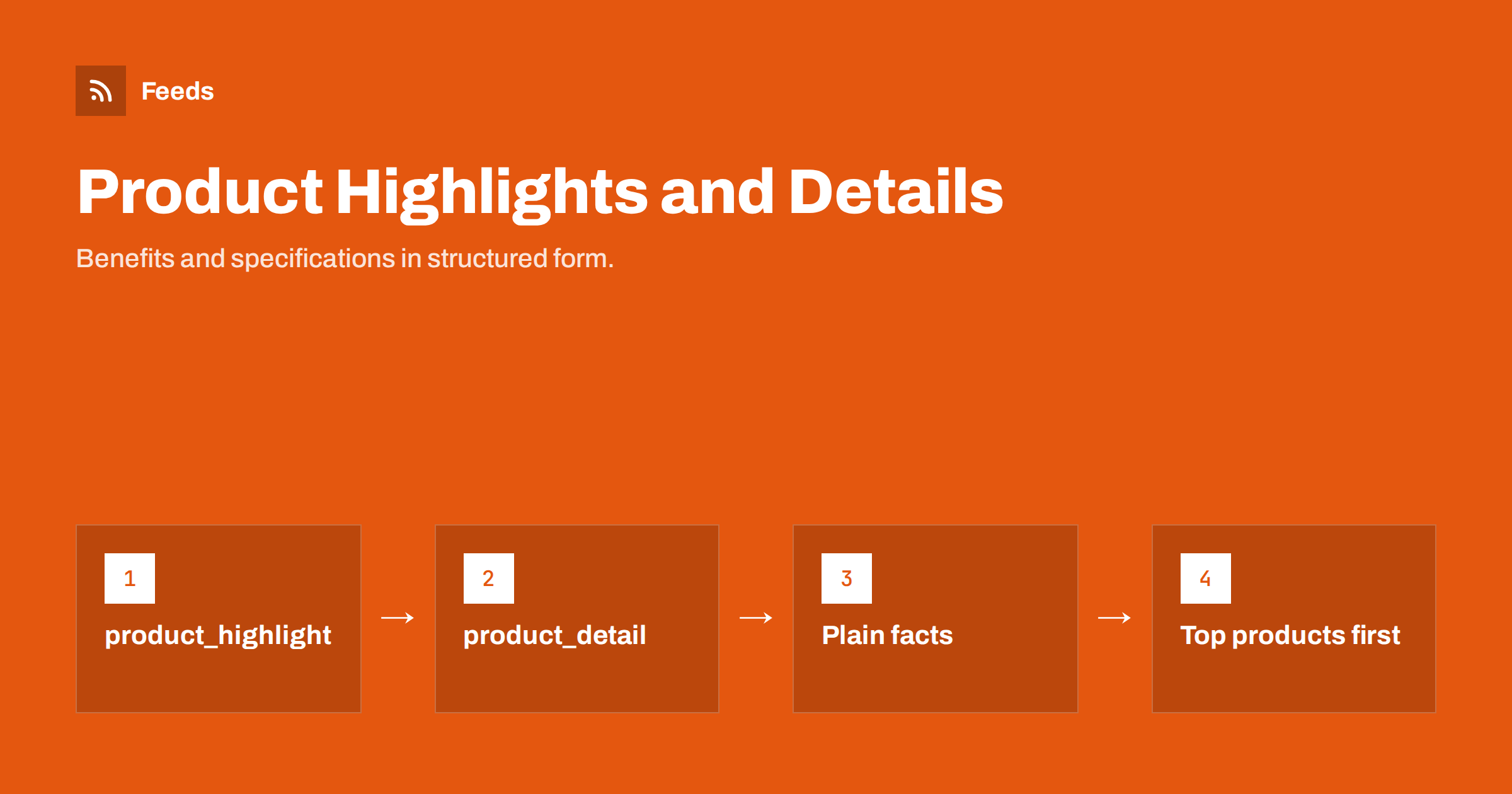
Short answer: product_highlight and product_detail are optional Google product feed attributes that add structured information to listings. product_highlight holds short bullet-style statements about key features, and a product can have several; product_detail holds technical specifications as a section name, attribute name and value, such as “General / Material / Stainless steel”. They can be shown to shoppers on product details in Google surfaces and help Google understand the product. Keep them factual, specific and free of promotional text.
What these attributes add
Titles and descriptions carry most product information in a feed, but they are unstructured text. A shopper comparing two blenders wants to see power, capacity and included accessories side by side, and a platform wants to read those facts reliably. product_highlight and product_detail provide that structure.
Google may display highlights as bullet points and details as a specification list when a shopper looks at a product more closely. Whether and where they appear depends on the surface and on Google’s own decisions, so there is no guarantee of display. Even when not shown, the structured facts give Google clearer information than a paragraph of prose.
These attributes are not required, and many stores never use them. That is exactly why they can be worth adding for the products that matter most: they help your listing look complete next to competitors that only send the minimum.
They also force useful discipline. Writing four highlights for a product makes you decide what actually matters about it, and that clarity often improves titles and descriptions too.
product_highlight: short benefit statements
A highlight is a short sentence or phrase describing an important feature or benefit. Google’s specification allows several per product, each with a character limit, and recommends a handful of good highlights rather than many weak ones.
- “Keeps drinks cold for up to 24 hours” (only if the manufacturer states it).
- “Dishwasher-safe lid and body”.
- “Fits standard car cup holders”.
- “Made from recycled stainless steel”.
Good highlights are specific and verifiable. They avoid words like “best”, “amazing” or “perfect”, prices, shipping information and references to other products or stores. Each highlight should add something the title does not already say.
Aim for consistency within a category: if every blender in your catalog has a highlight about capacity, shoppers can compare them quickly. Mixed approaches, where some products have detailed highlights and others none, make the catalog look uneven.
Write highlights in the language of the target country, just like titles and descriptions. Machine-translated highlights with wrong units or awkward phrasing undermine the credibility they are meant to add.
product_detail: structured specifications
product_detail has three parts: an optional section name, an attribute name and an attribute value. You can send many details per product. Examples for a laptop stand:
| section_name | attribute_name | attribute_value |
|---|---|---|
| General | Material | Aluminium |
| General | Color | Silver |
| Dimensions | Height range | 12 to 20 cm |
| Dimensions | Weight | 1.1 kg |
| Compatibility | Laptop size | 10 to 17 inches |
Use details for facts that are already defined elsewhere in your data: specifications from manufacturers, dimensions and materials stored as attributes in your store. Do not repeat attributes that have their own dedicated fields, such as color or size in apparel, unless you want them grouped in a specification list as well; the dedicated fields remain the primary source.
Section names are optional but helpful when a product has many details. Grouping specifications under “Dimensions”, “Power” or “Compatibility” makes them easier to scan, just like a well-organized specification table on a product page.
Formats in XML and CSV
In XML, each highlight is a separate g:product_highlight element, and each detail is a g:product_detail element containing g:section_name, g:attribute_name and g:attribute_value. Repeating elements is natural in XML, which makes these attributes easy to represent.
In CSV or TSV, the format is more awkward. Several values go into one field with separators, and product_detail values combine section, name and value with colons. This is one of the cases where XML is noticeably more comfortable and less error-prone than delimited files.
A supplemental feed is a practical way to add these attributes without changing your main feed. It can contain only the id plus highlights and details, maintained by whoever owns the product content.
If you use a supplemental feed, keep it tied to the same IDs as the primary feed and remove rows for discontinued products. A supplemental feed that grows stale can attach outdated highlights to products whose specifications have changed.
Where to get the content
- Manufacturer data: specification sheets and supplier files often contain structured details ready to use.
- Store attributes: materials, dimensions and compatibility stored as product attributes can be mapped to details automatically.
- Existing descriptions: bullet lists in descriptions are often good highlights once promotional wording is removed.
- Customer questions: frequently asked questions show which facts shoppers look for first.
For large catalogs, start with products that already receive impressions or have high value. Adding highlights to products that never appear does little; adding them to your best sellers improves listings that shoppers actually see.
Examples by category
What makes a good highlight or detail depends on the category. A few patterns that work for many stores:
- Kitchen and home: highlights about care (dishwasher-safe, oven-safe to a stated temperature), capacity and material; details for dimensions, weight and compatible appliances.
- Electronics and accessories: highlights about connectivity, battery life as stated by the manufacturer and what is in the box; details for ports, power, dimensions and compatible devices.
- Apparel: highlights about fabric feel, fit and care; details for material composition, lining, closure type and fit measurements.
- Tools and hardware: highlights about typical uses and safety features; details for power, voltage, weight, dimensions and included parts.
- Beauty and personal care: highlights about skin or hair type and texture, using only approved wording; details for volume, key ingredients as listed on the packaging and usage frequency.
Across categories, the pattern is the same: highlights answer “why would I want this”, details answer “what exactly is it”. Keep the two roles separate and both become more useful.
It is also worth standardizing attribute names in product_detail across the catalog. If one product says “Weight” and another “Item weight”, comparisons become harder. A short list of approved names per category, used by everyone who edits product data, keeps specifications consistent.
If you are unsure whether a statement belongs in a highlight or a detail, ask whether it has a clear name and value. “Weight: 1.1 kg” is a detail. “Light enough to carry in a laptop bag” is a highlight.
Rules and restrictions
- No promotional text, prices, discounts or shipping information.
- No claims you cannot support, especially health or safety claims.
- No keyword stuffing or repeated phrases.
- No links, contact details or references to other products.
- Keep capitalization and punctuation normal; no all caps.
Units matter as well. Write them consistently, with a space between number and unit, and use the units shoppers in the target country expect.
Content that breaks these rules can lead to warnings or the attribute being ignored. As with titles, clarity and accuracy beat cleverness.
Review highlights occasionally. Product changes, such as a new material or a revised capacity, must be reflected in highlights and details too, or they become a source of inaccurate claims.
Measuring the effect
Because display is not guaranteed and varies by surface, the effect of highlights and details is hard to isolate. A reasonable approach is to add them for a defined group of products, keep a comparable group unchanged, and compare click-through and conversion rates over several weeks. Even if the measurable effect is small, complete and structured product data tends to pay off across channels, including Meta and marketplaces that use similar fields.
Treat highlights and details as a long-term content asset. Once written for a product, they rarely need to change, and they can be reused on product pages, in marketplace listings and in customer support answers, not only in feeds.
How Feeds helps
Feeds creates the main product feed from WooCommerce, Shopify or a CSV link: a Google product XML file with id, title, link, image, price, availability and brand, refreshed automatically for Merchant Center and Meta. Highlights and details can be added alongside it with a supplemental feed in Merchant Center matched by the same product IDs. Rules in Feeds rewrite titles, adjust prices and skip out-of-stock items. See the pricing page for plans.
Related reading
- Supplemental Feeds in Merchant Center: When and How to Use
- How to Write Product Descriptions for Shopping Feeds
- Google Product XML Format Explained: RSS, Atom and g: Tags
The bottom line
product_highlight adds short, factual feature statements, and product_detail adds structured specifications with section, name and value. Both are optional, may be shown on product details and help Google understand products. Source them from manufacturer data and store attributes, keep them free of promotion, start with your most visible products and consider a supplemental feed to add them without touching the main feed.
الأسئلة الشائعة
Are product_highlight and product_detail required?
No. Both are optional attributes that add structured information to listings and can improve how complete they look.
How many highlights can a product have?
Google allows several highlights per product, each with a character limit. A handful of specific, useful highlights is better than many generic ones.
Will Google always show my highlights?
No. Display depends on the surface and Google’s decisions. The data still helps Google understand the product.
Can I add these attributes without changing my main feed?
Yes. A supplemental feed with the product id and the new attributes can add them to existing products in Merchant Center.
Can highlights mention a discount?
No. Promotional text, prices and shipping information are not allowed in highlights or details.