ENEnglish
 LTLietuviškai
 DEDeutsch
 FRFrançais
 RUРусский
 ESEspañol
 PLPolski
 ITItaliano
 UKУкраїнська
 CSČeština
 PTPortuguês
 JA日本語
JA日本語 LVLatviešu valoda
 ETEesti
 HUMagyar
 IDBahasa Indonesia
 TRTürkçe
 HIहिन्दी
 ELΕλληνικά
 ARالعربية
 THไทย
THไทย VITiếng Việt
 RORomână
 MSBahasa Melayu
 BNবাংলা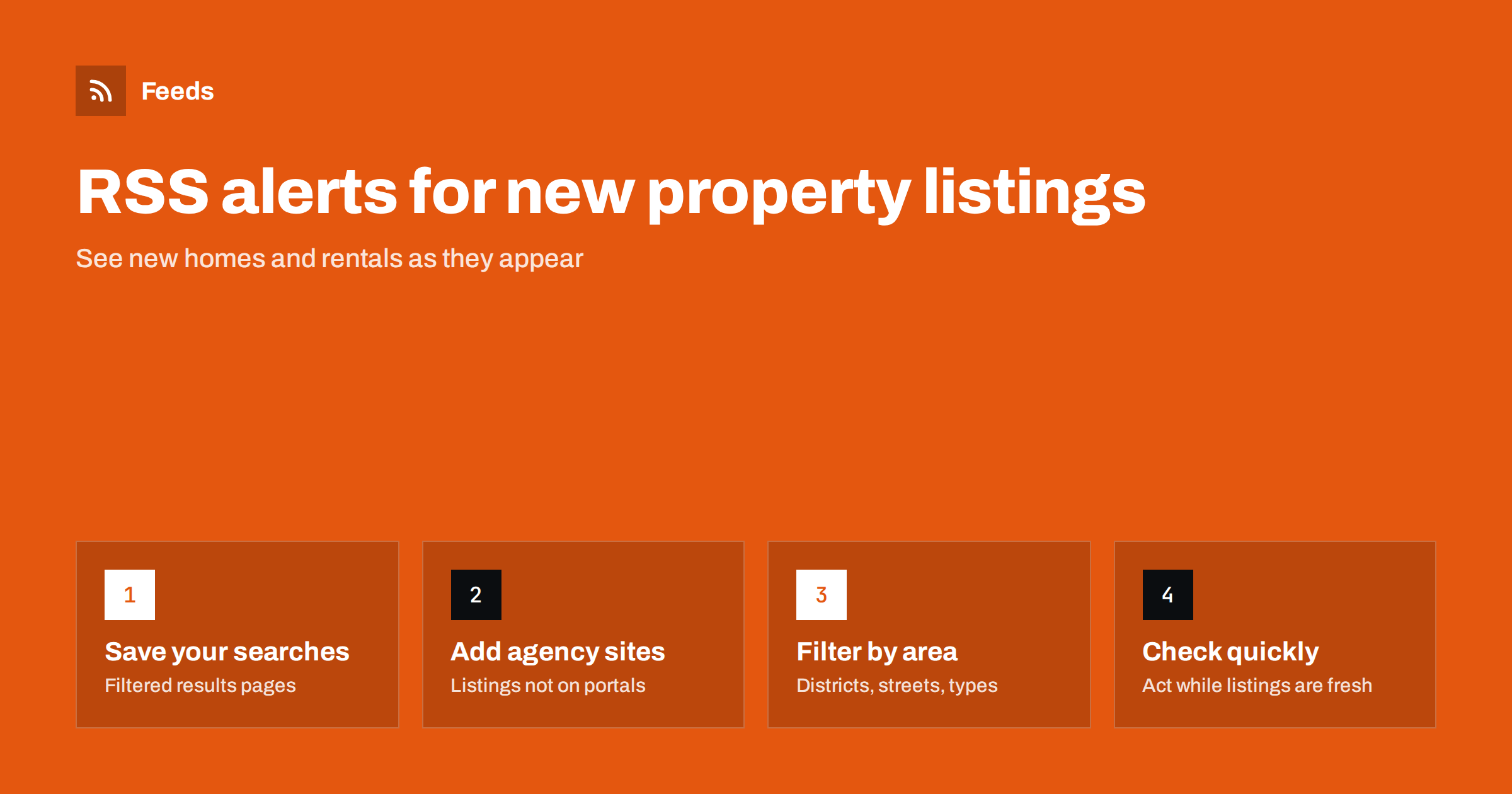
Short answer: Run your search on each listing portal with your filters for area, price and property type, and check whether the results page offers an RSS feed or has a stable address. Use that feed, or create one from the results page with a page-to-feed tool, and do the same for local agency websites that list properties the big portals miss. Merge the feeds, filter by district or property words, and read them several times a day in a feed reader so you see new listings early.
Anyone who has searched for a flat, a house or a commercial unit knows the pattern: the best listings attract enquiries within hours, and by the time you check the portal in the evening, viewing slots are gone. Portals offer their own alerts, but they vary in speed and flexibility, and they do not cover the smaller agencies that publish listings only on their own websites. A feed-based setup puts every source in one place under your control.
It also changes the search from a chore into a routine. Instead of repeating the same searches on four websites every evening, you open one reader and see only what is new since you last looked. Listings you have already seen stay marked as read, so you never waste time working out whether a property is new or one you rejected yesterday.
Who uses listing feeds
- Home buyers and renters in competitive markets.
- Investors watching for specific property types or price ranges.
- Businesses looking for offices, shops, warehouses or restaurant premises.
- Relocation agents and property finders searching on behalf of clients.
- Estate agents and analysts tracking the market and competitors’ new instructions.
The setup below is the same for all of them. What changes is the list of sources, the filters and how often the feeds need to be checked: a renter in a tight market may check several times a day, while an analyst reviewing weekly trends can read a digest once a week.
Step 1: Build searches on the main portals
On each portal you use, run a search with your criteria: area, price range, property type, number of rooms, and “sort by newest” if available. Then check three things:
- Does the results page offer RSS? Some portals still provide feeds for searches, sometimes through a small icon or a “subscribe” link. Look in the page source for feed links too.
- Is the search in the address? If your filters appear in the address as parameters, the results page has a stable address that a page-to-feed tool can read.
- Is the list in the HTML? Use “view page source” and search for the title or address of one listing. If it is there, the page can be turned into a feed.
Create one search per distinct need rather than one broad search. “Two-bedroom rentals in the old town” and “three-bedroom houses in the suburbs” are better as separate feeds that you can prioritize differently.
Step 2: Add local agency websites
Many properties, especially in smaller towns and in commercial property, appear first, or only, on the websites of local agencies. Their “for sale” or “to let” pages are usually simple lists of properties with a title, price and link, and they almost never offer feeds.
- List the agencies active in your target area; a quick look at signboards and local search results usually reveals them.
- Find each agency’s listings page, filtered to your property type if possible.
- Create a feed from each page and check the preview: each item should be one property with its own link.
- Merge all agency feeds into one “local agencies” feed.
Agency websites are often built on the same few property software platforms, so once one agency page works well as a feed source, similar pages from other agencies usually work too. If an agency’s site loads listings only through scripts, look for a “list view” or an alternative page, or rely on the portals for that agency.
Commercial property and business premises
Commercial listings deserve special mention. Shops, offices, restaurant premises and industrial units are frequently marketed by specialist commercial agents, landlords and property companies on their own websites, sometimes before they appear on any portal. Some large landlords publish a “properties available” page for each of their buildings or estates. Following those pages directly, together with the commercial sections of local agencies, often gives a business looking for premises a much fuller picture than portals alone. Local councils and development agencies also publish lists of available commercial sites to attract investment, and these are typically simple pages that convert well to feeds.
Step 3: Filter for what matters
Portal searches are already filtered, but agency pages list everything. Filters narrow them down.
| Need | Include words | Exclude words |
|---|---|---|
| Family home in specific districts | District and street names, “house”, “3 bed” | “retirement”, “shared ownership” if not relevant |
| City-centre rental | Neighbourhood names, “apartment”, “flat” | “parking space”, “storage” |
| Restaurant premises | “restaurant”, “café”, “A3”, “retail unit” | “office”, “residential” |
| Warehouse space | “warehouse”, “industrial”, “unit” | “garage”, “office suite” |
Filters see what appears in each item’s title and summary. Listing titles often include the property type, the number of bedrooms and the area, which makes filtering effective. Prices may or may not be included; check a few items to see what the feed contains.
Step 4: Read often and act quickly
For listings, speed matters more than for most monitoring. Choose a feed reader that works well on your phone, check feeds several times a day during an active search, and prepare in advance so you can act immediately:
- A short, polite enquiry template with your situation and availability.
- Documents that landlords or agents typically ask for, ready to send.
- A list of questions to ask during viewings.
Keep a simple note of each listing you enquire about: address, link, date and response. Busy searches blur together quickly, and a short record prevents duplicate enquiries and helps you compare options fairly when decisions have to be made fast.
Also be aware of the refresh interval of your feeds and reader. If both check every few hours, listings may reach you some time after publication. For a competitive search, shorter intervals are worth it.
Common mistakes
- Relying on one portal. Different portals and agencies carry different listings. Combine them.
- Overly narrow filters. Agents describe properties inconsistently. A too-specific filter may miss the perfect listing.
- Using results pages sorted by relevance. Sort by newest so that new listings appear at the top of the page.
- Forgetting to clean up. Once you have found a property, remove the feeds so alerts do not continue for months.
- Ignoring portal terms. Some portals restrict automated access. Use their own alert options where required, and keep refresh rates reasonable.
A worked example
A couple relocating for work is looking for a three-bedroom house to rent in two neighbourhoods of a mid-sized city. They set up searches on two portals, sorted by newest; one offers RSS for saved searches, the other has a stable results address, so they create a feed from it. They add the lettings pages of six local agencies, which have no feeds, merge them and filter for the two neighbourhood names, the names of four main streets and “3 bed” and “three bedroom”. Everything goes into a reader on both their phones. Over three weeks they see around forty relevant listings, several of them on agency sites a day before they reach the portals, and they secure a viewing on the first morning of a listing that fits them well.
How Feeds helps
Feeds turns search result pages and agency listing pages into RSS feeds, using an existing feed where a page has one and otherwise finding the list of items on the page, with a preview before anything is created. You can merge portals and agencies into one feed and keep only listings with your words, with duplicates removed automatically. Feeds refresh on their own; paid plans refresh more often, which matters for fast-moving listings. See the pricing page for current refresh intervals.
Related reading
- How to Set Up Keyword Alerts Using RSS Feed Filters
- How Often Do RSS Feeds Update? Refresh Intervals Explained
- Local News Monitoring: Follow Your Town’s Sources with RSS
The bottom line
New listings reward whoever sees them first. Use portal searches sorted by newest, add local agency pages that the portals miss, merge everything into one feed filtered for your areas and property types, and read it often on your phone with an enquiry ready to send. Clean up the feeds once you have found what you were looking for.
الأسئلة الشائعة
Can I get RSS feeds for property searches?
Some portals offer feeds for saved searches. If not, and the results page has a stable address with listings in its HTML, a page-to-feed tool can create a feed from it.
How do I follow estate agents that are not on the big portals?
Create feeds from their own listings pages and merge them into one feed. Filter it for the areas and property types you want.
How fast will I see new listings in a feed?
It depends on how often the feed is refreshed and how often your reader checks it. For competitive searches, choose shorter intervals where your tools allow it.
Can I filter listing feeds by price?
Only if the price appears in the item title or summary, and even then keyword filters are not ideal for numeric ranges. It is better to set price limits in the portal search itself.
Is it allowed to create feeds from property portals?
It depends on each portal’s terms. Many offer their own alerts; use them where automated access is restricted, and keep any refresh rates modest.