ENEnglish
 LTLietuviškai
 DEDeutsch
 FRFrançais
 RUРусский
 ESEspañol
 PLPolski
 ITItaliano
 UKУкраїнська
 CSČeština
 PTPortuguês
 JA日本語
JA日本語 LVLatviešu valoda
 ETEesti
 HUMagyar
 IDBahasa Indonesia
 TRTürkçe
 HIहिन्दी
 ELΕλληνικά
 ARالعربية
 THไทย
THไทย VITiếng Việt
 RORomână
 MSBahasa Melayu
 BNবাংলা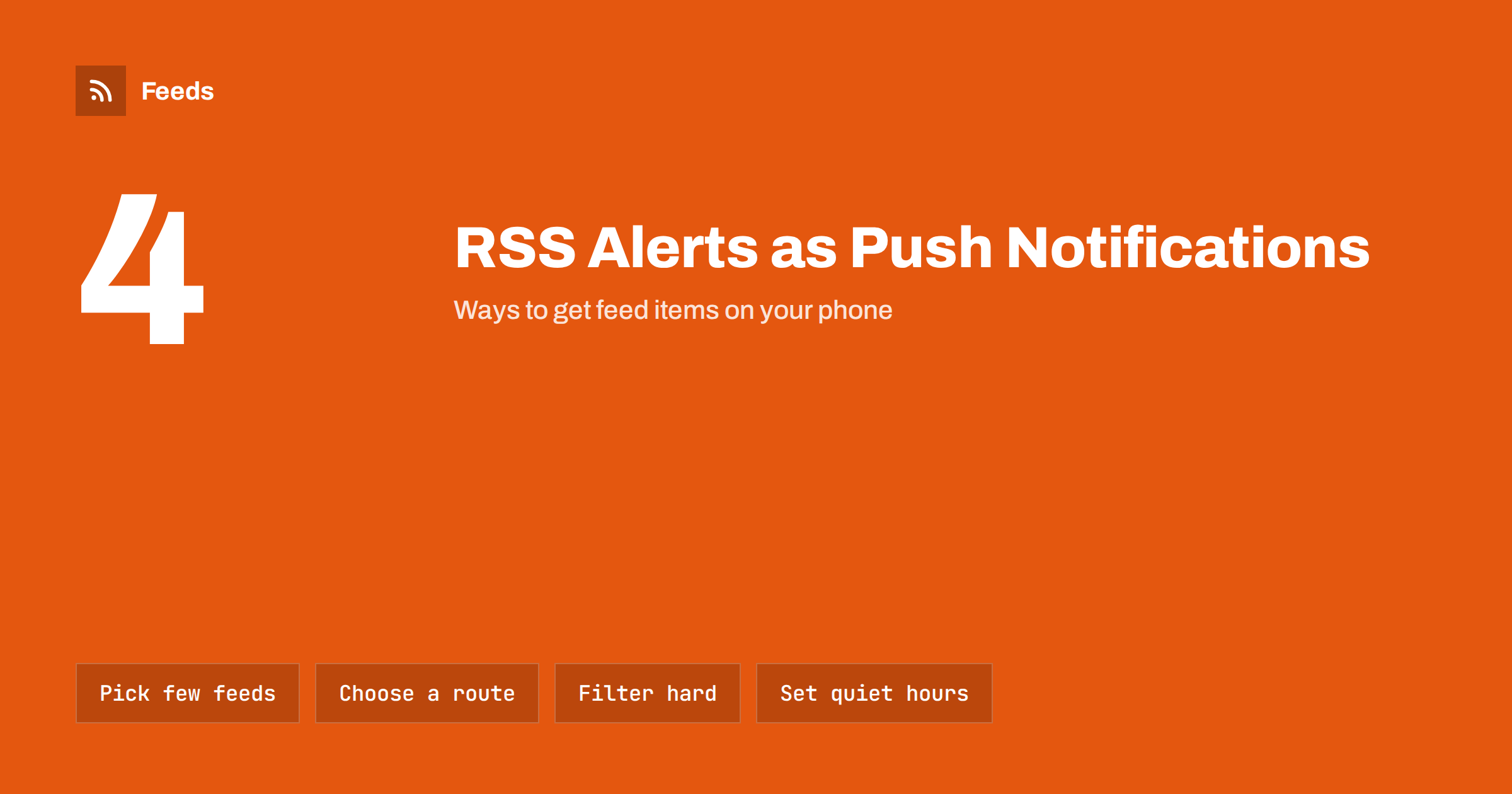
Short answer: You can get RSS items as push notifications on your phone in four main ways: an RSS reader app with per-feed notifications, a push notification service that receives messages from an automation or script, a chat app such as Telegram or Slack that notifies you when a bot posts, or an automation platform’s own mobile app. Whichever route you choose, reserve push notifications for a few rare, urgent feeds, filter them hard with keywords, and send everything else to a reader or digest, or you will soon start ignoring them.
When push notifications make sense for feeds
Most feed content is not urgent. Blog posts, news and newsletters can wait until you open a reader. Push notifications are worth it only when minutes matter or when missing an item has a real cost. Good examples:
- Outage and status updates from services your business depends on.
- Security advisories for software you run.
- Mentions of your brand in news sources, when you need to respond quickly.
- Rare listings, such as a specific item appearing on a classifieds or auction site.
- Tender or grant notices with short deadlines.
- School or local closure notices.
A useful test: if you would not want someone to phone you about it, it probably should not be a push notification.
It also helps to decide in advance what you will do when an alert arrives. An outage alert might mean checking your own service and informing customers; a brand mention might mean forwarding it to the person who handles press. If there is no action attached to an alert, it belongs in a reader or digest instead.
Option 1: an RSS reader with notifications
The simplest route is a feed reader app that can notify you when specific feeds have new items. Many mobile readers support notifications, and the better ones let you enable them per feed or per folder, rather than for everything.
- Pros: no extra tools, and everything stays in one app.
- Cons: delivery depends on how often the reader checks feeds. Some readers check only every hour or less often on mobile to save battery, and background refresh can be limited by the phone’s operating system.
Put the urgent feeds in a dedicated folder, turn on notifications only for that folder, and check how quickly alerts arrive during the first week. Our guide to how often RSS feeds update explains where delays come from.
Option 2: a push notification service
Push notification services provide an app for your phone and a simple way for other tools to send messages to it, often a single web request. Some are open source and can be self-hosted, such as ntfy; others are commercial apps with a small one-time or subscription cost.
A typical setup:
- Install the push app and create a topic or get your user key.
- Use an automation platform or a small script that checks the feed on a schedule.
- For each new item, send a message with the title, the source and the link to the push service.
- Tap the notification to open the article in your browser.
This route is fast, reliable and flexible: you control the polling interval, filtering and message format. Priorities are a useful extra: many push services let you mark messages as high or low priority, so a security advisory can bypass quiet mode while a brand mention stays silent. If you use a public topic on a shared server, choose an unguessable topic name, because anyone who knows it could read or send messages.
Keep the message itself short and scannable on a lock screen. A good format is the source name first, then the item title, with the link attached so a tap opens it. Long summaries are cut off on most phones and add little. If several feeds use the same push app, give each its own topic or tag, so you can mute a noisy source without losing the others.
Option 3: a chat app
If you already live in a chat app, let it deliver the alerts. Telegram bots and channels, Slack, Microsoft Teams, Discord and Google Chat can all receive feed items through bots or webhooks, and the app’s own notifications take care of the phone.
- Personal alerts: a private Telegram channel or bot chat that only you are in works well. Our guide to posting RSS items to a Telegram channel shows the setup.
- Team alerts: a dedicated channel in your team’s chat tool, with notifications set to “all messages” for the people on call.
The advantage is that alerts can be discussed right where they arrive. The disadvantage is that chat apps are noisy already, so alert channels must be kept strictly for alerts.
Option 4: automation platform apps
Some automation platforms have their own mobile apps that can display notifications as an action in a workflow. A workflow with an RSS trigger and a “send notification” action is quick to set up and requires no other tools. Check how often the platform checks feeds on your plan; on free tiers, polling intervals can be long. Our comparison of automation platforms for RSS covers these differences.
Comparing the options
| Route | Setup effort | Speed | Filtering | Best for |
|---|---|---|---|---|
| Reader app notifications | Very low | Depends on reader | Basic, in some readers | Personal use, a few feeds |
| Push service + script or automation | Medium | Fast, you choose | Full control | Urgent alerts, technical users |
| Chat app | Low to medium | Fast | Depends on the tool feeding it | Teams and people living in chat |
| Automation platform app | Low | Depends on plan | Good | Non-developers |
Filtering so notifications stay rare
A notification that fires ten times a day becomes background noise within a week. Filtering is what keeps push alerts valuable.
- Include only decisive words: your brand name, a specific product or model, “outage”, “critical”, “deadline”.
- Exclude recurring noise: weekly summaries, promotional items, “resolved” messages if you only care about new incidents.
- Merge and deduplicate: if the same news appears on several sources, you want one notification, not five.
- Limit per hour: if a source suddenly produces many items, send one summary notification instead of many.
- Use quiet hours: hold non-critical alerts overnight and deliver them in the morning.
Our guides to keyword alerts with RSS filters and reducing alert noise without missing anything go deeper into filter design.
A concrete example: a small web agency wants to know when any of five hosting and payment providers has an incident. It merges the providers’ status feeds, keeps only items containing “investigating”, “outage” or “degraded”, excludes “scheduled maintenance”, and sends the result to a push app with high priority. Everything else from those status pages goes to a team reader folder. The phone buzzes a few times a month, and each time it matters.
Making alerts fast
Feeds are pulled, not pushed, so the delay between publication and notification is the sum of several intervals: how often the source updates its feed, how often your tool checks it, and how quickly the notification is delivered. To keep it short:
- Poll urgent feeds more often than others, within what is reasonable for the source.
- Use push-capable sources where available; our explainer on webhooks vs RSS polling covers the alternatives.
- Avoid chaining several tools where each adds its own delay.
- Test the full path: publish or wait for a real item and measure how long it takes to reach your phone.
On phones, also check the operating system’s settings. Battery optimisation, focus modes and per-app notification settings can silently delay or hide alerts, especially for apps you rarely open.
Preparing feeds for notifications
Many sources worth alerts on have no RSS, or have too much in them. Feeds creates RSS feeds from web pages that have none, merges several sources into one feed, keeps only items with (or without) your keywords and removes duplicates, so the tool that sends notifications receives only items worth interrupting you for. Paid plans refresh feeds more often and alert you if a page changes and a feed stops finding items. See the pricing page for refresh intervals.
Related reading
- Set Up Website Monitoring with RSS in 30 Minutes: A Starter Plan
- How to Get Alerts for New Classified Ads and Auction Lots
- How to Monitor SaaS Status Pages and Outages with RSS
The bottom line
Getting RSS items as phone notifications is easy: a reader with per-feed notifications, a push service fed by a script or automation, a chat app, or an automation platform’s app all work. The hard part is restraint. Choose only feeds where minutes matter, filter them to the decisive words, deduplicate and limit bursts, use quiet hours, and send everything else to a reader or daily digest.
الأسئلة الشائعة
Can I get push notifications for an RSS feed?
Yes. Many RSS reader apps offer notifications per feed, and automation tools or scripts can send new items to push notification apps or chat apps on your phone.
Why are my RSS notifications delayed?
Delays add up from how often the source updates, how often your reader or tool checks the feed, and phone battery settings that limit background refresh. Shorten the polling interval for urgent feeds and test the whole path.
Which feeds should send push notifications?
Only rare, urgent ones: outages, security advisories, brand mentions, rare listings or short-deadline notices. Everything else is better in a reader or a daily digest.
How do I stop getting too many notifications?
Filter feeds by decisive keywords, remove duplicates, cap the number of alerts per hour and use quiet hours for non-critical sources.
Can I get RSS alerts in Telegram?
Yes. A bot or a private channel can receive new feed items, and Telegram’s notifications deliver them to your phone.