ENEnglish
 LTLietuviškai
 DEDeutsch
 FRFrançais
 RUРусский
 ESEspañol
 PLPolski
 ITItaliano
 UKУкраїнська
 CSČeština
 PTPortuguês
 JA日本語
JA日本語 LVLatviešu valoda
 ETEesti
 HUMagyar
 IDBahasa Indonesia
 TRTürkçe
 HIहिन्दी
 ELΕλληνικά
 ARالعربية
 THไทย
THไทย VITiếng Việt
 RORomână
 MSBahasa Melayu
 BNবাংলা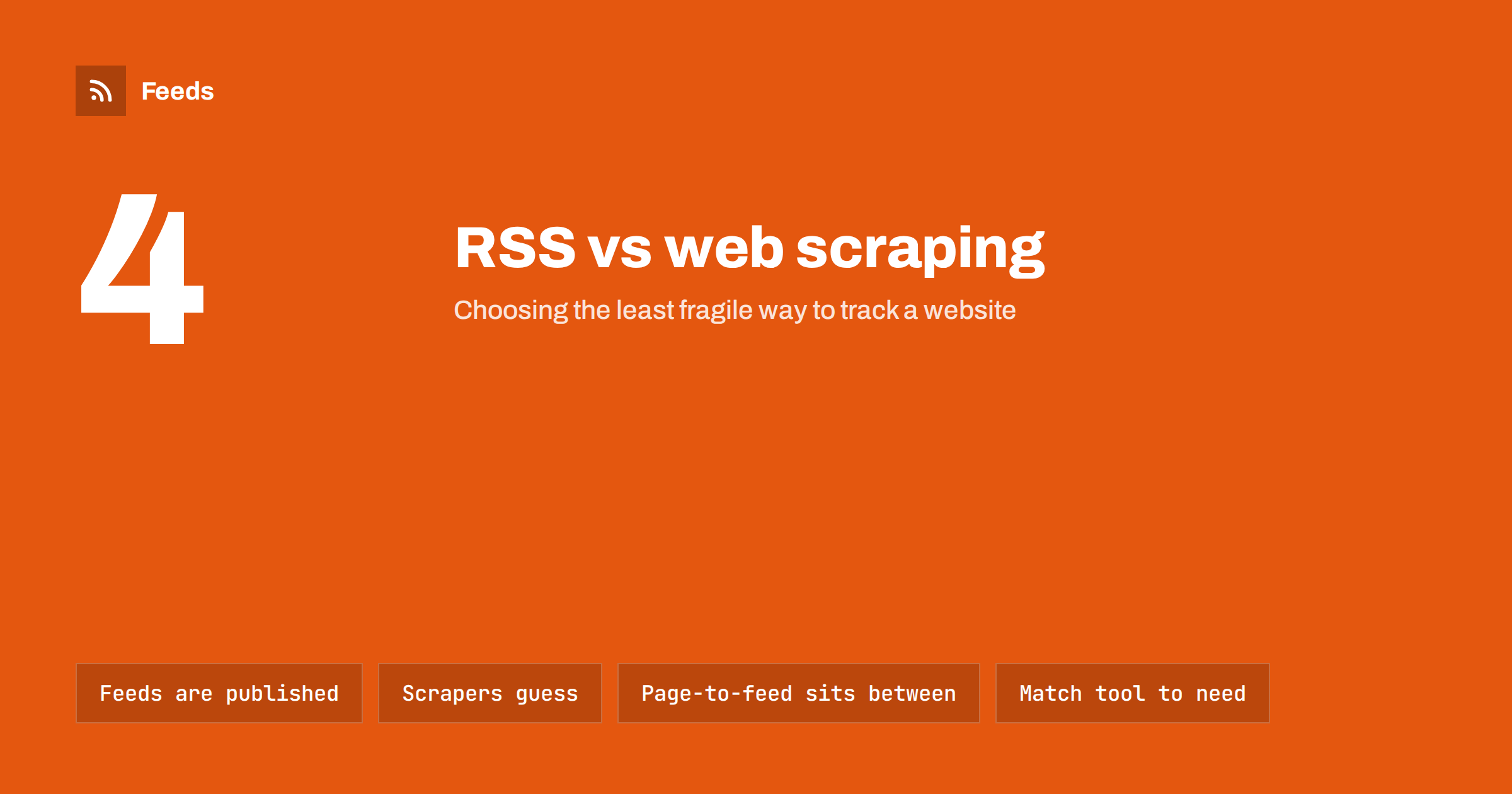
Short answer: Use RSS whenever the goal is to know about new items on a website, such as articles, jobs or announcements, because a feed is a stable, standard format that is cheap to read and easy to reuse. Use web scraping when you need specific data fields that no feed or structured data provides, and accept that scrapers need maintenance. For sites without RSS, a page-to-feed tool usually gives you the benefits of a feed without writing and maintaining a scraper.
People often reach for scraping because it feels like the universal answer: any page can be scraped, so why bother with anything else? The trouble shows up weeks later, when a redesign breaks the selectors, a site starts blocking the bot, or the script stops running and nobody notices. RSS solves a narrower problem, but it solves it much more reliably. Understanding where each approach fits saves a lot of maintenance.
What RSS is, in practical terms
An RSS feed is a file that a website publishes on purpose. It lists the newest items with a title, a link, a date and usually a summary. Because it follows a published standard, the RSS 2.0 specification, any reader or automation tool can consume it without knowing anything about the site’s design.
- It is an invitation. The publisher offers the feed so that others can follow the site. There is no guesswork about intent.
- It is layout-independent. The site can redesign completely and the feed keeps working, because it is generated from the content database, not from the page’s HTML.
- It is lightweight. A feed is small compared with a full page with scripts, images and styles, and it can be requested with caching headers that avoid downloading it when nothing changed.
- It is portable. The same feed link works in readers, dashboards, automation platforms and publishing tools.
What web scraping is, in practical terms
Scraping means writing code that downloads a page and extracts pieces of it, typically by CSS selectors or XPath expressions such as “the text inside every h2 within the element with class post-list“. The code then stores the data or turns it into another format.
- It is flexible. You can extract any visible data: prices, specifications, table cells, counts.
- It is fragile. Selectors depend on the page’s markup. A new theme, a renamed class or a moved block can silently break extraction.
- It needs infrastructure. Scheduling, error handling, storage, proxies for difficult sites, and monitoring of the scraper itself.
- It raises more etiquette questions. Heavy scraping can load servers, may conflict with site terms and is more likely to be blocked.
Side-by-side comparison
| Question | RSS feed | Custom scraper |
|---|---|---|
| Who defines the data? | The publisher | You, via selectors |
| Survives a redesign? | Usually yes | Often no |
| Setup effort | Paste a link | Write and host code |
| Ongoing maintenance | Minimal | Regular fixes |
| Data available | Title, link, date, summary, image | Anything visible on the page |
| Load on the site | Low | Depends on your code |
| Reusable in other tools | Yes, it is a standard | Only if you export a standard format |
When RSS is clearly the better choice
If your question is “what is new on this site?”, RSS is almost always the better tool. Typical examples include:
- Following competitor blogs, newsrooms and changelogs.
- Tracking industry news sections and trade publications.
- Watching regulators, public bodies and associations for announcements.
- Collecting job postings from career pages or job boards.
- Feeding new articles into a reader, a newsletter tool, a chat channel or a social publishing service.
In all these cases the unit of interest is an item with a title and a link. RSS carries exactly that, and it carries it in a format every tool understands.
When scraping is genuinely needed
Scraping earns its maintenance cost when you need structured data that is not an item list, or when you need fields that no feed exposes. Examples:
- Recording prices or stock levels across many product pages for analysis.
- Extracting table data, such as rates, schedules or statistics, into a spreadsheet.
- Collecting detailed attributes from each item, beyond title, date and summary.
- Research projects that need a one-time, complete snapshot of a site.
Even here, check first whether the site offers an API, a data export or structured data. Many sites embed JSON-LD for search engines, and reading that is far more stable than reading the visual layout.
The middle path: page-to-feed without custom scraping
The most common real-world situation is this: you want new items from a site, but the site has no RSS. That is where people start writing scrapers, and where a page-to-feed tool is usually the better answer.
A page-to-feed tool reads the public list page and detects the repeating items automatically instead of relying on selectors you wrote by hand. Good tools prefer the most stable sources first:
- An existing feed, if the site has one somewhere.
- Structured data such as JSON-LD article markup, which search engines also rely on.
- The list of articles visible on the page, detected again on each refresh.
Because detection runs on every refresh, a moderate layout change does not necessarily break the feed the way a fixed selector would. And because the output is plain RSS, you keep all the portability benefits: merge sources, filter by keywords, and send the result to any tool.
A quick decision checklist
When a new tracking request lands on your desk, run through these questions in order. The first “yes” usually tells you which approach to use.
- Does the site already publish RSS or Atom for the section you need? Use it. Nothing else is as stable.
- Is the need simply “tell me when something new appears”? Use a feed, generated from the list page if necessary.
- Does the site offer an official API or data export? Use that for structured data before considering scraping.
- Does the page carry JSON-LD or other structured data with the fields you need? Read that rather than the visual layout.
- Do you need many specific fields from each page, on a schedule? Only now is a custom scraper worth its maintenance cost.
It is also worth estimating the cost of each option over a year, not just on day one. A scraper that takes an afternoon to write can easily take several more afternoons to repair after redesigns, blocked requests and silent failures. Multiply that by the number of sites you follow and the difference becomes significant. A feed-based setup moves most of that maintenance to the publisher or to the tool, so the time you spend goes into reading and acting on the updates rather than keeping the pipeline alive.
Finally, think about who will own the solution. A scraper written by one developer tends to become an orphan when that person moves on. A list of feed links in a shared reader or tool is something anyone on the team can understand, check and change.
How Feeds fits in
Feeds is a page-to-feed tool for exactly this middle case. You paste a public address, and it uses an existing feed when there is one; otherwise it finds the list of articles on the page, reads JSON-LD article data, and shows a preview of titles and images before anything is created. There is nothing to install on the source website and no selectors to maintain. Feeds refresh automatically, sources can be merged and filtered by keywords, duplicates are removed, and paid plans alert you if a feed stops finding items. You can try it on a page and see the preview first.
Etiquette and good practice for either approach
- Keep request rates reasonable. A source that publishes daily does not need checking every minute.
- Identify your bot. A clear user agent lets site owners understand who is visiting and why.
- Respect robots rules and terms. Read the site’s robots.txt and terms, particularly for heavy or commercial extraction.
- Link back rather than copy. For monitoring, you need the headline and the link. Republishing full articles is a different matter and needs permission.
- Cache and deduplicate. Do not download or store the same content repeatedly.
Related reading
- How to Create an RSS Feed for a Website Without RSS
- How to Monitor Websites for New Content Automatically
- What Is an RSS Feed? A Plain-English Guide for Site Owners
The bottom line
RSS and scraping are not competitors so much as tools for different jobs. For knowing what is new on a site, a feed is simpler, sturdier and more portable. For extracting specific data, scraping may be justified, but check for APIs and structured data first. When a site has no feed, a page-to-feed tool usually gets you a working RSS feed without the maintenance burden of a custom scraper.
الأسئلة الشائعة
Is RSS a form of web scraping?
No. An RSS feed is published by the website itself, so reading it is using an offered interface rather than extracting data from the page layout. Generating a feed from a page is closer to scraping, but it produces a standard feed rather than custom data.
Why do scrapers break so often?
Scrapers depend on the exact structure of the page, such as class names and element order. Redesigns, A/B tests, new ad blocks or small template changes can all move or rename the elements a scraper looks for.
Can I get prices from a site with RSS?
Standard RSS items carry titles, links, dates and summaries, not structured price fields. For your own store, product feeds are the right format; for tracking data on other sites, you would need structured data, an API or scraping.
What should I do if a site has no RSS feed?
First check for a hidden feed in the page source or at common paths such as /feed/. If there is none, use a page-to-feed tool on the site’s list page, which gives you a standard feed without writing your own scraper.
Is page-to-feed more reliable than a scraper?
Often, yes, for item lists. A good tool prefers existing feeds and structured data and detects the list again on each refresh, while a hand-written scraper uses fixed selectors that fail when the layout changes.