ENEnglish
 LTLietuviškai
 DEDeutsch
 FRFrançais
 RUРусский
 ESEspañol
 PLPolski
 ITItaliano
 UKУкраїнська
 CSČeština
 PTPortuguês
 JA日本語
JA日本語 LVLatviešu valoda
 ETEesti
 HUMagyar
 IDBahasa Indonesia
 TRTürkçe
 HIहिन्दी
 ELΕλληνικά
 ARالعربية
 THไทย
THไทย VITiếng Việt
 RORomână
 MSBahasa Melayu
 BNবাংলা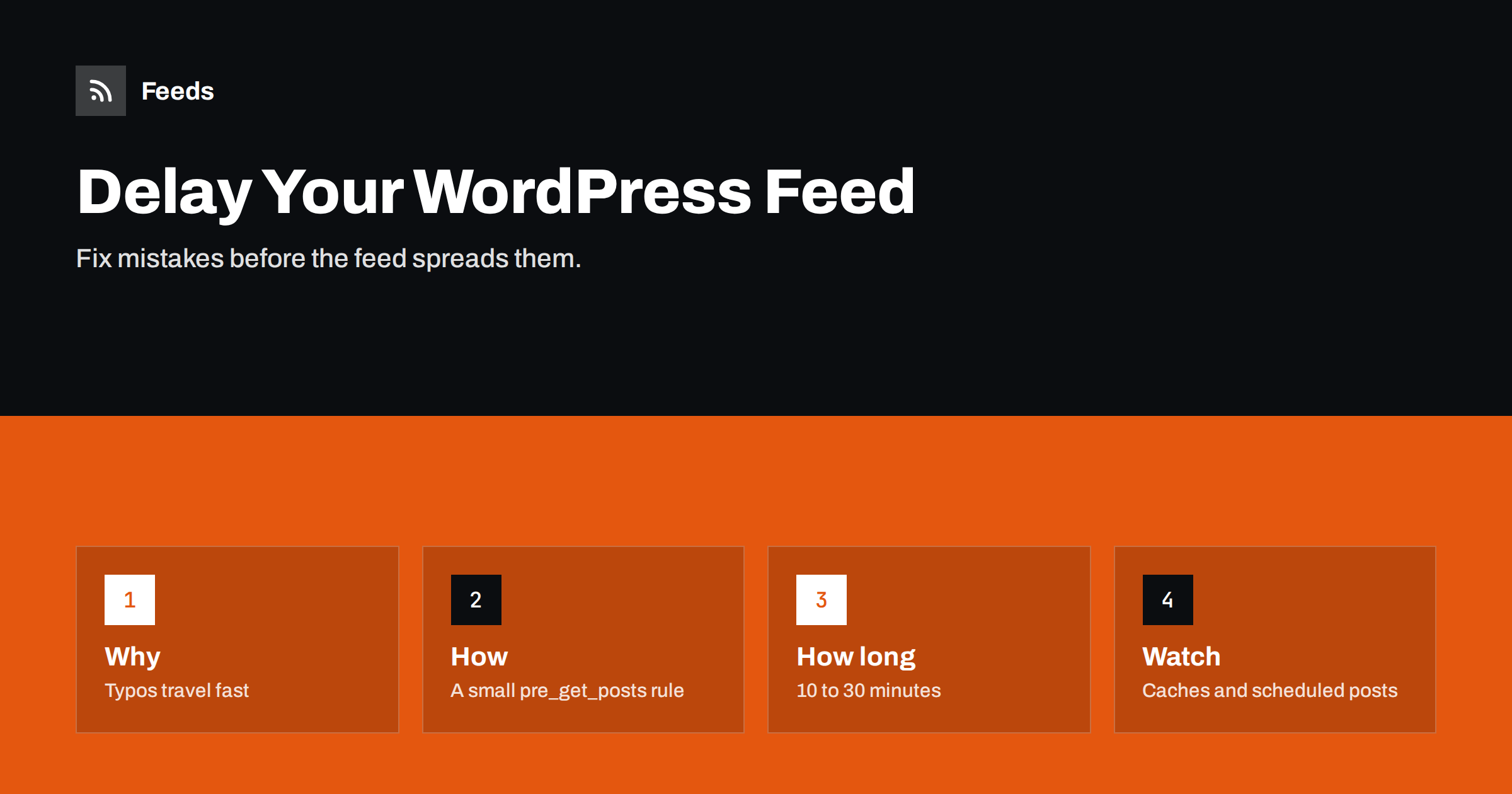
Short answer: A feed delay keeps newly published posts out of your WordPress RSS feed for a set time, typically 10 to 30 minutes, so you can catch typos, broken links or the wrong featured image before feed readers, newsletters, social posting tools and partners copy the post. You can add it with a feed-delay plugin or a short posts_where or pre_get_posts snippet that applies only to feeds. Keep the delay short, and remember that caching adds to it.
Anyone who has published a post and spotted a typo in the headline one minute later knows the feeling. On the website, a quick edit fixes it. But the feed may already have been fetched: a reader shows the wrong title, an RSS-to-email tool queues the post for tonight’s newsletter, a social automation tool shares it with the typo, and a partner portal imports it. Most of these do not update items they have already received. A small delay between publishing and appearing in the feed is a simple safety net.
Why a feed delay helps
Feed consumers act quickly and rarely look back:
- Readers keep the first version. Many readers do not refresh the content of items they have already stored.
- Automation posts immediately. Social and chat tools may share a new item within minutes of fetching it.
- Newsletters lock content. RSS-to-email tools often capture items when they first see them.
- Partners import once. Syndication partners may not re-import corrected items.
- WebSub pushes instantly. If you use WebSub, subscribers get the post within seconds.
The problem grows with every channel you connect to the feed. A site whose feed drives a newsletter, two social profiles and a partner portal can turn one typo into five public copies within the hour. A delay gives you a window to review the live post, click the links, check the image on mobile and fix anything before the wider world copies it.
When a delay is not the right tool
A feed delay is a safety net, not a publishing process. It does not suit every situation:
- Breaking news and live updates, where minutes matter more than polish. Newsrooms often prefer a very short delay or none, combined with careful editing before publishing.
- Posts that must stay private until a fixed time, such as embargoed announcements. Use scheduling for these; a feed delay does nothing to hide the page on your website.
- Sites with an approval workflow in the editor. If every post is reviewed before it goes live, the delay adds little.
- Feeds consumed by time-critical partners who expect items as soon as they appear on the site. Tell them if you add a delay, so they do not report missing items.
In these cases, invest in a pre-publication checklist and previews instead. For everyone else, a short delay is cheap insurance that costs readers almost nothing.
How long should the delay be?
| Delay | Good for | Trade-off |
|---|---|---|
| 5 to 10 minutes | News sites and time-sensitive posts | Only catches obvious mistakes |
| 15 to 30 minutes | Most blogs and company sites | Enough time to review the live post |
| 1 hour or more | Sites with approval steps after publishing | Feed feels slow; readers see posts late |
Think about who reads your feed and how quickly they expect new items. Most feed readers check every half hour to a few hours anyway, so a 20-minute delay is barely noticeable to them. Automation tools that check every few minutes will notice more, but a short wait before a social post is rarely a problem. For most sites, 15 to 30 minutes is a sensible balance. If you regularly need more, the real fix is probably a better review before publishing, such as previews and a checklist, not a longer delay.
Option 1: use a plugin
Several plugins add a feed delay with a simple setting, and some SEO or feed-management plugins include one. Look for a plugin that:
- Applies the delay only to feeds, not to the website, sitemaps or search.
- Covers all feeds, including category, tag and Atom feeds.
- Is actively maintained and compatible with your WordPress version.
Plugins are the easiest route for teams where non-developers manage the site, because the delay can be changed from the dashboard without touching code. The downside is one more plugin to update and one more place where a conflict can break the feed. If you already use a well-maintained SEO or feed plugin with a delay option, prefer that over adding a new one. After installing, test with a real post as described below.
Option 2: add a small snippet
If you prefer code, a snippet in a site-specific plugin keeps new posts out of feeds for a set number of minutes. One common approach filters the SQL condition for feed queries:
add_filter( 'posts_where', function ( $where, $query ) {
    if ( $query->is_main_query() && $query->is_feed() ) {
        global $wpdb;
        $minutes = 20;
        $limit   = gmdate( 'Y-m-d H:i:s', time() - $minutes * 60 );
        $where  .= $wpdb->prepare( " AND {$wpdb->posts}.post_date_gmt <= %s", $limit );
    }
    return $where;
}, 10, 2 );
Notes on the snippet:
- It compares with
post_date_gmt, which avoids time zone confusion. - It applies only to the main feed query, so widgets, the website and sitemaps are unaffected.
- Change
$minutesto your preferred delay. - Put it in a small plugin rather than the theme, so a theme change does not remove it.
Caching adds to the delay
Your effective delay is the feed delay plus any caching: a 20-minute delay and a 15-minute feed cache can mean up to 35 minutes before a post appears. Also, a cached feed generated before the delay expired will not include the post until the cache refreshes. Options:
- Shorten the feed cache time if you add a delay.
- Rely on time-based cache expiry rather than purge-on-publish for feeds, since purging at publish time happens before the post is due to appear anyway.
- Test the combination with a real post and a stopwatch.
Interactions with scheduling and WebSub
Scheduled posts use the same publication date, so they enter the feed delay minutes after their scheduled time. That is usually fine; if a post must reach the feed at an exact time, schedule it earlier by the length of the delay.
WebSub plugins typically ping the hub at publish time. With a delay, the hub fetches the feed before the post is in it, and subscribers get nothing new until the next ping. If you use both, check whether your WebSub plugin can ping later or when the feed actually changes, or accept that WebSub subscribers will see the post on the next update.
Updates to existing posts are not affected, because the delay depends on the original publication date. A correction to an old post appears in the feed straight away if your feed shows modified content.
Testing your delay
- Publish a test post, ideally in a category that is excluded from automation, or on a staging site.
- Open the raw feed immediately and confirm the post is not there.
- Check again after the delay plus your cache time and confirm it appears.
- Confirm the website, the category archive and the sitemap show the post immediately.
- Delete or unpublish the test post, and check that downstream tools did not pick it up during testing.
A review routine for the delay window
The delay only helps if you use it. A two-minute routine right after publishing:
- Read the headline and first paragraph on the live page.
- Check the featured image and how it crops on mobile.
- Click every link in the post.
- Check the excerpt, which many feed consumers display instead of the full text.
- Confirm the category and tags, which may decide which feeds and automations pick the post up.
If you follow other publishers’ feeds and share their items automatically, a similar safety net on your side helps: our tool, Feeds, shows a preview of items before a feed is created and lets you filter merged sources by keywords, so only the items you want reach your tools. See the plans.
Related reading
- How to Exclude Categories or Posts From Your WordPress Feed
- WebSub Explained: Instant Updates for Your RSS Feed
- How to Automate Social Media Posts from an RSS Feed
The bottom line
A short feed delay, usually 15 to 30 minutes, gives you time to fix mistakes before readers, newsletters, social tools and partners copy a new post. Add it with a plugin or a small feed-only snippet, account for caching and WebSub, test with a real post, and use the window for a quick review of the live page. It is one of the simplest ways to make feed-driven publishing safer.
FAQ
Why delay an RSS feed?
To catch mistakes before feed consumers copy them. Readers, newsletter tools, social automation and partners often keep the first version they fetch, so fixing a typo after they have it is too late.
How long should a feed delay be?
Between 10 and 30 minutes suits most sites. News sites may prefer 5 to 10 minutes. Longer delays make the feed feel slow and usually point to a missing review step before publishing.
Does a feed delay affect my website or SEO?
Not if it applies only to feeds. The post appears on the website, in archives and in sitemaps immediately; only the feed waits.
Does the delay apply to scheduled posts?
Yes. Scheduled posts enter the feed after their scheduled time plus the delay. Schedule them earlier if they must reach the feed at a precise time.
Will my caching plugin interfere with the delay?
It adds to it. A cached feed may not include the post until the cache refreshes after the delay has passed. Use a short feed cache time and test the combination.