ENEnglish
 LTLietuviškai
 DEDeutsch
 FRFrançais
 RUРусский
 ESEspañol
 PLPolski
 ITItaliano
 UKУкраїнська
 CSČeština
 PTPortuguês
 JA日本語
JA日本語 LVLatviešu valoda
 ETEesti
 HUMagyar
 IDBahasa Indonesia
 TRTürkçe
 HIहिन्दी
 ELΕλληνικά
 ARالعربية
 THไทย
THไทย VITiếng Việt
 RORomână
 MSBahasa Melayu
 BNবাংলা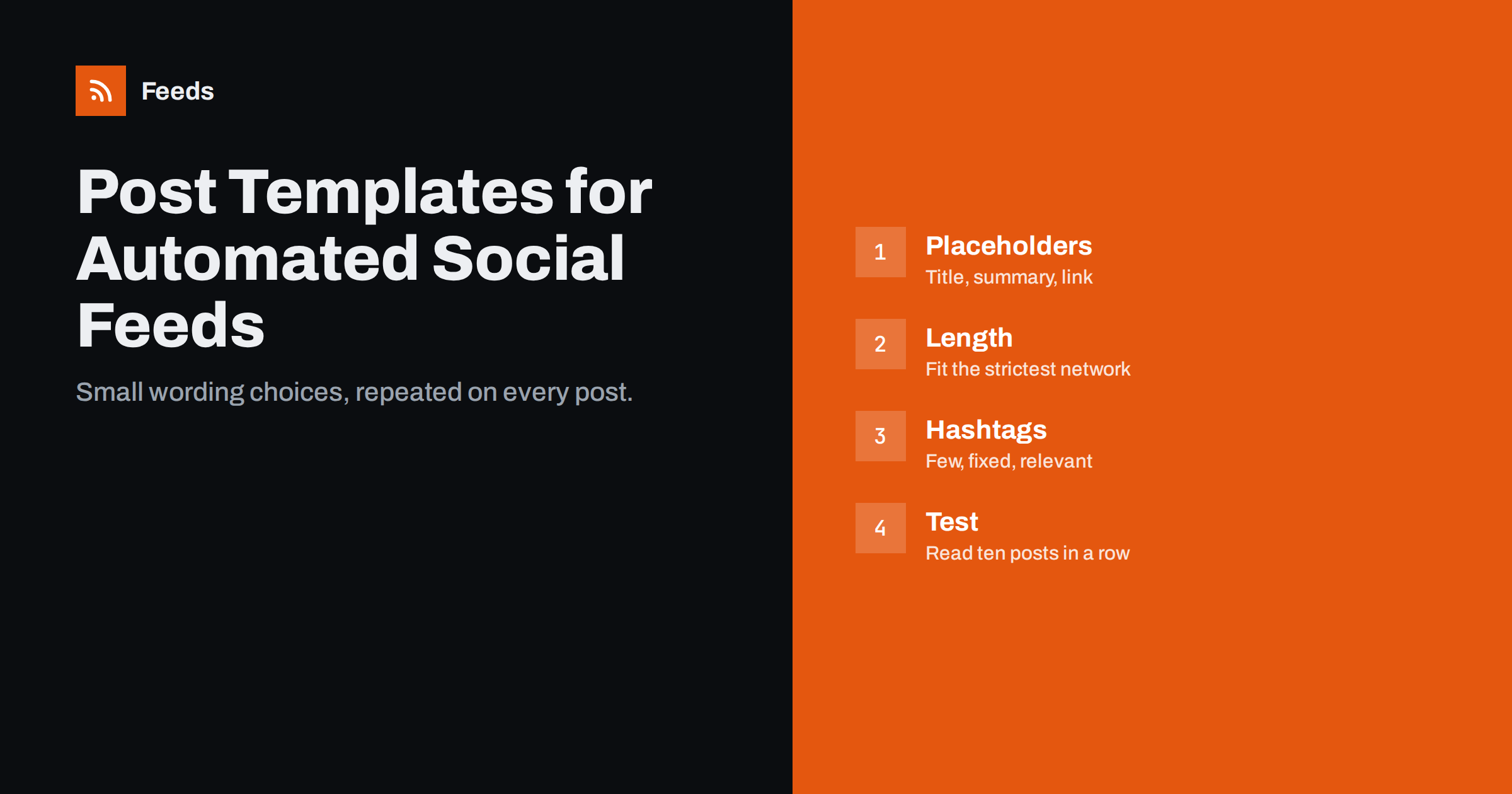
Short answer: A post template decides how every automated social post reads, so it deserves more care than a single post. Build it from placeholders the feed fills reliably (title, short summary, link), keep fixed text to a minimum, write a separate template per network to respect length limits and conventions, use at most a few relevant hashtags, and add tracking to the link. Before going live, generate ten posts from real feed items and read them in a row: if they feel repetitive or awkward, adjust the template or the source titles.
Why templates matter so much
When you write a post by hand, a clumsy phrase affects one post. A template is multiplied: the same wording appears on every automated post for months or years. A small improvement, such as leading with the benefit instead of “New blog post:”, therefore pays off hundreds of times. A small mistake, such as a typo or an irrelevant hashtag, is repeated just as often.
Templates are also where automation either sounds like your brand or like a machine. Followers rarely object to automated posts as such; they object to posts that are repetitive, generic or badly formatted. A well-written template avoids most of that.
Because the feed supplies most of the content, a template is really a partnership between two things: what you write once and what your site provides every time. Improving either improves every post.
The building blocks: placeholders
Most posting tools let you insert fields from the feed item into the post text. Common placeholders are:
- Title: the item’s headline. Usually the core of the post.
- Summary or description: the excerpt. Useful when it is short and well written; harmful when it is a truncated first paragraph or contains HTML.
- Link: the item’s URL, ideally with tracking parameters added by the tool.
- Author, category or tags: sometimes available, useful for routing or labels.
- Image: attached from the feed or shown through the link preview.
Only use placeholders the feed fills reliably. If a quarter of your items have empty summaries, a template that depends on the summary will produce a quarter of odd-looking posts. Check a sample of items before relying on a field.
Patterns that read naturally
Here are template patterns that work across many types of content:
- Title only:
{title} {link}. Best when titles are descriptive, as with news. - Benefit first:
{summary} {link}, where summaries are written as one clear sentence about what the reader gains. - Label plus title:
Guide: {title} {link}orNew arrival: {title} {link}, where the label tells readers what kind of item it is. - Title plus context:
{title}. {summary} {link}for networks that allow longer posts.
Choose labels that add information. “Guide:”, “Case study:”, “Event:” or “Job:” tell readers what to expect before they read the title, which helps them decide quickly whether the post is for them. Labels like “Must read:” or “Don’t miss:” add nothing and tend to wear thin when repeated on every post.
Avoid long fixed openings like “Check out our latest blog post, which we just published on our website:”. They waste the most valuable space in the post, the first line, on words that say nothing.
One template per network
Networks differ in length limits, hashtag habits and tone. A single template for all of them fits none well.
| Network | Template approach |
|---|---|
| Title plus one or two sentences of context; line breaks; up to three hashtags | |
| Short context line; let the link preview carry title and image | |
| X | Short hook or title plus link, within 280 characters |
| Bluesky | Under 300 characters; make sure a link card is generated |
| Mastodon | Title, short context, a few CamelCase hashtags |
| Telegram | Bold headline, one line, link; silent posts for minor items |
Length and truncation
Feed titles and summaries vary in length, and templates must handle the extremes. Check how your tool truncates: at a word boundary with an ellipsis is fine; mid-word or mid-link is not. For character-limited networks, calculate the worst case: longest likely title plus fixed text plus link. If it exceeds the limit, drop the summary for that network or shorten the fixed text.
Line breaks deserve a test too. Some networks keep them, others collapse them, and some tools strip them from templates. A template that looks tidy in the editor can arrive as one dense block of text.
Remember that links count toward limits differently on different networks, and that some tools shorten links automatically. Test with your longest recent title.
Hashtags and mentions
- Use few, fixed and relevant hashtags, such as one for your brand and one or two for the topic. Rotating random hashtags looks spammy.
- Category-based hashtags can come from the feed’s categories if your tool supports it, but check that category names make sense as hashtags.
- CamelCase multi-word hashtags (#ContentAutomation) are easier to read and friendlier to screen readers.
- Never automate mentions of other accounts. Automated mentions are often perceived as spam and can breach network rules.
Variation without chaos
Identical openings on every post make a timeline look robotic. Some tools support several templates that rotate, or spintax-style alternatives. Use this lightly: two or three variations of the label or opening, all natural and on-brand. The goal is to avoid a wall of identical first words, not to disguise automation.
A more robust way to create variety is better source text. When authors write specific titles and one-sentence summaries, even a simple template produces varied, interesting posts, because the content itself varies.
Fixing the source so templates can shine
Many template problems are really source problems. If posts look dull, the titles may be vague; if they look messy, the summaries may be truncated paragraphs or contain leftover HTML. A few editorial habits on the website side improve every automated post at once.
- Write standalone titles. A title should make sense in a social feed without the surrounding page. “Part 2” or “Update” does not; “How to price handmade products, part 2: shipping costs” does.
- Write a real excerpt. Most CMSs have an excerpt or summary field. One clear sentence about what the reader gains is ideal for templates, newsletters and search snippets alike.
- Set a proper social image. Choose the image that should appear in previews rather than leaving it to chance.
- Use categories deliberately. If templates or routing depend on categories, keep them consistent and meaningful.
- Avoid special characters in titles that some networks or tools render badly, such as unusual quotation marks or emoji that do not display everywhere.
Share these habits with everyone who publishes on the site. Authors rarely think about how their titles look on LinkedIn or in a Telegram channel; a short guideline with two good and two bad examples usually changes that quickly.
When sources are third-party sites you do not control, you cannot change their titles, but you can choose sources with good titles, filter out item types that produce poor posts and use templates that rely on the title only, since third-party summaries are often the least reliable field.
Testing and maintaining templates
- Generate ten posts from real recent items, in preview or test mode.
- Read them in a row, as a follower would see them on a timeline.
- Check the extremes: longest title, empty summary, special characters, items without images.
- Look at live posts after the first real run, on desktop and mobile.
- Review quarterly: compare engagement across networks and adjust one element at a time.
Feeds helps at the source level: when you create feeds from pages without RSS or merge several sources, the preview shows exactly which titles, summaries and images your template will receive, and keyword filters and duplicate removal keep unsuitable items away from the template altogether. See the pricing page for plans.
Related reading
- How to Automate Social Media Posts from an RSS Feed
- How to Post RSS Feed Items to X (Twitter) Automatically
- How Often Should Automated Feeds Post to Social Media?
- How to Reshare Evergreen Content Automatically Without Spamming
The bottom line
Templates turn feed items into posts thousands of times, so small choices matter. Use only reliable placeholders, keep fixed text short and meaningful, write one template per network, handle length limits and truncation, use a few consistent hashtags, never automate mentions, and test by reading ten generated posts in a row. Good source titles and summaries do the rest.
FAQ
What should an automated social post template contain?
Usually the item’s title or a one-sentence summary, the link with tracking parameters and, where appropriate, a short label and a few hashtags. Keep fixed text minimal.
Should I use the same template on every network?
No. Length limits, hashtag habits and tone differ, so a separate template per network produces posts that fit each platform.
How many hashtags should automated posts include?
A few relevant, consistent ones are enough, typically up to three on most networks. Too many hashtags make posts look like spam.
How do I stop automated posts from looking repetitive?
Avoid long fixed openings, rotate a few natural label variations if your tool allows, and above all write specific titles and summaries at the source.
How should I test a new template?
Generate around ten posts from real feed items, read them in a row, test extreme cases such as very long titles and missing summaries, then check the first live posts.
Why do my automated posts show HTML code or cut-off sentences?
The feed’s summary field probably contains HTML or a truncated first paragraph. Use a proper excerpt at the source, strip HTML in the tool if it offers that option, or use a title-only template.