ENEnglish
 LTLietuviškai
 DEDeutsch
 FRFrançais
 RUРусский
 ESEspañol
 PLPolski
 ITItaliano
 UKУкраїнська
 CSČeština
 PTPortuguês
 JA日本語
JA日本語 LVLatviešu valoda
 ETEesti
 HUMagyar
 IDBahasa Indonesia
 TRTürkçe
 HIहिन्दी
 ELΕλληνικά
 ARالعربية
 THไทย
THไทย VITiếng Việt
 RORomână
 MSBahasa Melayu
 BNবাংলা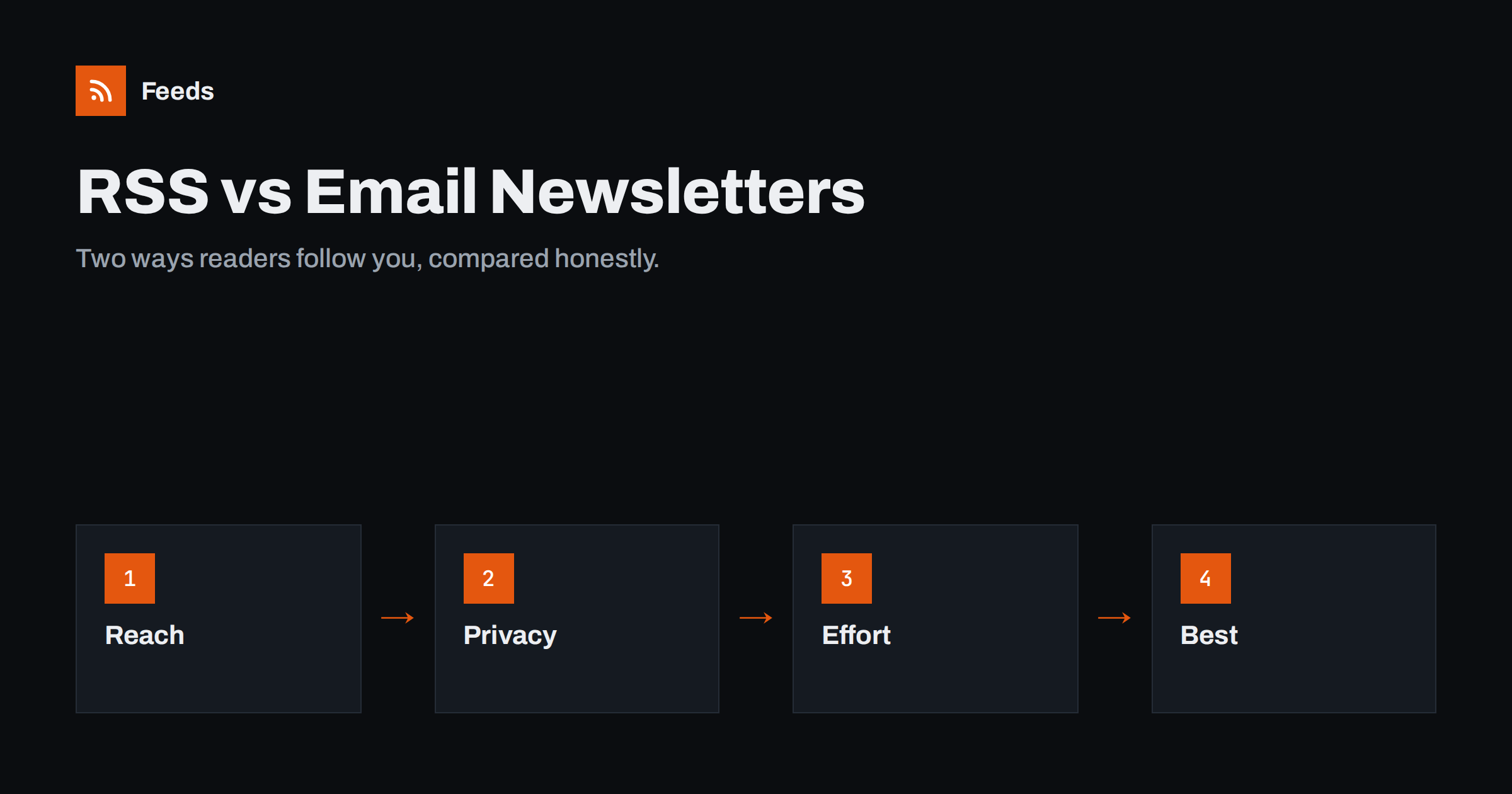
Short answer: Email newsletters reach far more ordinary readers, give you a list of subscribers you own, and let you add commentary, but they take work to produce and compete in crowded inboxes. RSS reaches a smaller, more technical audience and tools, costs nothing once set up, needs no personal data and never lands in spam. Most publishers should offer both: keep a clean feed for readers and tools, and use it as the source for an automated or curated newsletter.
“How do I follow your site?” is a question every publisher should be able to answer clearly. For most of the web’s history, the two main answers have been “subscribe to the RSS feed” and “sign up for the newsletter”. They are often presented as rivals. In practice they serve different people and different purposes, and the best results come from understanding those differences and letting each channel do what it does best.
How each channel works
RSS is a pull channel. Your site publishes a feed; readers add its address to a reader app, podcast app or tool, which checks it regularly. You never learn who they are, and you do not send anything. When you publish, the item simply appears in their app.
Email newsletters are a push channel. Readers give you their email address, usually through a signup form with a confirmation step. You send messages from an email service, either written by hand or generated automatically from your latest posts. You know exactly who is subscribed and can see who opened and clicked, within the limits of privacy features in modern email apps.
That single difference, pull versus push, explains most of the trade-offs below. With RSS, the reader is in control: they can unsubscribe silently, mute you, or read your posts months later in a batch. With email, you are in control of timing and format, but you are asking for a place in one of the most crowded spaces in anyone’s day. Neither model is better; they simply suit different habits and different kinds of content.
A side-by-side comparison
| Factor | RSS feed | Email newsletter |
|---|---|---|
| Who uses it | Feed reader users, professionals, tools and apps | Almost everyone with an email address |
| Setup effort | Usually automatic in your CMS | Email service, signup forms, templates, consent |
| Ongoing effort | None | Low if automated, high if curated |
| Subscriber data | None; counts are approximate | Full list you control |
| Privacy for readers | Complete; no address shared | Address shared; tracking common |
| Deliverability | Not an issue | Spam filters, promotions tabs, bounces |
| Cost | Gratis | Often grows with list size |
| Legal requirements | Minimal | Consent, unsubscribe links, data protection |
| Reuse by tools | Excellent | Limited |
The strengths of RSS
- Zero effort after setup. Your content management system updates the feed every time you publish.
- No algorithm and no spam folder. If an item is in the feed, every subscriber’s app receives it.
- Privacy. Readers who do not want to give out their email address can still follow you. Some audiences, particularly technical ones, strongly prefer this.
- Machine-friendly. The same feed powers newsletter tools, social posting tools, aggregators, partner sites and internal dashboards.
- No list to maintain, no consent records and no cost per subscriber.
The strengths of email newsletters
- Reach. Most people check email daily, and far fewer use feed readers. For a general audience, a newsletter reaches many more people.
- Ownership of the relationship. You have a list of people who asked to hear from you. That list survives changes in search and social platforms.
- A personal voice. An editor’s note, a recommendation or a behind-the-scenes story gives readers a reason to open that a list of links cannot.
- Measurable response. Clicks, replies and conversions are visible, which matters for businesses.
- Timing. You choose when a message goes out, for example a weekly digest on Tuesday morning.
The weaknesses of each
RSS’s biggest weakness is audience size: many readers have never used a feed reader, and you cannot see who your subscribers are. You also cannot reach out to them with anything that is not in the feed.
Email’s weaknesses are effort and friction. Someone has to maintain the list, templates and sending schedule. Inboxes are crowded, open rates fluctuate, and messages can be filtered as promotions or spam. Legal rules on consent and data protection apply, and costs usually rise as the list grows. A newsletter that is simply an automated list of links can also feel impersonal and lead to unsubscribes.
Why you should usually offer both
The two channels are not really competitors. RSS serves the smaller group that prefers readers and every tool that consumes content automatically. Email serves the larger group that lives in its inbox. Offering both costs little extra, because the feed can drive the newsletter:
- Your site publishes a clean feed with good titles, excerpts and images.
- Your email service reads the feed and builds a digest automatically, daily or weekly, or gives you a draft to edit.
- You add a short introduction or recommendation on top, if you have time.
This way the feed is the single source of truth and the newsletter never misses a post. The quality of your feed directly shapes the quality of your automated emails, which is one more reason to keep it valid, with images and well-written excerpts.
Presenting both options on your site
- Lead with email for general audiences. A clear signup form near the end of articles and in the footer works for most sites.
- Keep RSS visible but quiet. A small RSS link or icon in the footer, and autodiscovery tags in the page head, are enough for the people who look for it.
- Explain the difference in one line on a “Subscribe” page: “Get a weekly email, or follow every post in your RSS reader.”
- Offer topic choices where it makes sense: category feeds for RSS readers, and interest groups or separate lists for email.
- Do not hide the feed behind an email signup. That defeats the purpose of RSS for the readers who want it.
Measuring what each channel does for you
Email makes measurement easy, sometimes deceptively so. Open rates are inflated or hidden by privacy features in several major email apps, so clicks, replies and conversions are more reliable signals than opens. Look at trends over months rather than single sends, and compare the clicks per issue with the effort that issue took.
RSS is harder to measure, but not impossible:
- Add UTM parameters to the links in your feed, so visits from feed readers appear as their own source in analytics.
- Check server logs for feed requests. Several hosted readers report the number of subscribers in their user agent string, which gives a rough total.
- Count downstream uses. If your feed drives your newsletter, social posts or partner widgets, some of their results are really the feed’s results too.
Do not expect the numbers to be comparable. An email list of 2,000 and a feed with 300 reader subscribers are not a contest; they are two different groups of people, and the feed also quietly powers channels that the list does not.
Choosing for your situation
- Technical blog, developer tools, research: RSS matters more than usual; keep it prominent, add a newsletter for the wider audience.
- Small business blog: newsletter first, feed in the background feeding the newsletter and social tools.
- News site: both, with category feeds for partners and power users and topic newsletters for readers.
- Podcast: the RSS feed is mandatory; a newsletter adds a direct line to listeners that no directory gives you.
On the curation side, many newsletters are built from other people’s content: industry news from several sites, only on certain topics. If some of those sites have no feed, or you want one filtered stream for your email tool, our tool, Feeds, can turn pages without RSS into feeds and merge several sources into one feed that keeps only items with your keywords, with duplicates removed. That single link can then drive your newsletter tool. See the plans.
Related reading
- How to Turn an RSS Feed into an Automatic Email Newsletter
- Full Text or Summary? Choosing What Your RSS Feed Shows
- RSS Autodiscovery: Help Readers and Apps Find Your Feed
The bottom line
Email newsletters reach more people and give you a list you own; RSS reaches readers who value privacy and every tool that consumes content automatically, with no effort after setup. They work best together: a clean feed as the single source, and a newsletter built on top of it with a human touch. Make both easy to find, and let readers choose.
FAQ
Is RSS better than an email newsletter?
Neither is better in general. Email reaches far more everyday readers and gives you a subscriber list; RSS is effortless, private and ideal for tools. Most publishers benefit from offering both, with the feed as the source for the newsletter.
Can my newsletter be created automatically from my RSS feed?
Yes. Many email services offer RSS-to-email campaigns that check your feed and send new posts on a schedule. A clean feed with images and good excerpts produces better emails.
Why would anyone use RSS instead of email?
RSS readers keep updates out of the inbox, need no email address, cannot be spammed and put many sources in one chronological list. People who follow dozens of sites often prefer this.
Do I need consent to publish an RSS feed?
No. An RSS feed does not collect personal data, so there is no signup or consent involved. Email newsletters, by contrast, need consent and a working unsubscribe link under most data protection rules.
Should I put the RSS link in my header or footer?
For most sites, the footer is enough, together with autodiscovery tags in the page head. Technical and news sites whose readers commonly use feeds may want a more visible link.