ENEnglish
 LTLietuviškai
 DEDeutsch
 FRFrançais
 RUРусский
 ESEspañol
 PLPolski
 ITItaliano
 UKУкраїнська
 CSČeština
 PTPortuguês
 JA日本語
JA日本語 LVLatviešu valoda
 ETEesti
 HUMagyar
 IDBahasa Indonesia
 TRTürkçe
 HIहिन्दी
 ELΕλληνικά
 ARالعربية
 THไทย
THไทย VITiếng Việt
 RORomână
 MSBahasa Melayu
 BNবাংলা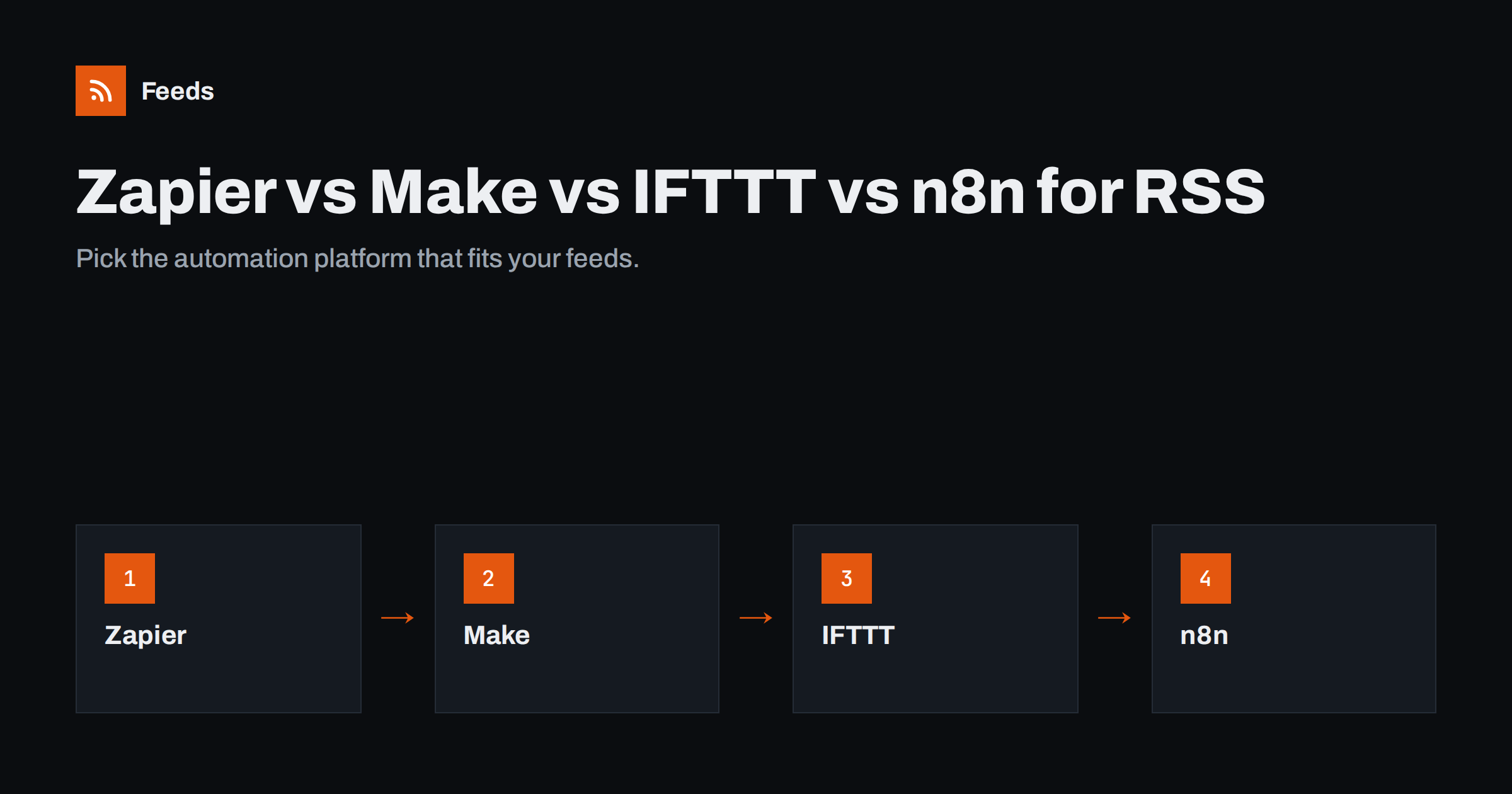
Short answer: All four platforms can watch an RSS feed and act on new items. Zapier is the easiest for non-technical teams and connects to the most apps; Make offers more detailed visual workflows at a lower cost per operation; IFTTT is best for simple personal or small-business applets; and n8n suits technical teams that want to self-host and control data and costs. The right choice depends mostly on volume, how complex your workflow is and who will maintain it.
What an RSS automation platform actually does
Every one of these tools follows the same basic pattern. A trigger watches a feed URL and fires when it finds an item it has not seen before. Optional filters decide whether the item continues. One or more actions then do something with it: post to a social network, send a Slack message, add a row to a spreadsheet, create a task or send an email.
The differences lie in the details that matter once a workflow runs every day:
- Polling interval: how often the platform checks the feed. On entry-level plans this can be anywhere from a few minutes to an hour or more.
- Deduplication: how the platform decides an item is new, usually by its GUID or link.
- Filtering and transformation: how easily you can keep only certain items, shorten text or reformat dates.
- Pricing model: whether you pay per task, per operation, per active workflow or for hosting.
- Error handling: what happens when an action fails, and whether you get notified.
Plans, limits and prices change often, so treat any specific numbers you read as a snapshot and check each vendor’s current pricing page before deciding.
Zapier: the easiest starting point
Zapier’s “RSS by Zapier” app offers triggers for new items in one feed or in several feeds, and you can also filter by content. Workflows (“Zaps”) are built as a linear sequence of steps, which makes them easy to understand for people without technical background.
Where it shines: a very large catalogue of app connectors, clear setup screens, good task history and built-in steps for filters, formatting and delays. If your team needs to send a feed item to a less common SaaS tool, Zapier is the most likely to have a ready connector.
Watch out for: costs that grow with the number of tasks. A busy feed that triggers several actions per item can use up a plan’s allowance quickly. Branching logic is possible but gets harder to manage as workflows grow.
Make: detailed visual scenarios
Make (formerly Integromat) represents workflows as visual scenarios with modules connected on a canvas. Its RSS module can watch a feed and return new items, and routers let one item go down several paths with different filters.
Where it shines: complex logic, such as sending items with one keyword to LinkedIn and items with another to a newsletter, is easier to see and build. Data mapping and text functions are powerful, and pricing per operation is often cheaper than per-task models for the same volume.
Watch out for: a steeper learning curve. Every module run counts as an operation, so scenarios with many steps consume more than you might expect. Schedules are set per scenario, and short intervals may need a higher plan.
IFTTT: simple applets for small jobs
IFTTT (“If This Then That”) is built around simple applets: one trigger, one or a few actions. The RSS service offers triggers for any new feed item or for new items matching a keyword or phrase.
Where it shines: extremely quick setup for straightforward jobs, such as “post every new item from my blog feed to a page” or “email me when a feed item mentions my company”. It is friendly for solo founders and personal use.
Watch out for: limited logic and formatting, a smaller business-focused connector list, and less transparency about exactly when feeds are checked. It is rarely the right tool for an agency managing many clients.
n8n: self-hosted control for technical teams
n8n is a workflow tool that you can self-host (it also offers a cloud version). It has an RSS Feed Trigger node and an RSS Read node, plus nodes for code, HTTP requests and hundreds of services.
Where it shines: full control over data, schedules and logic. When self-hosted, there is no per-task fee; costs are your server and your time. Developers can add custom JavaScript to clean titles, remove tracking parameters or combine feeds in any way they like.
Watch out for: you own the operations. Someone must update the software, back up workflows and credentials, and monitor failures. Review the licence terms for your use case, especially if you plan to offer workflows to clients.
Side-by-side comparison
| Criteria | Zapier | Make | IFTTT | n8n |
|---|---|---|---|---|
| Ease of use | Very easy | Moderate | Very easy | Technical |
| Complex logic | Good | Very good | Basic | Very good |
| Keyword filtering | Yes | Yes | Keyword trigger | Yes |
| Pricing basis | Tasks | Operations | Plan tiers | Hosting or cloud plan |
| Hosting | Cloud | Cloud | Cloud | Self-host or cloud |
| Best for | Non-technical teams | Power users, agencies | Simple personal jobs | Developers |
How to choose for your situation
Ask four questions and the choice usually becomes obvious.
- Who will maintain it? If nobody on the team writes code, choose Zapier or IFTTT. If a developer is available and willing, n8n becomes attractive.
- How many items per month? Multiply the number of new feed items by the number of actions per item. That is your rough monthly task or operation count, and it tells you which pricing tier you would need.
- How complex is the logic? One feed to one destination is simple anywhere. Several feeds, keyword routing and formatting per destination favour Make or n8n.
- Where may data be processed? If client or company policies restrict third-party processing, self-hosting n8n may be the only acceptable option.
Many small businesses also discover they do not need a general platform at all. If the only job is “post new blog articles to social networks”, a dedicated RSS-to-social tool is usually simpler and handles images and network formatting better.
Example: one feed, three destinations
To make the differences concrete, imagine a small company blog that publishes three articles a week. The team wants each new article posted to LinkedIn, announced in a Slack channel and added as a row to a content log spreadsheet.
- In Zapier, this is one Zap with an RSS trigger and three action steps. It takes a few minutes to build. Each article uses several tasks, so roughly a dozen articles a month means a few dozen tasks, which fits comfortably in small plans.
- In Make, it is one scenario: an RSS “watch items” module followed by three modules, or a router if the destinations need different filters. The scenario is scheduled to run at an interval you choose, and each module run counts as an operation.
- In IFTTT, you would probably create separate applets for each destination, depending on which services and multi-action features your plan includes. Simple, but three things to maintain.
- In n8n, one workflow with an RSS Feed Trigger node and three output nodes. On a self-hosted instance the monthly cost does not depend on the number of articles.
At this volume, all four work and cost differences are small. The picture changes when the same team adds ten industry news feeds for a Slack channel, each publishing several items a day. Suddenly the monthly item count runs into the thousands, and the pricing model, filtering and deduplication become the deciding factors. Plan for the volume you will have in six months, not just the first workflow.
Improve the feed before it reaches the platform
Whichever platform you choose, the workflow is only as good as the feed it watches. Three problems come up again and again: the source site has no feed at all, several sources need to be combined, and the feed contains many items you do not want. Solving these inside the automation platform means extra steps, extra operations and extra cost for every item.
Feeds handles these steps before the platform sees anything. It creates an RSS feed from any page that lists articles, uses the site’s existing feed when there is one, merges several sources into one feed, keeps only items with (or without) your keywords, and removes duplicates automatically. The platform then watches a single, clean feed and runs fewer, more relevant tasks. You can start on the free plan; the pricing page shows the limits of each plan.
Related reading
- How to Automate Social Media Posts from an RSS Feed
- How to Send RSS Feed Updates to a Slack Channel
- How to Turn an RSS Feed into an Automatic Email Newsletter
The bottom line
Zapier is the safest choice for non-technical teams, Make for detailed logic at a reasonable cost, IFTTT for small and simple jobs, and n8n for developers who want full control. Estimate your monthly volume, be honest about who will maintain the workflows, and clean up the feed itself before it reaches the platform. That combination keeps costs predictable and workflows reliable.
FAQ
Which automation platform is cheapest for RSS workflows?
It depends on volume and complexity. For very simple jobs, free tiers may be enough; for high volume, self-hosted n8n often costs least but requires technical time. Always compare current pricing using your own estimate of items and actions per month.
Can these platforms read feeds from sites without RSS?
Not directly. Their RSS triggers need an existing feed URL. For sites without RSS, create a feed from the page that lists the content first, then use that feed as the trigger.
How do these platforms decide an item is new?
Most compare the item’s GUID or link with items seen before. If a site changes these values when it edits posts, the platform may treat old items as new and run the workflow again.
Is n8n free?
n8n can be self-hosted, which avoids per-task fees, but you pay for your server and your own maintenance time. It also offers a paid cloud version. Check the licence terms for your specific use case.
Do I need a general automation platform for posting to social media?
Not necessarily. If you only want to post new feed items to social networks, a dedicated RSS-to-social service is usually simpler and handles images and formatting better than a general workflow tool.