ENEnglish
 LTLietuviškai
 DEDeutsch
 FRFrançais
 RUРусский
 ESEspañol
 PLPolski
 ITItaliano
 UKУкраїнська
 CSČeština
 PTPortuguês
 JA日本語
JA日本語 LVLatviešu valoda
 ETEesti
 HUMagyar
 IDBahasa Indonesia
 TRTürkçe
 HIहिन्दी
 ELΕλληνικά
 ARالعربية
 THไทย
THไทย VITiếng Việt
 RORomână
 MSBahasa Melayu
 BNবাংলা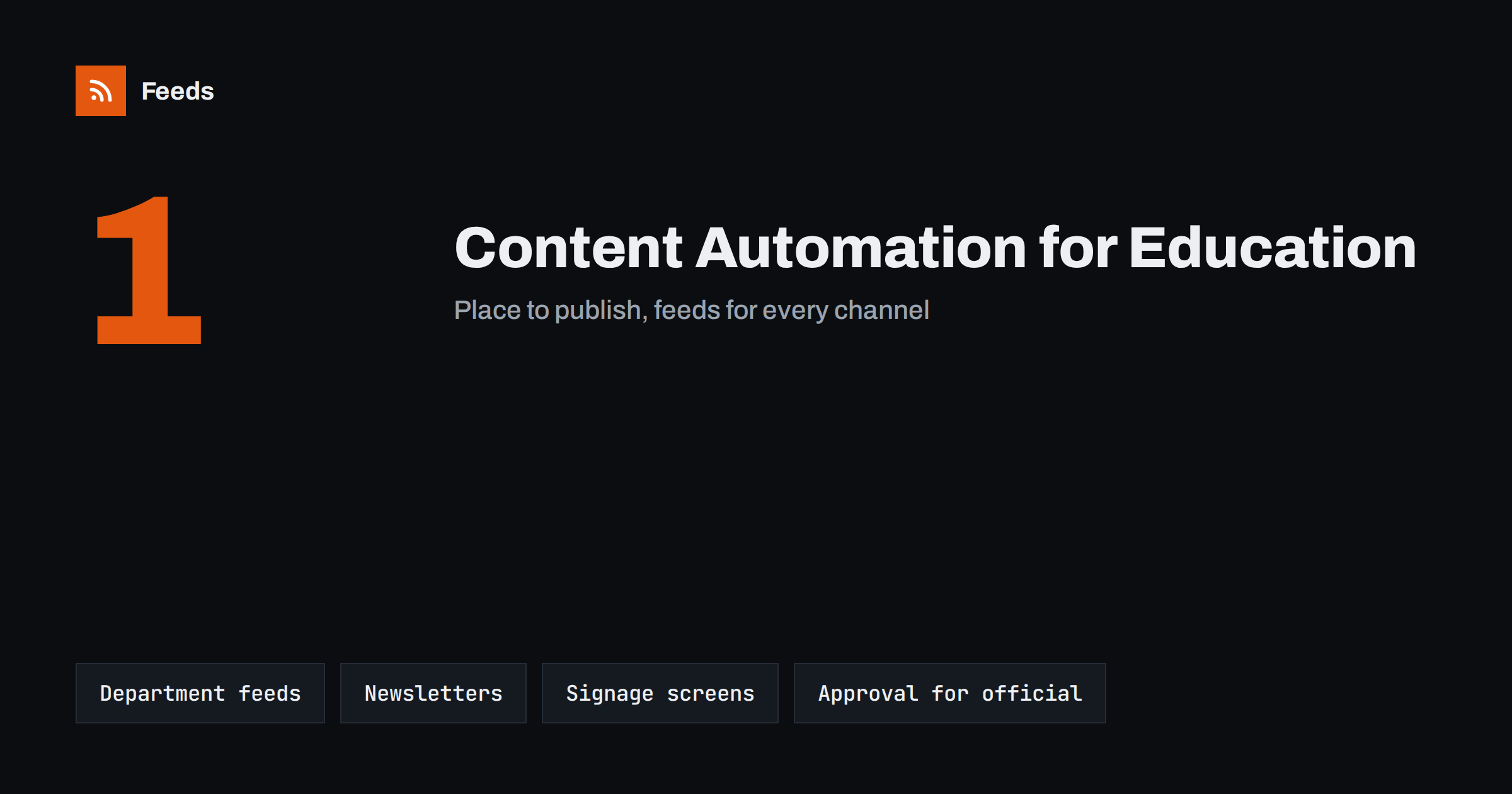
Short answer: Educational institutions publish a steady flow of news, events, vacancies and research from many departments, which makes them ideal for feed-based content automation. Publish everything once on the website, give each department and content type its own feed, and let those feeds drive social accounts, newsletters for parents or alumni, intranet pages and digital screens. Keep an approval step for official accounts, never automate emergency messages, and be careful with pupils’ names and photos.
Why education is a natural fit for automation
A school, college or university is really dozens of publishers under one name. Faculties, departments, libraries, sports clubs, admissions, research groups and student services all produce content, and each has an audience that wants to hear about it: pupils, students, parents, staff, alumni, partners, funders and the local community.
The communications team rarely has time to copy each item to every channel by hand. The result is familiar: a website that is up to date, social accounts that are not, a newsletter assembled at the last minute, and a screen in the entrance hall still showing last month’s events. Automation fixes the repetitive part, so the team can spend its time on writing and on the stories that deserve extra attention.
What content institutions typically automate
- News stories from the central newsroom and from departments, shared to the matching social accounts and newsletters.
- Events such as open days, lectures, concerts and sports fixtures. Calendar pages can be followed as feeds; see turning event calendars into RSS feeds.
- Job vacancies for academic and support staff, shared on social networks and professional channels, as described in sharing job openings automatically.
- Research outputs, such as new publications and project news, for researchers’ profiles and research newsletters.
- Library and IT service notices for staff and student portals.
- Admissions updates such as application deadlines and open day announcements, for prospective students and parents.
Start with the content that is published most often and reaches the widest audience, usually news and events. Vacancies and research outputs follow naturally once the pattern works. Service notices are useful but tend to be internal, so they belong in a separate internal track from the start.
The architecture: publish once, feed everywhere
The most robust setup treats the website as the single place where content is published, and uses feeds to carry it everywhere else:
- Publish on the website first. Every news item, event and vacancy gets a page. This keeps one authoritative version and gives every channel a link to point to.
- Create feeds by department and type. Most content management systems can produce a feed per category or section. Where they cannot, feeds can be created from the listing pages. Following one section of a website explains the approach.
- Connect each feed to its channels. The engineering news feed goes to the engineering faculty’s social accounts, the sports feed to the sports club’s channels, the vacancies feed to careers channels.
- Merge for central channels. The main institutional accounts and newsletters can receive a merged, filtered feed of the most important items.
Naming matters more than it seems. Agree a consistent set of categories across departments, such as “news”, “events” and “vacancies”, instead of letting each department invent its own. Consistent categories produce consistent feeds, and consistent feeds are much easier to connect, document and hand over when staff change.
This structure also makes it easy to add channels later. A new department account simply subscribes to its existing feed.
Channels that work well with feeds
| Channel | Typical feed | Tip |
|---|---|---|
| Department social accounts | Department news and events | One template per network, modest frequency |
| Parent or alumni newsletter | Merged weekly selection | Automated digest with a short written intro |
| Staff intranet or portal | Service notices, internal news | Keep internal-only items off public channels |
| Digital signage screens | Today’s and this week’s events | Many signage systems can display RSS; keep titles short |
| Team chat channels | Research news, vacancies | One channel per audience, not one for everything |
For newsletters, the guide to turning an RSS feed into an automatic newsletter shows how to set up a weekly digest. For staff-facing content, automating an internal news feed applies directly to universities and school groups.
Governance: who can publish what
Institutions carry reputational and legal responsibilities that a small company does not. Automation needs rules that reflect this:
- Approval for official accounts. The main institutional accounts usually benefit from an approval queue, while department accounts can often run fully automatically. The trade-offs are explained in full auto versus an approval queue.
- Company-owned access. Social accounts should be owned by the institution, not by a staff member’s personal login, so automations survive staff changes.
- Clear ownership per feed. Every department feed needs a named person responsible for what is published in it.
- Frequency limits. Busy periods such as graduation or results day can produce a flood of items. Limit how many posts go out per hour on each account.
It also helps to write templates per audience rather than per department. A post for prospective students reads differently from one for researchers or parents, and templates are the place to set that tone once instead of rewriting every post.
Privacy, safeguarding and accessibility
Automation copies content quickly and widely, which makes getting the source right even more important in education:
- Pupils’ names and photos. Schools usually need consent before publishing identifiable images or names of children, and many have strict policies. Make sure items that fail this check never reach the feed, because an automated post may be shared before anyone notices.
- Internal information. Staff notices, exam arrangements and internal events should sit in separate categories whose feeds only go to internal channels.
- Alt text and captions. Add image descriptions on the website. Some posting tools can carry them to social networks, and your website stays accessible regardless.
- Emergency communication. Closures, safety incidents and crisis messages should always be sent manually through dedicated channels, never through automated feed posting with its delays and templates.
Monitoring the outside world
Feeds work in both directions. The same tools that distribute your content can bring relevant information in:
- Education ministry and regulator announcements, following the method in tracking government and regulator updates.
- Funding calls and grant announcements for research offices and school leaders; see tracking grant and funding announcements.
- News mentioning the institution in local and national media, useful for press offices.
- Partner institutions’ news pages, for collaboration and shared announcements.
Routing these into a team channel or a daily digest keeps leadership and communications staff informed without extra reading.
Getting started in a month
- Week 1: list your content types, departments and channels, and find out which feeds your website already produces.
- Week 2: create the missing feeds and agree who owns each one.
- Week 3: connect two or three departments as a pilot, with templates and frequency limits.
- Week 4: review the first posts, adjust templates and approval rules, then roll out to other departments.
Decide in advance how you will judge the pilot. Useful measures include how many hours per week the team saves on copying content, whether department accounts post more regularly than before, and how many visits the automated posts and newsletters bring to the website. Tagging links with UTM parameters per channel makes the last one easy to measure.
Expect small adjustments in the first weeks: a template that is too long for one network, a category that mixes internal and public items, or a department that publishes more than its followers want. These are normal and quick to fix once you can see real posts.
How Feeds helps
Many institutional websites have listing pages without feeds: department news, events calendars, vacancy boards or partner pages. Feeds turns such pages into clean RSS feeds with titles, images, summaries and dates, uses existing feeds where they exist, merges several sources and filters by keywords, all without plugins or code on the source website. The feed links then work in any posting, newsletter, signage or chat tool. Plans for publishers are on the pricing page.
Related reading
- Content automation for nonprofits and community groups
- Content automation checklist: 30 checks before you go live
- Automating multilingual content distribution with feeds
The bottom line
Schools, colleges and universities publish more than their communications teams can distribute by hand. Publish everything on the website, create a feed per department and content type, and let those feeds drive social accounts, newsletters, intranets and screens. Protect official accounts with approval steps, keep internal and sensitive content out of public feeds, and handle emergencies manually. The result is consistent communication with far less copy and paste.
KKK
What can schools and universities automate in their communications?
Sharing news, events, vacancies and research updates from the website to social accounts, newsletters, intranets, team channels and digital screens. Writing, approval of official messages and emergency communication should remain manual.
How do we automate social media for many departments?
Give each department its own feed, usually from a news category on the website, and connect it to that department’s accounts. Merge the most important items into a feed for the central institutional accounts.
Can digital signage show our events automatically?
Many digital signage systems can display RSS feeds. Create a feed of upcoming events and keep titles short so they are readable on screen.
Is it safe to automate posts that include pupils?
Only if your consent and safeguarding checks happen before content is published on the website. Automated posting spreads content quickly, so make sure items without consent never enter a public feed.
Should emergency messages be automated?
No. Closures and safety messages should be sent manually through dedicated channels, where timing and wording are fully controlled.