ENEnglish
 LTLietuviškai
 DEDeutsch
 FRFrançais
 RUРусский
 ESEspañol
 PLPolski
 ITItaliano
 UKУкраїнська
 CSČeština
 PTPortuguês
 JA日本語
JA日本語 LVLatviešu valoda
 ETEesti
 HUMagyar
 IDBahasa Indonesia
 TRTürkçe
 HIहिन्दी
 ELΕλληνικά
 ARالعربية
 THไทย
THไทย VITiếng Việt
 RORomână
 MSBahasa Melayu
 BNবাংলা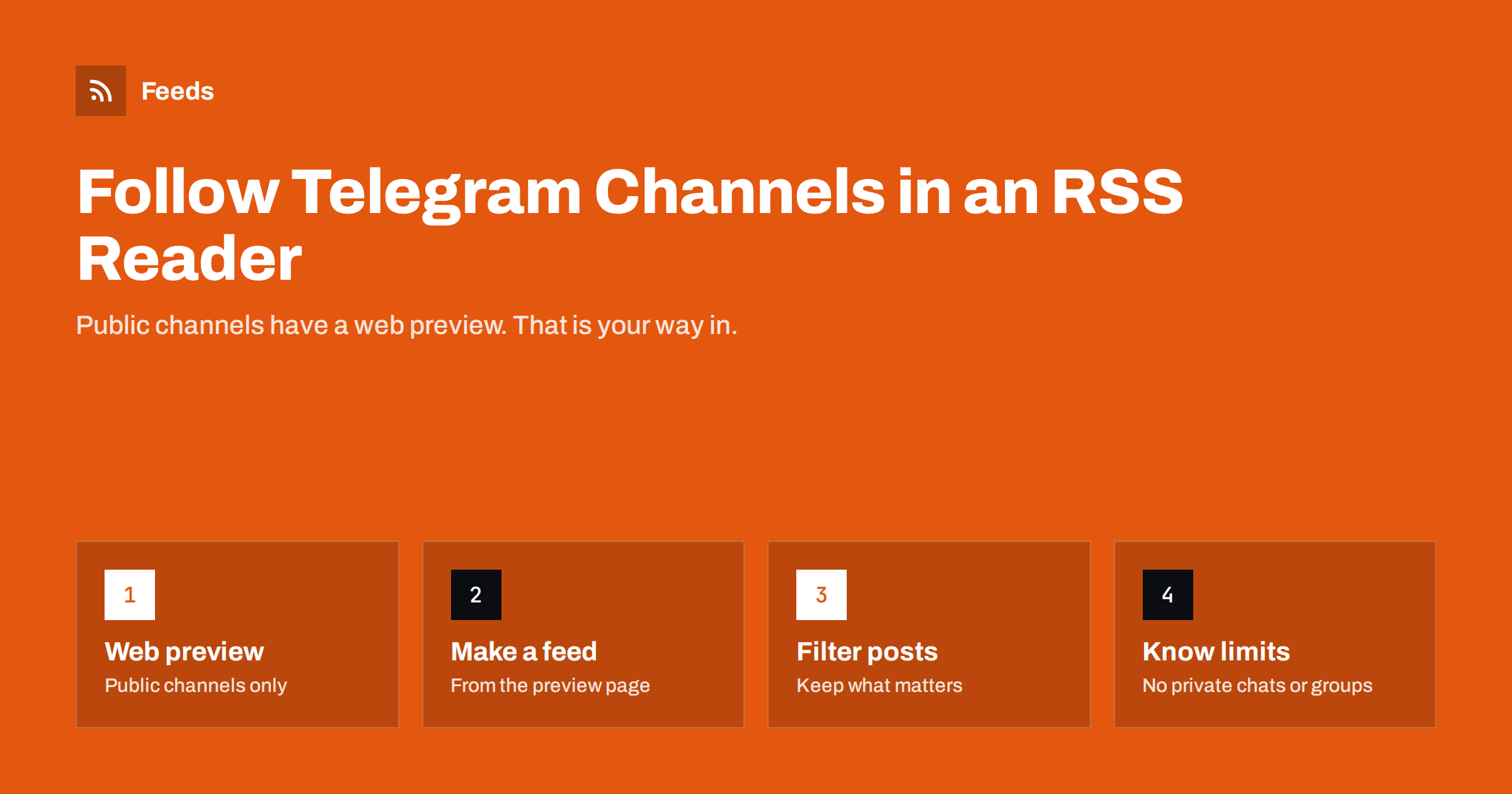
Short answer: Telegram does not publish RSS feeds, but every public channel has a web preview page at t.me/s/ followed by the channel name. That page lists the channel’s recent posts, and a page-to-feed tool or an open-source feed bridge can turn it into an RSS feed you can add to any reader. It works only for public channels, not for private channels, groups or chats, and media such as long videos usually appear as links rather than playable files.
Why follow Telegram channels outside Telegram
Telegram channels have become an important publishing channel for news outlets, companies, public bodies, developers and communities, especially in some regions and industries. Yet many people who need the information do not want another app full of notifications, or they want Telegram updates next to their other sources.
Following channels in an RSS reader brings several practical benefits:
- One place for all sources. Channel posts sit next to blogs, news sites and alerts instead of in a separate app.
- Your own pace. A reader lets you skim a day’s posts at once, rather than reacting to every notification.
- Filtering. You can keep only posts that mention your keywords, which is hard to do inside Telegram.
- Sharing and automation. A feed can be forwarded to a team chat, an email digest or an archive.
- No account needed for public channels, which is useful for research and monitoring.
The same logic applies to other platforms that do not offer feeds on their own. Our guide to following Mastodon and Bluesky accounts in an RSS reader covers two networks where the situation is easier, because they publish feeds natively.
How the public web preview works
When a Telegram channel is public, it has a username, and anyone can open https://t.me/s/channelname in a normal browser. This preview page shows the most recent posts with their text, images, link previews, view counts and dates, and loads older posts as you scroll. No login is required.
That page is the key. Because it is a normal public web page with a list of posts, each with its own date and permanent link, it can be read by the same techniques that create feeds from news pages and blogs. Each post has a stable address in the form t.me/channelname/1234, which makes a good link and unique identifier for a feed item.
A few things to check first:
- Is the channel public? If
t.me/s/channelnameredirects to an invitation page or shows nothing, the channel is private or has disabled the preview. - Is it a channel or a group? Groups are conversations, not publications, and are not suited to feeds.
- How active is it? Very busy channels may post dozens of times a day, which affects how often the feed needs to refresh.
Option 1: a page-to-feed tool
A page-to-feed tool reads a web page, finds the repeating list of items and turns it into RSS. Paste the preview address, check that the tool detected the posts correctly, and subscribe to the feed it gives you.
- Open
https://t.me/s/channelnameand confirm the posts you expect are visible. - Paste that address into the page-to-feed tool.
- Look at the preview: each item should be one post, with its text as the title or summary, the post link and the date.
- Add the resulting feed URL to your RSS reader.
Telegram posts have no headlines, so the tool will typically use the first words of the post as the title. That is normal and works well in most readers. If you want to understand what happens under the hood, see how page-to-feed tools find the items on a web page.
Option 2: an open-source feed bridge
Several open-source projects act as bridges that generate RSS feeds for sites and platforms without them. RSSHub is a well-known example and includes a route for public Telegram channels. You can use a public instance or host your own.
| Approach | Effort | Strengths | Watch out for |
|---|---|---|---|
| Page-to-feed service | Low | No setup, preview before use, filtering and merging | Depends on the preview page staying public |
| Public bridge instance | Low | Free, many platforms supported | Shared instances can be rate-limited or unavailable |
| Self-hosted bridge | High | Full control, no third party | You maintain it, update it and fix breakages |
| Telegram bot or API script | High | Can read what your account can see | Development work, must respect Telegram’s terms |
For most people who just want to read a few channels, a page-to-feed service or a public bridge is enough. Self-hosting makes sense for developers who already run their own tools.
What the resulting feed will and will not contain
Be realistic about what a feed built from the preview can show.
- Text: usually complete for normal posts. Very long posts may be shortened on the preview page.
- Images: often included as the item image or inside the description.
- Videos, voice messages and files: usually appear as a link to the post rather than as playable media.
- Polls, reactions and comments: generally not included.
- Edits: if a post is edited after the feed picked it up, many readers will keep the original version.
- Deleted posts: may stay in your reader even after they disappear from the channel.
For following news and announcements, this is almost always enough: you see the text, click through for anything else, and never miss a post.
Filtering busy channels
Some channels post constantly: news aggregators, trading and crypto channels, deal channels. Following them unfiltered turns your reader into another noisy app. Keyword filtering fixes this.
- Include words: keep only posts that mention your company, product, city or topic.
- Exclude words: drop posts containing words like “giveaway”, “promo” or “ad”.
- Merge related channels: combine several channels on the same subject into one feed, with duplicates removed when they repost each other.
- Use a separate folder: keep Telegram-based feeds apart from sources you read fully.
Our guide to organising your RSS reader so it never overwhelms you has more ideas for keeping busy sources under control.
Using channel feeds in a team workflow
Once a channel is available as a feed, it can travel beyond your personal reader. A few common setups:
- Team chat alerts. Send a filtered channel feed to a Slack, Teams or Discord channel, so colleagues see relevant posts without joining Telegram.
- Daily email digest. Many email tools can turn a feed into a scheduled digest, which suits slower channels such as official announcements.
- Research archive. Save items to a spreadsheet or database to keep a searchable record of what a channel published and when.
- Monitoring dashboards. Journalists and analysts often combine channel feeds with news sites and official sources on one screen.
In each case, share the post link and a short excerpt rather than copying entire posts, and label the source clearly so readers know the information came from a Telegram channel rather than an official website.
Respect the source
Reading a public channel in your own reader is similar to visiting its public page. Republishing its posts elsewhere is a different matter: the text, photos and videos belong to their authors, and copying them to your own website or channel generally needs permission. If you use channel feeds for automation, forward links and short excerpts to your team rather than republishing content publicly. Our article on the legal side of creating feeds from other websites discusses this in more detail.
Also remember that channels can change their settings. A channel that goes private or disables its preview will stop updating your feed. If a feed suddenly goes quiet, open the preview page in a browser before assuming the channel stopped posting.
How Feeds handles this
Feeds creates RSS feeds from public web pages that have none, and shows a preview of the items it found before anything is created, so you can see immediately whether a channel’s public preview page gives you usable posts. It can also merge several sources into one feed, keep only items with (or without) your words, and remove duplicates. Paid plans refresh more often and send an alert if a feed stops finding items, which is useful when a channel changes its settings. You can try it on one website on the free plan.
Related reading
- How to Create an RSS Feed for a Website Without RSS
- How to Set Up Keyword Alerts Using RSS Feed Filters
- How to Choose an RSS Reader: Features That Actually Matter
The bottom line
You can follow public Telegram channels in any RSS reader by turning the channel’s t.me/s/ web preview into a feed, either with a page-to-feed tool or an open-source bridge. Expect full text and usually images, but links rather than videos. Filter busy channels by keyword, merge related ones, and remember it only works while the channel stays public.
KKK
Does Telegram have RSS feeds?
No, Telegram does not publish RSS feeds for channels. Public channels do have a web preview page, which can be turned into a feed with a page-to-feed tool or an open-source bridge.
Can I follow a private Telegram channel with RSS?
Not through the web preview, because private channels do not have one. Reading private channels would require your own account and the Telegram API, and should only be done within Telegram’s terms.
Do I need a Telegram account to follow a channel by RSS?
No. The web preview of a public channel is visible without logging in, so a feed built from it works without an account.
Why does my Telegram feed show no videos?
The preview page usually shows videos as embedded players or thumbnails, which feeds typically turn into links. Open the post link to watch the video in a browser or the app.
How often will a Telegram channel feed update?
That depends on how often the tool refreshes the feed and how often your reader checks it. For busy channels, choose a shorter refresh interval so you do not miss posts that scroll off the preview page.