ENEnglish
 LTLietuviškai
 DEDeutsch
 FRFrançais
 RUРусский
 ESEspañol
 PLPolski
 ITItaliano
 UKУкраїнська
 CSČeština
 PTPortuguês
 JA日本語
JA日本語 LVLatviešu valoda
 ETEesti
 HUMagyar
 IDBahasa Indonesia
 TRTürkçe
 HIहिन्दी
 ELΕλληνικά
 ARالعربية
 THไทย
THไทย VITiếng Việt
 RORomână
 MSBahasa Melayu
 BNবাংলা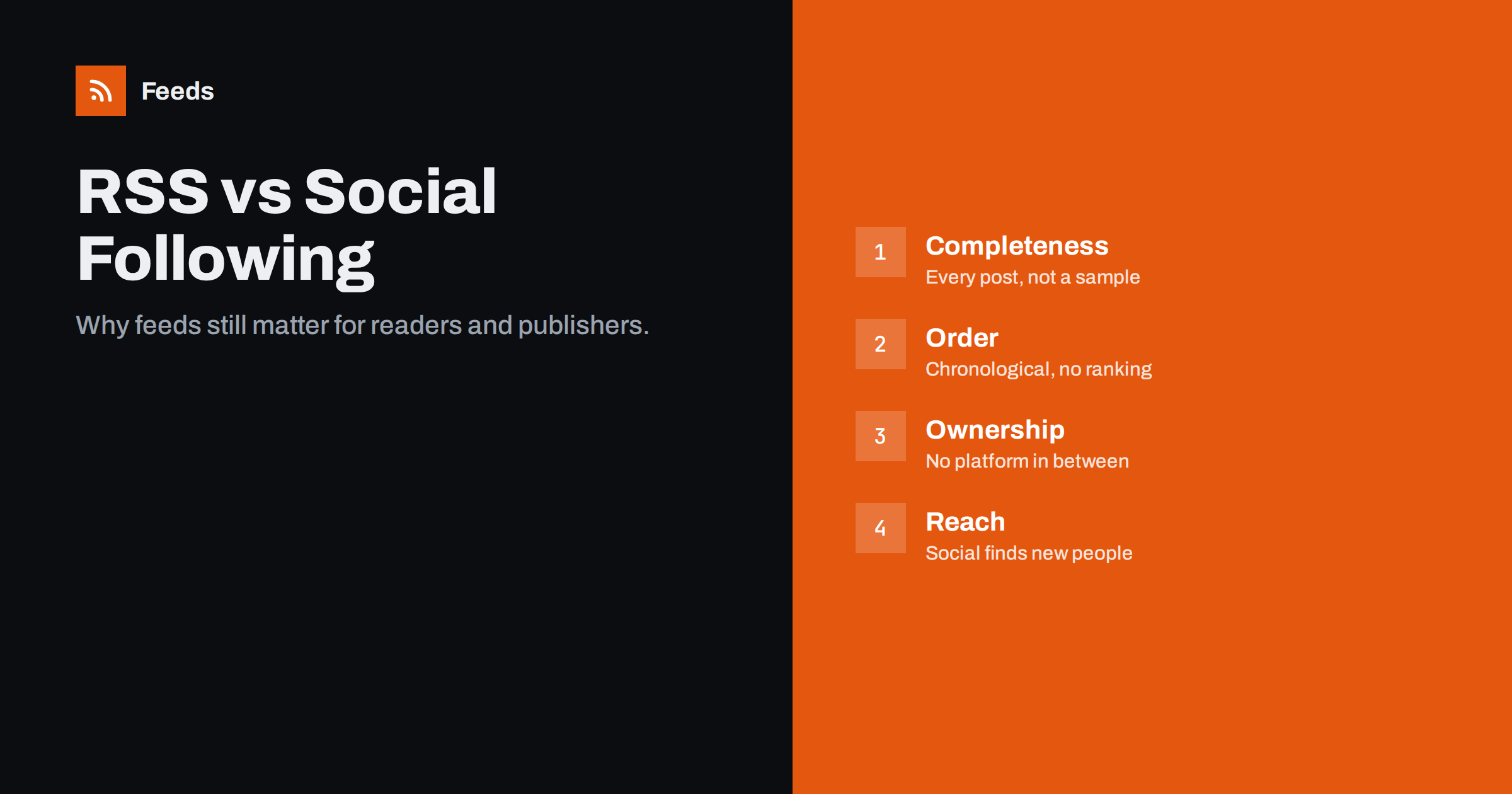
Short answer: Following a site on social media means seeing some of its posts, when an algorithm decides to show them, mixed with everything else. Following it with RSS means receiving every post, in chronological order, in an app you choose, with no account and no ranking. Social media is better for discovery and conversation; RSS is better for reliably keeping up. Publishers benefit from offering both, with the feed as the dependable channel they control.
“Just follow us on social media” has become the default answer to “how do I keep up with your site?”. It is convenient: most people already have accounts, and a follow button is one click. But anyone who has followed a favourite blog or a company page on a social network knows the result: some posts appear, many do not, and the ones that do are surrounded by other content competing for attention. RSS offers a different deal. This article compares the two honestly, from the reader’s and the publisher’s point of view.
How each works for the reader
Social following adds a source to a mixed stream. The platform decides which of that source’s posts you see, in what order and next to what. The decision depends on engagement signals, your past behaviour, the platform’s business priorities and constant experimentation. Following is a signal of interest, not a guarantee of delivery.
RSS adds a source to your reader. Every new item from the feed appears, in order, for as long as you stay subscribed. Nothing is inserted between items by the source’s platform, and nobody else decides what you miss. You organise sources into folders and read at your own pace.
Side-by-side comparison
| Factor | Social following | RSS |
|---|---|---|
| Completeness | A selection chosen by the platform | Every item in the feed |
| Order | Ranked by algorithm | Chronological |
| Account needed | Yes, on each platform | No, for public feeds |
| Privacy | Activity tracked by the platform | Minimal; sources do not know who you are |
| Discovery of new sources | Strong: shares, recommendations | Weak: you find sources yourself |
| Conversation | Built in: replies, likes, shares | Separate: on the site or elsewhere |
| Durability | Depends on platform rules and existence | Works as long as the site publishes a feed |
| Automation | Limited, platform-controlled APIs | Any tool can read a feed |
What social media does better
A fair comparison acknowledges social media’s strengths:
- Discovery. People find new sources through shares, recommendations and conversations. RSS has no equivalent at scale.
- Conversation. Replies, comments and community discussion happen naturally on social platforms.
- Reach beyond followers. A post can travel far beyond the people who already know you.
- Familiarity. Most people already use social apps daily; feed readers are a niche.
- Rich formats. Short video, stories, live streams and polls are built for social platforms.
For a publisher trying to reach new people, social media is usually essential.
What RSS does better
- Reliability. Everything you publish reaches every subscriber’s reader. No reach decline, no pay-to-reach.
- Respect for attention. Readers choose what to read and when, without engagement tricks.
- Independence. The feed lives on your domain. A platform changing its rules, restricting links or closing cannot take it away.
- Privacy. Readers can follow without creating accounts or being profiled.
- Machine-friendliness. Newsletter tools, social schedulers, partner portals and internal dashboards can all use the same feed.
- Longevity. RSS has worked the same way for over two decades.
How platform changes affect followers
Over the past decade, publishers have repeatedly seen the reach of their social posts change without warning. Platforms have reduced the visibility of posts containing links, prioritised video or content from friends over pages, introduced paid boosts to reach existing followers, restricted access to their APIs and, in some cases, lost large parts of their audience to newer networks. Each change altered how many followers actually saw a publisher’s posts, even though the follower count stayed the same.
A follower count on a social platform is therefore best understood as potential reach, not delivered reach. An RSS subscriber, by contrast, receives every item as long as the feed works and they remain subscribed. That difference is invisible on a normal day and very visible on the day a platform changes its rules.
The publisher’s view: rented reach vs owned channels
Marketers often distinguish between “rented” channels, such as social platforms, where someone else controls distribution, and “owned” channels, such as your website, email list and feed. Rented channels can be very effective, but their value can change overnight with an algorithm update, a policy change or a platform decline. Owned channels grow more slowly but stay yours.
A feed is an owned channel with an unusual advantage: it also powers the rented ones. Many social posting tools read your feed and publish each new post automatically, so a single clean feed can drive both your subscribers’ readers and your social profiles. It also feeds your newsletter tool and partners’ pages. Keeping it healthy is one of the most efficient things a publisher can do.
Common objections to RSS, answered
- “Nobody uses RSS any more.” Fewer people say they use it, but podcasts, newsletter tools, social schedulers, aggregators and many professionals rely on feeds every day. The audience is quieter, not gone.
- “We cannot measure it.” Not precisely, but reader-reported subscriber counts, UTM-tagged links and the tools connected to the feed give a useful picture.
- “Full-text feeds invite copying.” Scrapers can copy web pages too. An attribution line with a link back in every item protects you better than removing the feed.
- “It is extra work.” Most platforms publish a feed automatically. The work is a one-time check of titles, excerpts and images, which also improves your social and email output.
- “Social media is where our audience is.” Probably true for discovery. The feed is not a replacement; it is the dependable channel underneath, and it can feed your social posting as well.
Offering both to your audience
Readers differ. Some will only ever follow you on a social platform; others avoid social media and want RSS; many use email. Make every option easy:
- Publish a clean feed with good titles, excerpts and images, advertised with autodiscovery on every page.
- Show follow options together: social profiles, newsletter signup and an RSS link, on a single “Follow” or “Subscribe” page.
- Use the feed to automate social posting, so social followers see every new post without extra work, and spend your manual effort on conversation.
- Check that open social profiles have feeds, too: Mastodon and Bluesky offer RSS for public profiles, so people can follow your social posts in a reader.
For readers: a balanced setup
If you have relied on social media to follow sites for years, switching everything at once is unnecessary. Start with the five or ten sources you would genuinely hate to miss, and follow them in a reader for a month. Most people notice quickly how many posts they had never seen in their social timelines.
You do not have to choose one or the other. A practical approach many people find calmer:
- Follow the sources you truly care about with RSS, so you never miss them.
- Use social media for discovery, conversation and serendipity, without relying on it to deliver important updates.
- When you discover a great source on social media, check whether it has a feed and add it to your reader.
- For sources that have no feed, use a tool that creates one from their news page.
Our tool, Feeds, handles that last case: it turns a public page listing articles into an RSS feed, uses the site’s own feed when one exists, and can merge several sources into one filtered feed. You see a preview before creating anything, and the free plan lets you try it on one website. See the plans.
Related reading
- RSS vs Email Newsletters: How Should Readers Follow You?
- How to Follow Mastodon and Bluesky Accounts in an RSS Reader
- How to Automate Social Media Posts from an RSS Feed
- How to Subscribe to RSS Feeds: A Beginner’s Step-by-Step Guide
The bottom line
Social media is excellent for discovery and conversation but unreliable for keeping up, because algorithms decide what followers see. RSS delivers every post, in order, without accounts or ranking, and it lives on the publisher’s own domain. Readers get the best of both by following key sources in a reader and using social media to discover new ones. Publishers get the best of both by keeping a clean feed and letting it power their social posting too.
KKK
Is RSS better than following on social media?
For reliably keeping up with specific sources, yes: RSS shows every post in order. For discovering new sources and joining conversations, social media is better. Many people use both.
Why don’t I see all posts from pages I follow on social media?
Social platforms rank and filter posts using algorithms. Following a page tells the platform you are interested, but it does not guarantee that every post appears in your feed.
Do I need an account to follow a site with RSS?
No. Public feeds can be read by any feed reader without an account on the site. Some readers ask you to create an account with the reader itself, mainly for syncing.
Should publishers still offer RSS if most readers use social media?
Yes. The feed costs almost nothing, serves readers who prefer it, and powers newsletters, social posting tools and partner integrations. It is an owned channel that no platform can take away.
Can I follow social media accounts through RSS?
Some platforms support it. Mastodon and Bluesky offer RSS feeds for public profiles, and YouTube offers feeds for channels. Other platforms generally do not.