ENEnglish
 LTLietuviškai
 DEDeutsch
 FRFrançais
 RUРусский
 ESEspañol
 PLPolski
 ITItaliano
 UKУкраїнська
 CSČeština
 PTPortuguês
 JA日本語
JA日本語 LVLatviešu valoda
 ETEesti
 HUMagyar
 IDBahasa Indonesia
 TRTürkçe
 HIहिन्दी
 ELΕλληνικά
 ARالعربية
 THไทย
THไทย VITiếng Việt
 RORomână
 MSBahasa Melayu
 BNবাংলা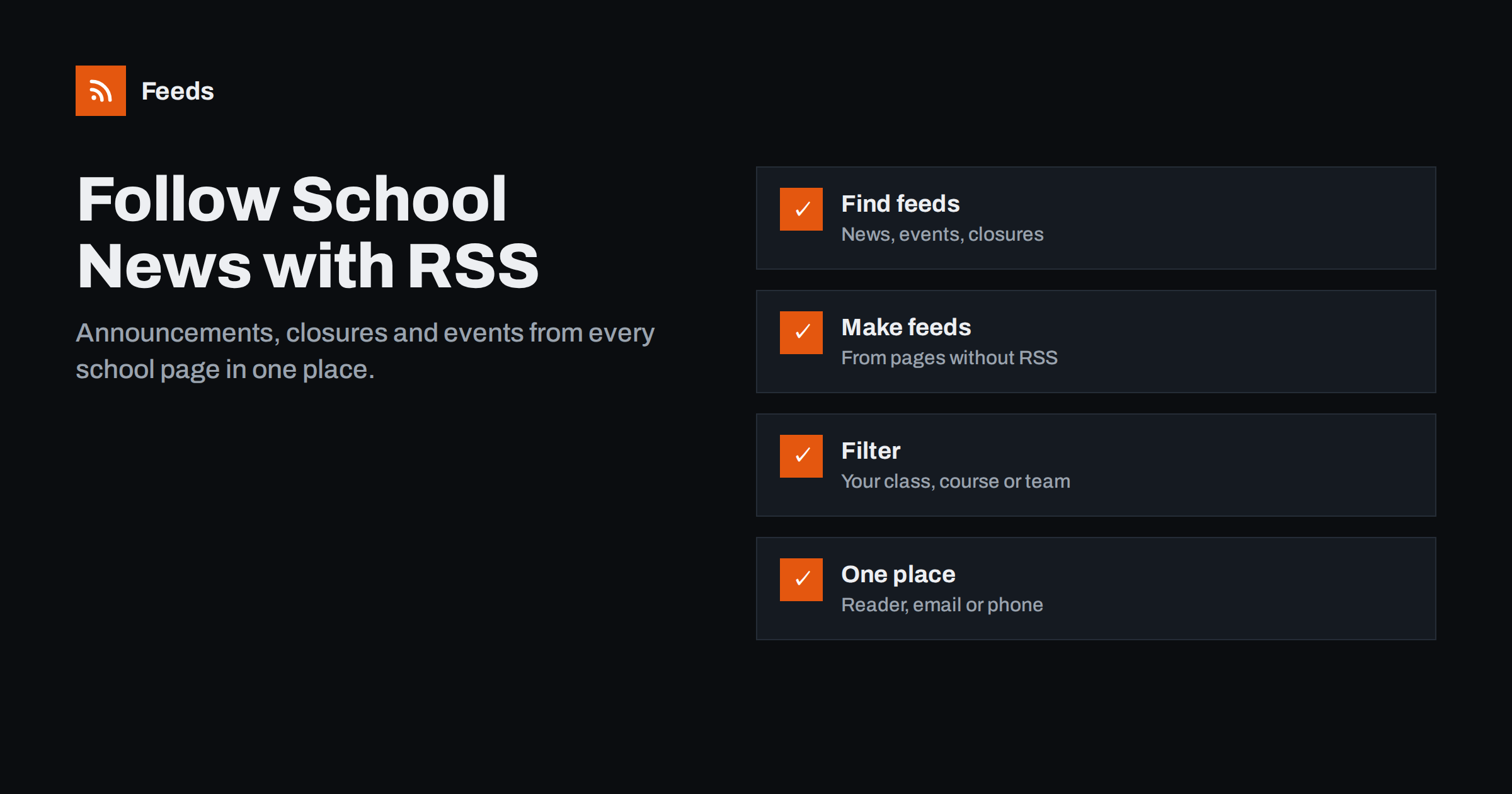
Short answer: Parents and students can follow school news with RSS by collecting the announcement, news and events pages of every school, university department and club they care about, subscribing to feeds where they exist and turning the other pages into feeds. Merge them into one feed or a reader folder, filter by class, year group, course or team names, and get the result in an RSS reader, a daily email or phone notifications. That way important notices, such as closures, schedule changes and deadlines, are not lost among dozens of emails and apps.
The problem: school information is everywhere
A typical family with two or three children receives school information from many directions: the school website, a messaging app, emails from teachers, a sports club site, a music school, the local education authority and perhaps a university for an older child. Students face the same problem with course pages, department news, student union announcements and scholarship notices.
The result is familiar: a notice about an early closure is posted on the website but not emailed, a club changes its training time on its news page, or a university department announces a deadline in a place nobody checks. Missing these is rarely anyone’s fault. There are simply too many places to watch.
RSS offers a calm solution. Each source becomes a feed; all feeds arrive in one place; and you check that place when it suits you, instead of visiting every website in turn.
Step 1: list your sources
Start with a short inventory. For each child or course, write down the web pages where announcements appear:
- School or university news page: general announcements, closures and achievements.
- Events or calendar page: parent evenings, exams, trips and holidays.
- Class, year group or department pages: often the most relevant and the least visited.
- Clubs and activities: sports teams, music schools, scouts, tutoring centres.
- Local authority or education office: closures due to weather, strikes or emergencies, and admission deadlines.
- Canteen or transport pages: menu changes, bus route changes.
You do not need every page. Choose the ones where information you would act on actually appears.
A useful test is to look back at the last few things your family missed or learned about too late. Where were they published? Those pages belong at the top of your list, even if they look minor.
Step 2: look for existing feeds
Many school and university websites are built on content management systems that publish RSS feeds automatically, even if there is no RSS icon on the page. Try these checks:
- Paste the news page address into an RSS reader. Many readers find a feed automatically if the page declares one.
- Look for an RSS link near the news list or in the page footer.
- For sites built with common systems, try adding
/feed/to the news page address. - Check the events page too: some calendar systems offer RSS or calendar subscription links.
If you need a refresher on subscribing, our guide on how to subscribe to RSS feeds walks through it step by step. For calendars, see how to turn event calendars into feeds.
Step 3: turn pages without RSS into feeds
Many school pages have no feed at all: a simple list of notices, a class page, a club’s “latest news” section. As long as each announcement has a title and its own link or clear date, a page-to-feed tool can turn the page into a feed. Paste the address, check the preview of detected items and subscribe to the result.
A few limitations to know:
- Pages behind a login, such as a school portal or learning platform, cannot be read from the outside. Use the platform’s own notifications for those.
- Documents, such as newsletters published as PDFs, can often be followed if they are listed on a page with links.
- Notices that are edited in place rather than added as new items may not appear as new.
Our guide to creating a feed for a website without RSS explains the options in more detail.
Step 4: filter for what concerns you
A large school or university publishes a lot that does not concern your family. Keyword filters help:
- Include words: your child’s class or year group, course codes, team names, “closure”, “cancelled”, “deadline”, “exam”, “trip”.
- Exclude words: topics that never concern you, such as other year groups or alumni news.
- Keep an unfiltered emergency source: closures and safety notices should never be filtered out. Follow the closure page or the local authority separately.
Test filters for a few weeks and adjust. Schools do not always use the same words, and a filter that is too strict can hide something important. Our guide to setting up keyword alerts with RSS filters has more tips.
Step 5: choose where to read
| Option | Best for | Tip |
|---|---|---|
| RSS reader app | Parents and students comfortable checking an app | One folder per child or course |
| Daily email digest | Parents who prefer email | One summary a day instead of many messages |
| Phone notifications | Urgent sources like closures | Only for filtered, high-priority feeds |
| Family chat channel | Families sharing school logistics | Both parents see the same notices |
Keep urgent and routine information separate. A closure notice deserves a notification; a report about the school choir can wait for the weekly read.
It also helps to agree on a routine within the family. For example, one parent checks the school folder every evening during term, while the other gets only the urgent feed on their phone. Older children can have their own folder for their clubs and courses, which teaches them to keep track of deadlines themselves. At the start of each school year, spend fifteen minutes updating the list: new class pages, new clubs, a new school for a younger child, and sources that no longer matter.
For students: university and course information
University students have their own version of the problem. Department news, course announcements, library notices, student union events, internship and job boards, scholarship pages and exchange programmes all publish updates in different places.
- Follow the department and faculty news pages, filtered by your course or programme name.
- Follow scholarship, exchange and internship pages with a filter for your field of study.
- Follow the careers or job board if it has a public listing page; our guide to RSS feeds for job listings applies here.
- Use the learning platform’s own notifications for course materials behind a login.
A reader folder per semester, cleared out at the end of term, keeps things manageable.
A note for schools and clubs
If you run a school, club or department website, you can make all of this much easier by publishing a clear news page with a feed. Put each announcement on its own page with a date, keep closures and urgent notices in a dedicated category with its own feed, and mention the feed on your website. Parents who prefer email or apps lose nothing; those who use RSS gain a reliable channel that does not depend on anyone’s inbox or social media feed.
A few more details make a real difference for families: use clear titles that say what the notice is about (“Year 5 trip moved to Friday” rather than “Update”), always include the date the notice applies to, and avoid publishing important information only as an image or a PDF attachment without text on the page. Keep old notices in an archive rather than deleting them, so links shared in messages continue to work. These habits also help parents who use translation tools, screen readers or search to find information.
How Feeds can help
Feeds creates RSS feeds from public web pages that have none, such as school news pages and club announcement lists, and shows you a preview of the items it found before anything is created. It can merge several sources into one feed, keep only items with (or without) your words, and remove duplicates. Paid plans refresh more often and send an alert if a page changes its layout and a feed stops finding items. You can try it on one website for free; see the Feeds homepage.
Related reading
- Local News Monitoring: Follow Your Town’s Sources with RSS
- How to Organize Your RSS Reader So It Never Overwhelms You
- How to Follow Just One Section or Category of a Website
The bottom line
School information is spread across many websites, and RSS brings it together. List the pages where announcements appear, subscribe to existing feeds, turn the rest into feeds, filter by class, course or team while keeping closure notices unfiltered, and read everything in one place. It takes an evening to set up and saves many missed notices over a school year.
KKK
Do school websites have RSS feeds?
Many do, because common website systems publish feeds automatically. Try pasting the news page into an RSS reader or adding /feed/ to the address. If there is no feed, a page-to-feed tool can create one.
Can I follow a school portal or learning platform with RSS?
Usually not, because those pages require a login. Use the platform’s own notifications for private information, and RSS for public news and announcement pages.
How do I avoid missing school closure notices?
Follow the closure or urgent news page and the local authority’s announcements as separate feeds without keyword filters, and send them to phone notifications.
Can both parents get the same school updates?
Yes. Share the same feed with both parents in their readers, send it to a family chat channel, or set up a daily email digest to both addresses.
Is RSS useful for university students?
Yes. Department news, scholarships, exchange programmes, careers pages and student union events can all be followed in one reader, filtered by your course or field.