ENEnglish
 LTLietuviškai
 DEDeutsch
 FRFrançais
 RUРусский
 ESEspañol
 PLPolski
 ITItaliano
 UKУкраїнська
 CSČeština
 PTPortuguês
 JA日本語
JA日本語 LVLatviešu valoda
 ETEesti
 HUMagyar
 IDBahasa Indonesia
 TRTürkçe
 HIहिन्दी
 ELΕλληνικά
 ARالعربية
 THไทย
THไทย VITiếng Việt
 RORomână
 MSBahasa Melayu
 BNবাংলা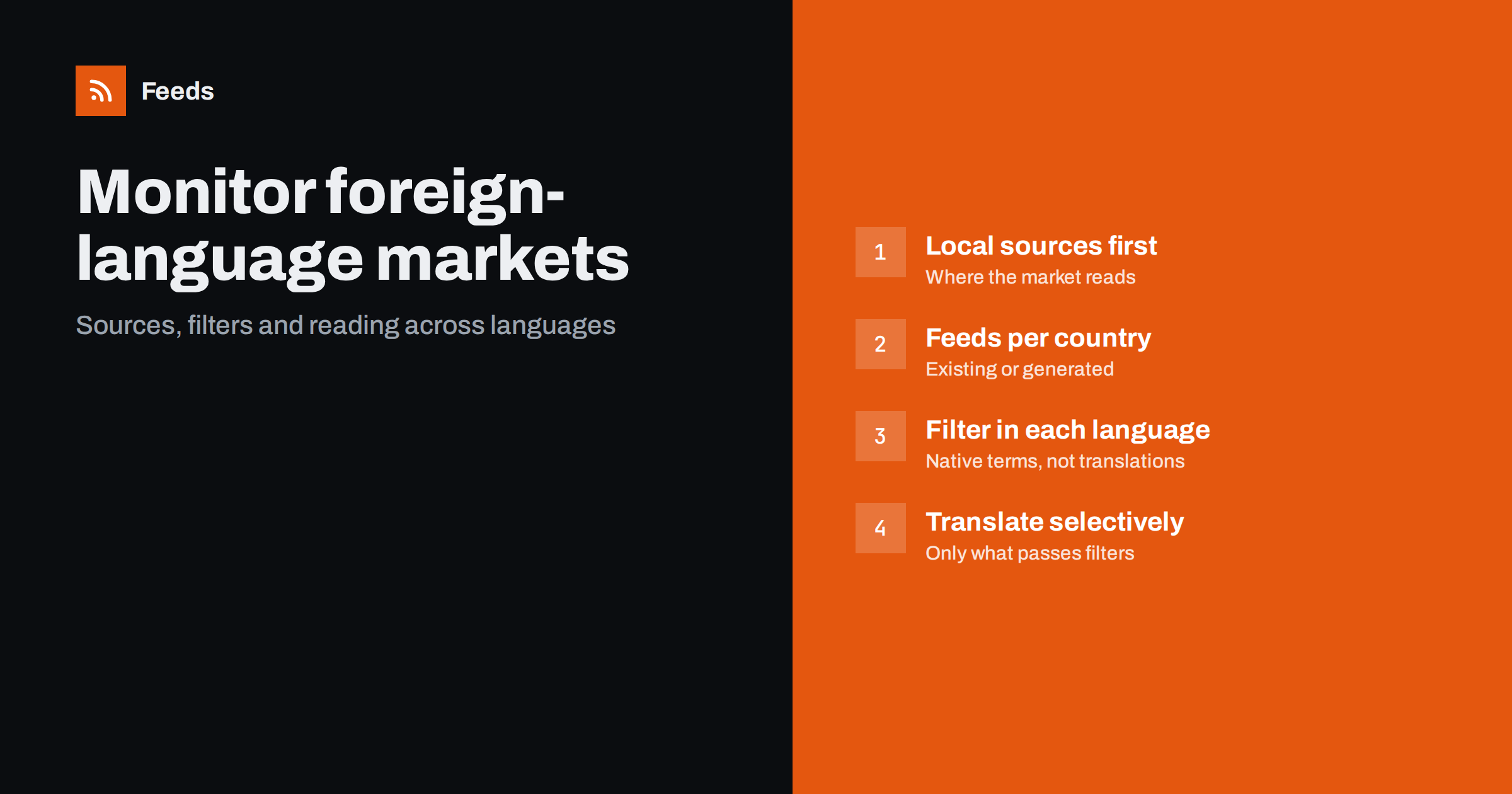
Short answer: Identify the sources that people in each target market actually read, such as local trade press, regulators, competitors and communities, in their language. Get a feed for each, generating feeds for the many local sites without RSS, and build one merged feed per country. Write filters using the terms native speakers use rather than direct translations of your English keywords, and translate only the items that pass the filters. Review each country feed with someone who knows the market whenever possible.
Companies that sell abroad, source from abroad or plan to expand need to know what is happening in markets whose language they may not speak. English-language coverage of those markets is usually thin, late and general. The useful information, such as a competitor’s launch, a regulatory change, a local trade fair or a shift in customer concerns, appears first in local sources, in the local language. Feeds make it practical to follow those sources systematically, and filters keep the volume manageable even when you cannot read everything.
The same approach works whether you follow one foreign market or ten. What changes is the number of feeds and owners, not the method. Start with the market that matters most, get it working well, and use it as the template for the next.
Why local-language sources matter
- Speed: local sources report local news first; international outlets pick up only the biggest stories, if at all.
- Detail: regulations, tenders, prices and customer complaints are discussed in detail only locally.
- Competitors: local competitors often publish only in their own language and never appear in English-language searches.
- Customer language: reading how customers describe problems and products helps with positioning, translation and support.
There is a practical benefit too: local-language sources are followed by fewer of your international competitors. Insight that is hard to get is insight that others probably do not have.
Step 1: Find the sources each market reads
For each country or language market, list sources in the same categories you would use at home:
| Category | How to find them |
|---|---|
| Trade publications | Ask local partners or distributors; check exhibitor lists of local trade fairs for media partners |
| Regulators and public bodies | The national regulator for your sector, customs and tax authorities, standards bodies |
| Competitors | Local search results for your product category in the local language |
| Communities | Local forums and Q&A sites where your customers ask questions |
| Business news | The business sections of the main national and regional news sites |
| Associations and chambers | Industry associations and bilateral chambers of commerce |
Local partners, distributors and employees are the best guides. Ask them which three sources they would read to stay informed about your sector; their answers are usually more valuable than hours of searching.
Also look for sources that cover a region rather than a single country. Some trade publications serve several countries in one language area, and regional bodies publish rules that apply across borders. One such source can replace several national ones, which keeps the setup smaller.
Step 2: Get feeds and build one feed per country
RSS availability varies a lot by country and type of site. News sites in some markets still publish section feeds widely; regulators and associations often do not. Check each source for an existing feed, and create feeds from list pages where none exists. Merge the feeds for each country into one country feed, so you can review one market at a time.
Check each preview carefully even if you cannot read the language fluently. The structure is what matters: each item should be one article, notice or product, with a headline and a link. Browser translation of the source page can help you confirm that the right list was detected. If you are unsure, ask your local contact to glance at a few items; it takes them a minute and saves you from following the wrong list for months.
Step 3: Write filters in the local language
Filters are where most multilingual monitoring goes wrong. A direct translation of your English keyword is often not the term local people use.
- Ask native speakers for the everyday and professional terms for your product category, including informal words and abbreviations.
- Look at competitors’ local websites to see which words they use for the same products.
- Include inflected forms. Many languages change word endings by grammatical case or number. Filters that match whole words may miss variants; use the forms that appear in real headlines or shorter stems if your tool matches parts of words.
- Keep brand and product names, which often stay the same across languages, as reliable filters.
- Consider accents and characters. Some sites drop diacritics in addresses or headlines. Include both spellings where it matters.
Test filters on a few weeks of real items with someone who reads the language, and adjust until the important items consistently pass.
Step 4: Read and translate selectively
You do not need to translate everything. Scan headlines, which browser or reader translation can render well enough to judge relevance, then fully translate only the items that matter. For important decisions, such as a regulatory change, a contract notice or a legal issue, have a fluent speaker confirm the meaning rather than relying on automatic translation alone.
Keep a short summary in your working language for each relevant item, with the original link. Over time, these summaries become an accessible record of the market for colleagues who do not read the language. They are also useful when you brief local partners, since they show what you already know and let the conversation focus on interpretation.
Step 5: Assign market owners
Each country feed needs an owner who reviews it on a schedule and passes relevant items to the right people. Ideally this is someone who knows the market: a local employee, partner or a colleague who speaks the language. If no such person exists, assign a central owner and agree on a regular review with a local contact for items that need interpretation. Make the schedule explicit, such as a monthly call, so the review does not depend on anyone remembering.
A worked example
A Scandinavian maker of outdoor furniture decides to test the German and Polish markets. Its export manager speaks German but not Polish. With help from a German distributor and a Polish sales agent, she lists about fifteen sources per country: two garden and furniture trade publications, the product safety authority, the national furniture association, the news pages of four local competitors, a large home and garden forum and the business sections of two news sites. Roughly half have feeds; she generates the rest.
The German feed is filtered with terms the distributor suggested, including several regional and professional words for garden furniture that she would not have guessed. The Polish feed is filtered with terms from the sales agent, including different word endings for the main product words. She scans the German feed herself each week; the Polish feed is reviewed with the agent in a monthly call, with translated headlines in advance. Within two months, the Polish feed surfaces a new packaging regulation that affects imported furniture, which the company addresses before its first shipment.
Common mistakes
- Relying on English-language coverage. It is thin and late for most markets.
- Translating keywords literally. Local professional vocabulary often differs from dictionary translations.
- Ignoring word endings. In many languages a filter for one form misses others.
- Acting on unverified translations. Confirm important items with a fluent speaker.
- One feed for all countries. Mixed languages and markets are hard to review. Keep one feed per country.
How Feeds helps
Feeds works the same way on websites in any language: it uses an existing feed when a site has one, and otherwise finds the list of articles on the page and shows a preview before anything is created. You can build one merged feed per country and keep items with or without your words, written in the local language, with duplicates removed automatically. Feeds refresh on their own, and paid plans alert you if a feed stops finding items. See the plans for limits on feeds and sources.
Related reading
- How to Track Competitor Blogs and News with RSS Feeds
- How to Track Government and Regulator Updates with RSS
- How to Set Up Keyword Alerts Using RSS Feed Filters
The bottom line
Foreign markets are best understood through their own sources, in their own language. Find what each market reads, build one feed per country from existing and generated feeds, filter with native terms and word forms, translate only what passes, and give each country an owner who knows the market. It turns distant markets into something you can follow week by week.
GYIK
How can I monitor news in a language I do not speak?
Follow local sources as feeds, filter with terms supplied by native speakers, and use translation to judge headlines. Have a fluent speaker confirm anything important before acting.
Do keyword filters work in other languages?
Yes, but use the words local people actually use, including different word endings and spellings. Direct translations of English keywords often miss relevant items.
Should I merge all countries into one feed?
Usually not. One feed per country is easier to review and to assign to someone who knows that market.
Can I create feeds from foreign websites without RSS?
Yes. Page-to-feed tools work on list pages in any language, as long as the page lists items with headlines and links.
Where do I find the right sources in a new market?
Ask local partners, distributors and employees, check trade fair media partners, and search for your product category in the local language.