ENEnglish
 LTLietuviškai
 DEDeutsch
 FRFrançais
 RUРусский
 ESEspañol
 PLPolski
 ITItaliano
 UKУкраїнська
 CSČeština
 PTPortuguês
 JA日本語
JA日本語 LVLatviešu valoda
 ETEesti
 HUMagyar
 IDBahasa Indonesia
 TRTürkçe
 HIहिन्दी
 ELΕλληνικά
 ARالعربية
 THไทย
THไทย VITiếng Việt
 RORomână
 MSBahasa Melayu
 BNবাংলা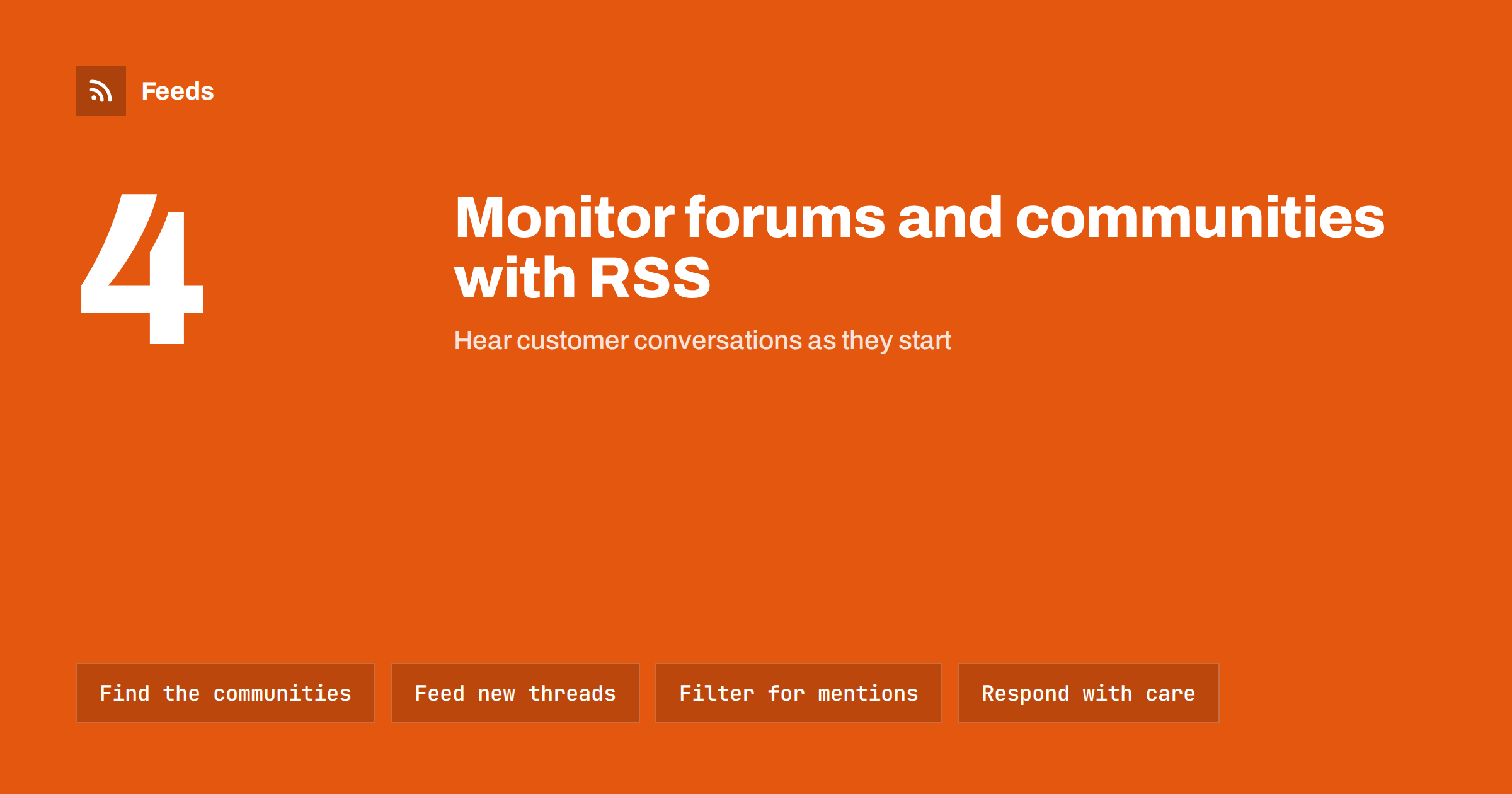
Short answer: Identify the forums, Q&A sites and community boards where your customers and prospects talk, then follow the pages that list new threads in the categories that matter. Many forum platforms have built-in RSS feeds for categories, tags and searches; for those that do not, create a feed from the “latest threads” page. Filter for your brand, products, competitors and the problems you solve, and review the feed daily so you can learn from conversations and respond helpfully.
Communities are where people speak most openly about products. They ask for recommendations, complain about bugs, compare alternatives and share workarounds. For a business, that is invaluable: early warning of problems, honest feedback, content ideas and chances to help. The difficulty is volume and scattering. Relevant threads appear across several communities, often in categories you would never browse by hand. Feeds bring them together, and they do it without you having to log in to each community every day or rely on a platform’s own notification settings, which differ from site to site.
Which communities are worth following
- Industry forums where professionals in your customers’ field discuss tools and practices.
- Q&A sites with tags for your technology, product category or platform.
- Platform communities run by software vendors your product integrates with, where users of that platform ask about add-ons like yours.
- Regional or language-specific forums in markets you serve.
- Your own community, if you run one, so no question goes unanswered.
- Hobby and enthusiast forums for consumer products, where buying decisions are often discussed in detail.
Ask your support and sales teams where customers mention having read about you. They often know communities that marketing has never heard of. A quick search for your product category plus words like “forum” or “community” in each of your main markets usually finds a few more.
Step 1: Look for built-in feeds
Forum software is one of the places where RSS never went away. Many widely used forum and community platforms generate feeds automatically.
- Category feeds: new threads in one category.
- Tag feeds: new questions or threads with a specific tag, common on Q&A sites.
- Latest-topics feeds: every new thread across the forum.
- Search feeds: some platforms offer a feed for a saved search.
Try adding .rss to a category or tag address, look for feed links in the page source, or check the forum’s help pages. If you find a category or tag feed that matches your topic closely, you may not need filters at all.
Verify each feed before relying on it. Open it in a browser or reader and compare the newest items with what the forum shows. Some platforms limit feeds to public categories only, and some old feed addresses keep working but no longer update after a forum upgrade.
Step 2: Generate feeds where there are none
Custom-built forums, older boards and some community platforms offer no feeds. For these, find the page that lists new or recently active threads, ideally within the relevant category, and create a feed from it with a page-to-feed tool.
Check the preview carefully. Forum pages contain many repeated links: thread titles, user names, “last post” links and pagination. The feed items should be thread titles linking to the threads. If user profiles or page numbers appear as items, try a different listing view, such as “new threads” rather than “recent activity”, or a category page with a simpler layout.
New threads versus new replies
Decide whether you care about new threads or about new activity. A “latest activity” page moves old threads to the top whenever someone replies, which a feed may or may not treat as new items depending on how links are formed. A “newest threads” view gives a cleaner feed of new conversations. For most monitoring, new threads are what you want; ongoing replies can be read by opening the thread.
Step 3: Filter for relevance
Community titles are informal, which affects how you write filters.
| Filter group | Examples | Purpose |
|---|---|---|
| Brand and product | Your brand, product names, common misspellings | Direct mentions, support needs |
| Competitors | Competitor names and product names | Comparisons, switching intentions |
| Problems you solve | “how do I”, “alternative to”, problem phrases | People who could use your product |
| Recommendations | “recommend”, “best tool for”, “which should I use” | Buying-stage conversations |
Misspellings matter more in communities than anywhere else. Look at how people actually write your brand and add the common variants. Keep problem-phrase filters broad at first and tighten them after a week of real results.
Step 4: Review and respond with care
How you respond matters as much as how quickly. Communities are sensitive to marketing, and most have rules about self-promotion.
- Read the rules of each community before posting, and follow them.
- Help first. Answer the question asked. Mention your product only when it genuinely solves the problem, and disclose that you work for the company.
- Take support issues seriously. A public complaint answered helpfully often improves how people see you.
- Do not argue. Criticism of your product is feedback. Pass it to the product team and respond politely if at all.
- Often, just listen. Many threads are best used as insight rather than as a reason to reply.
Step 5: Share insights internally
Community monitoring produces valuable qualitative data. Route it where it is used:
- Bug reports and confusion to support and product teams.
- Feature requests and comparisons with competitors to product management.
- Recurring questions to the content team as ideas for help articles and blog posts.
- Buying-stage conversations to sales, where community rules allow helpful follow-up.
A short weekly summary, such as “top three things people asked about this week”, is often more useful to colleagues than a stream of links. Over months, these summaries add up to a record of what your market worries about, in its own words, which is excellent input for positioning, documentation and product decisions.
A worked example
A company that sells a scheduling add-on for a popular e-commerce platform follows four communities: the platform’s official community forum, a Q&A site’s tag for that platform, a merchants’ forum in its main European market and a subreddit-style board for small online sellers. The official forum and the Q&A tag have built-in feeds; the merchants’ forum does not, so the team generates a feed from its “new threads” page in the apps category.
Everything is merged into one feed filtered for the product name and two misspellings, three competitors, and phrases like “schedule”, “pre-order” and “delivery date”. A support agent reviews the feed every morning. In the first month she answers a dozen setup questions that would otherwise have become support tickets or bad reviews, the product team learns that merchants keep asking about a feature one competitor lacks, and the content team writes two help articles based on the most common questions. None of this required replying to threads that did not ask for help.
Common mistakes
- Following only your own brand name. Most valuable threads never mention you; they describe a problem or compare alternatives.
- Replying to everything. Constant company replies feel like marketing and can get accounts banned.
- Using activity views as sources. They produce repeated items as old threads are bumped.
- Ignoring smaller communities. A small, focused forum may matter more to your market than a huge general site.
- Not noticing when a forum moves. Communities migrate to new platforms, and generated feeds can stop finding threads. Check each feed’s newest item now and then.
How Feeds helps
Feeds creates RSS from community pages that do not publish feeds, by finding the list of threads on the page and showing a preview before anything is created. When a forum already has a feed, Feeds uses it. You can merge several communities into one feed and keep only threads with your words, with duplicates removed automatically. Feeds refresh on their own, and paid plans alert you if a feed stops finding items, for example after a forum changes platforms. Plans and limits are on the pricing page.
Related reading
- Media Monitoring with RSS: Track Brand Mentions in the News
- How to Reduce Noise in RSS Alerts Without Missing Anything
- How to Set Up Keyword Alerts Using RSS Feed Filters
The bottom line
Forums and community sites are where customers speak most honestly. Find the communities that matter, use built-in category and tag feeds where they exist, generate feeds from new-thread pages where they do not, filter for brands, competitors and problems, and respond helpfully within each community’s rules. The insight you gain is often worth more than any reply you post.
GYIK
Do forums have RSS feeds?
Many forum platforms generate feeds for categories, tags or latest topics, even if links are not prominent. Check the page source, try adding .rss to category addresses, or look in the forum’s help pages.
How can I get alerts when my brand is mentioned in a forum?
Follow the forum’s feeds, or generate feeds from its new-thread pages, and filter them for your brand name and its common misspellings. Remember that filters usually see only thread titles and summaries.
Should I follow new threads or new replies?
For most monitoring, new threads give a cleaner feed. Activity views repeat threads whenever someone replies, which can create noise.
Is it acceptable for a company to reply in forums?
Yes, if you follow each community’s rules, disclose your affiliation and focus on helping rather than promoting. In many cases, reading and learning is more valuable than replying.
What if a forum has no RSS feed at all?
Use a page-to-feed tool on the page that lists new threads. Each new thread then becomes a feed item that you can filter and merge with other sources.