ENEnglish
 LTLietuviškai
 DEDeutsch
 FRFrançais
 RUРусский
 ESEspañol
 PLPolski
 ITItaliano
 UKУкраїнська
 CSČeština
 PTPortuguês
 JA日本語
JA日本語 LVLatviešu valoda
 ETEesti
 HUMagyar
 IDBahasa Indonesia
 TRTürkçe
 HIहिन्दी
 ELΕλληνικά
 ARالعربية
 THไทย
THไทย VITiếng Việt
 RORomână
 MSBahasa Melayu
 BNবাংলা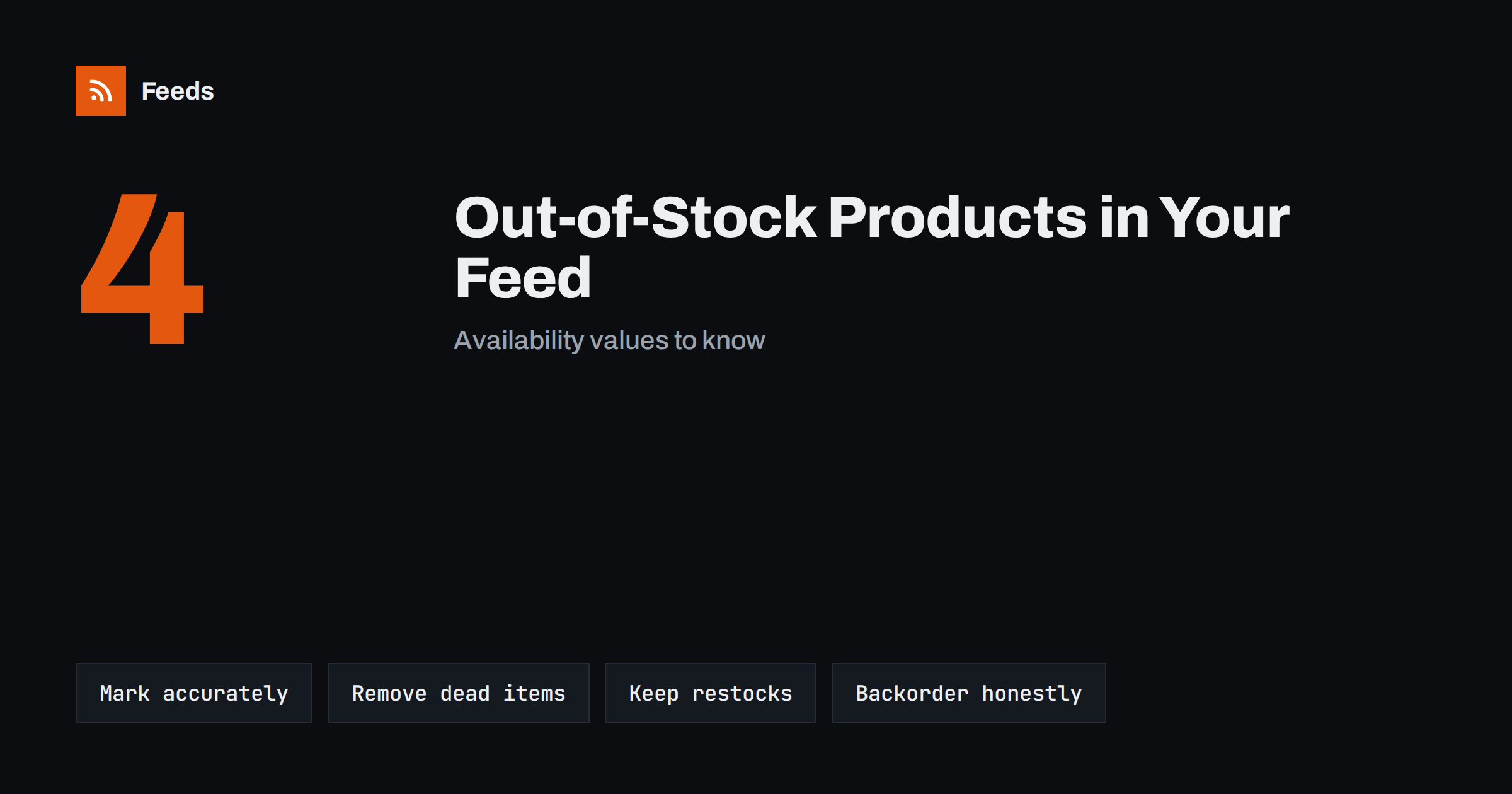
Short answer: Every product in your feed must show the same availability as its landing page. Products that will return soon can stay in the feed marked out_of_stock, which keeps their history and stops ads from showing them. Discontinued products should be removed. Use backorder or preorder only when customers can actually order and you can state when it ships. A rule that excludes or marks sold-out items automatically is safer than doing it by hand.
Why availability is a high-stakes field
Availability looks like a small field, but platforms treat it seriously. From a shopper’s point of view, clicking an ad for a product that turns out to be sold out is one of the most frustrating shopping experiences. From your point of view, it is a paid click that cannot convert. Google and Meta both compare the availability you send with what they see on the landing page, and repeated mismatches lead to item warnings, disapprovals and, in persistent cases, account-level problems.
Availability also changes faster than almost any other field. Titles and images change occasionally; stock can change several times a day during a sale. That makes it the field most likely to be out of date if your feed is not generated from live data and refreshed often.
The availability values and what they mean
Google defines four values, and Meta uses equivalent ones:
- in_stock: the product is available and ships in your normal handling time.
- out_of_stock: the product cannot be ordered right now. Items with this value are not shown in ads.
- preorder: the product is not yet released, but customers can order it now. Google expects an availability_date telling shoppers when it will ship.
- backorder: the product is temporarily out of stock, but customers can order it and it will ship once restocked. An availability_date is also expected.
The landing page must say the same thing in plain language. If the page shows “Sold out” and a disabled button, the feed must say out_of_stock. If the page accepts orders with “Ships in 3 weeks”, backorder is appropriate. If the page says “In stock” but the warehouse is empty, the problem is on the site, not in the feed.
Three ways to handle sold-out products
Option 1: keep sold-out products, marked out of stock
Keeping products in the feed with availability set to out_of_stock is the default behavior of most feed tools. The product stays known to the platform, its item ID and history are preserved, and it becomes eligible again the moment you change it back to in stock.
This is the right approach for items that sell out regularly and come back: core products, seasonal items with a restock planned, and best sellers with supply hiccups. The small downside is a longer feed full of items that are not showing, which can make diagnostics noisier. It is a price worth paying for products that matter.
Option 2: remove sold-out products from the feed
Removing products means they disappear from Merchant Center and the catalog after the next fetch. For products that will never come back, such as discontinued models, one-off clearance lots and limited editions, this is cleaner. There is no reason to carry dead products, and removing them keeps reports and product sets focused.
The risk is removing products that do return. When they come back, they are treated as new items and need review again, and any product-level performance data is effectively split. If you remove items automatically by stock status, consider keeping an exception for products you know will be restocked.
Option 3: backorder and preorder
Backorder and preorder let you keep advertising products customers can buy even though you cannot ship them right now. They are useful for made-to-order products, popular items with reliable restock dates, and new releases. They are risky when used to hide the fact that you do not know when stock will return.
- Only use backorder if the site genuinely accepts orders for the product.
- Send an availability_date and keep it realistic. Update it if the date slips.
- Make the expected shipping time visible on the product page and at checkout.
- Consider lower bids or separate campaigns for backordered items, since conversion rates are often lower.
Comparing the options
| Situation | Recommended handling | Why |
|---|---|---|
| Regular product, restock expected soon | Keep, mark out_of_stock | Preserves history; returns to ads instantly |
| Discontinued or one-off item | Remove from feed | Nothing to gain from keeping it |
| Orders accepted, ships later | backorder with availability_date | Honest and still sellable |
| Not yet released, orders open | preorder with availability_date | Captures early demand |
| Variant sold out, others in stock | Mark that variant out_of_stock | Other variants keep showing |
| Very low stock, fast sell-through | Keep in stock, consider excluding from ads | Avoid paying for clicks you cannot fulfill |
Variants: the most common availability trap
Stock usually runs out per variant, not per product. The medium size of a shirt sells out while the other sizes remain. If your feed sends only the parent product, or reads availability at the product level, it may show the whole product as in stock while the linked variant is sold out, or the reverse. Make sure each variant is its own item with its own availability, and that each link opens that exact variant so the page shows the matching status.
Keeping availability fresh
Accurate availability is a timing problem as much as a data problem. A feed generated at midnight and fetched at 6 a.m. may be wrong by noon during busy periods. A few practices reduce the gap:
- Generate the feed from live store data, not from a copy exported by hand.
- Refresh the feed several times a day if stock changes quickly, and schedule platform fetches to match.
- Consider Google’s automatic item updates, which can update availability and price from structured data on your pages between fetches.
- Add structured data with availability to product pages, so crawlers see the same status the feed sends.
- Check the diagnostics after big sales and launches, when stock moves fastest.
Do not forget ad-level safety nets
Even with a good feed, it helps to add safeguards in campaigns. In Meta, build product sets for ads that include only in-stock items. In Google campaigns, you can use custom labels to separate low-stock or backordered items and bid on them differently. These safety nets catch the gaps between feed refreshes and give you control over what gets budget.
Handling stock during sales and launches
Big promotions are when availability errors pile up. Stock that lasted weeks can sell out in hours, and ads keep running on the old data until the next fetch. A little preparation goes a long way:
- Increase refresh frequency for the event. If your feed normally refreshes daily, refresh it several times a day during the sale, and align the platform fetch schedule.
- Separate limited stock. Put products with small quantities into their own campaign or product set, so you can pause them quickly or give them a smaller budget.
- Set a low-stock threshold. Some stores treat anything below a few units as effectively sold out for advertising purposes, because the last units often sell before the feed catches up.
- Plan the restock message. If you know sold-out items will be back, decide in advance whether they switch to backorder or stay out of stock, and make sure the page and feed agree.
After the event, review the diagnostics for availability mismatches. They reveal where the gap between stock changes and feed updates was too large, which tells you how to set refresh intervals for the next event.
What the landing page must show
Platforms judge availability from the page, so the page must be unambiguous. A sold-out product should show a clear status near the price and a disabled or replaced purchase button, such as “Notify me when available”. A backordered product should show that orders are accepted and when they ship. Avoid pages where the button still says “Add to cart” but the cart later refuses the item: crawlers read the page, not the cart, and shoppers find out too late. Structured data on the page with the same availability value helps crawlers read the status correctly.
How Feeds helps
Feeds can skip out-of-stock products automatically when it builds a product feed from WooCommerce, Shopify or a CSV link, and the feed refreshes on its own so stock changes flow through to Google Merchant Center and Meta. Availability is included for every item in the Google product XML format. You can also rewrite titles and adjust prices with rules. See the plans for refresh intervals and limits.
Related reading
- Google Product Feed Attributes: Required and Recommended
- How to Add a Product Feed to a Meta Catalog, Step by Step
- WooCommerce Product Feed for Google Shopping: A Setup Guide
The bottom line
There is no single right answer for sold-out products; decide per product. Keep and mark products that will return, remove products that will not, and use backorder or preorder only when customers can truly order. Whatever you choose, availability must match the page for each variant, and the feed must refresh often enough to keep up with your stock.
GYIK
Do out-of-stock products hurt my Google Shopping account?
Correctly marked out-of-stock products do not. Problems come from mismatches, such as a feed showing in stock while the page shows sold out.
Will ads show products marked out_of_stock?
No. Items marked out_of_stock are not shown in Shopping ads, but they remain in Merchant Center and return when availability changes.
When should I use backorder instead of out of stock?
Use backorder only when customers can place an order now and you can give a realistic shipping date. Otherwise mark the item out of stock.
Should I delete discontinued products from the feed?
Yes. Products that will never return add noise and have no benefit. Remove them from the feed or exclude them with a rule.
How often should availability be updated?
At least daily, and several times a day if stock moves quickly. Match the platform’s fetch schedule to your feed refresh.