ENEnglish
 LTLietuviškai
 DEDeutsch
 FRFrançais
 RUРусский
 ESEspañol
 PLPolski
 ITItaliano
 UKУкраїнська
 CSČeština
 PTPortuguês
 JA日本語
JA日本語 LVLatviešu valoda
 ETEesti
 HUMagyar
 IDBahasa Indonesia
 TRTürkçe
 HIहिन्दी
 ELΕλληνικά
 ARالعربية
 THไทย
THไทย VITiếng Việt
 RORomână
 MSBahasa Melayu
 BNবাংলা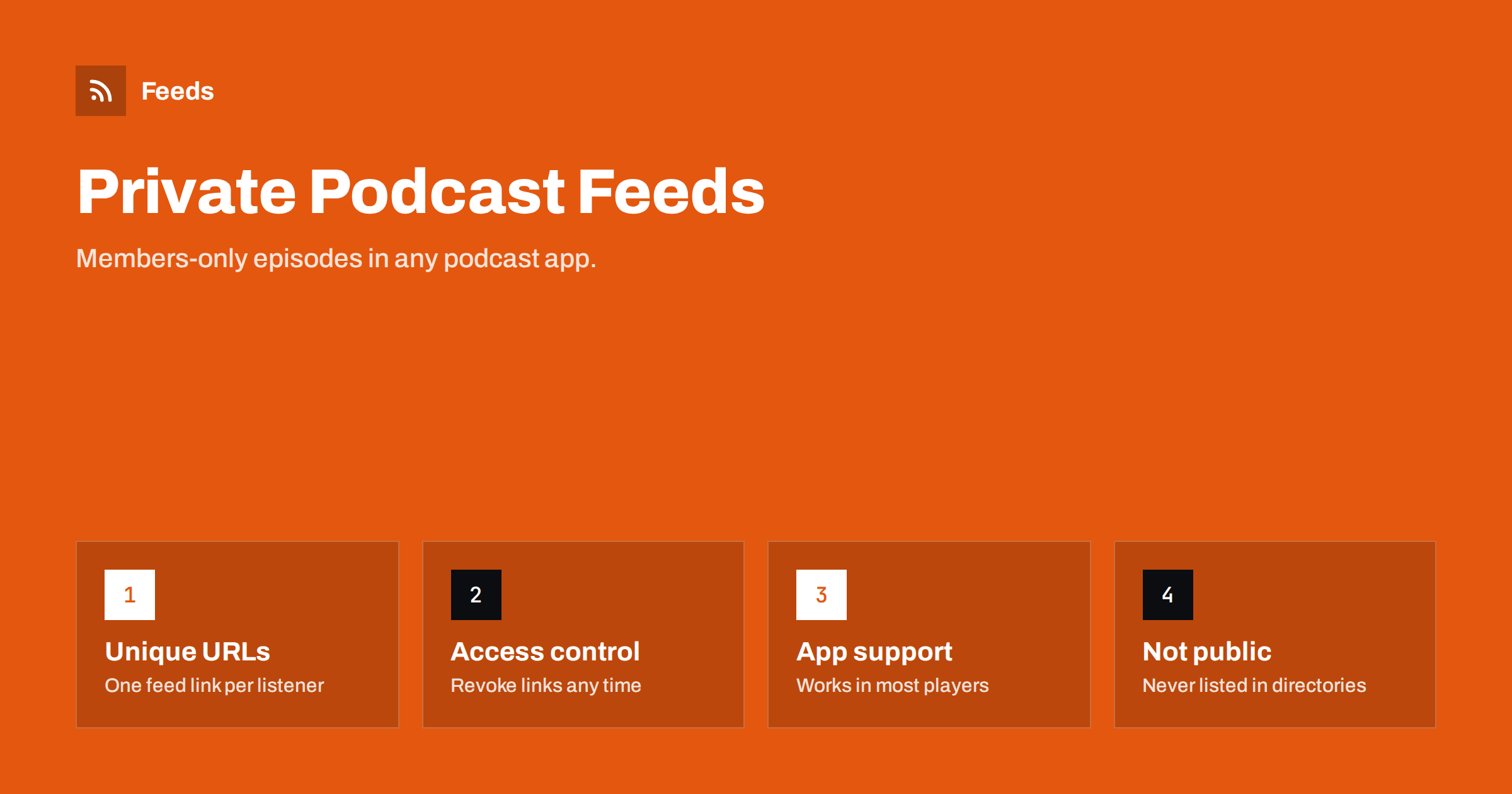
Short answer: A private podcast feed is a normal podcast RSS feed that is not listed in public directories and is protected by a unique, hard-to-guess URL for each listener, sometimes combined with a login. Listeners add the link to their podcast app, which fetches it like any other feed. When someone’s membership ends, their personal link is revoked. It is the standard way to deliver premium episodes, courses and internal company podcasts, and its security is good but not absolute.
Podcasting’s openness is one of its strengths: anyone can subscribe to any show in any app. But many creators and organisations want the opposite for some content: bonus episodes for paying supporters, a course delivered as audio, a weekly briefing for employees, or a show for a client’s customers only. Private feeds solve this without asking listeners to install a special app. This guide explains how they work, what the options are, and how to avoid the common pitfalls.
How a private feed differs from a public one
Technically, a private feed looks almost identical to a public podcast feed: a channel with show information and items with enclosures pointing to audio files. The differences are around it:
- It is never submitted to Apple Podcasts, Spotify or other public directories.
- Its URL is secret, usually containing a long random token.
- Each listener often gets their own URL, so access can be granted and removed individually.
- The media files may also be protected, with tokenised or expiring URLs, so that sharing a single episode link does not expose everything.
- It usually signals privacy with the
itunes:blocktag set to “Yes” so that Apple Podcasts does not list it even if someone submits it, and many hosts also add headers or tags asking indexes not to crawl it.
The three common models
| Model | How access works | Best for |
|---|---|---|
| Tokenised URL per listener | A unique link generated for each member, revocable individually | Paid memberships, courses, supporter bonuses |
| Shared secret URL | One private link for everyone who should listen | Small internal teams, short-lived projects |
| Authenticated feed | Feed or app requires a login, sometimes through a company identity system | Corporate internal podcasts with strict access rules |
Tokenised URLs are the most common because they balance convenience and control: listeners paste one link into their app, and you can cut off anyone without affecting others. Shared URLs are simple but cannot be revoked for one person without changing the link for everyone. Authenticated feeds are the most secure, but not every podcast app supports feeds that require a username and password, so listeners may need a specific app.
Which apps support private feeds
Most podcast apps that let you “add a show by URL” work with tokenised private feeds, because to the app it is just another feed. That includes many popular independent players. Apple Podcasts can add shows by URL through its library menu on several platforms. Spotify, by contrast, does not let users add arbitrary RSS feeds, so private feeds generally do not work there unless a platform has a special integration.
Support for password-protected feeds, where the app sends a username and password with each request, is patchier. If you plan to use authenticated feeds, test with the apps your audience actually uses and give clear instructions.
How secure is a private feed?
Honest answer: secure enough for most business and membership uses, but not a vault. Consider the realistic risks:
- Link sharing. A member can share their personal link. Per-listener tokens let you see unusual usage, such as downloads from many different locations, and revoke that link.
- Downloaded files. Once an episode is downloaded, it is an ordinary audio file that can be copied. No feed technology prevents that.
- Accidental indexing. If a private feed URL is posted publicly, crawlers or podcast indexes could pick it up. The
itunes:blocktag,podcast:blockfrom the Podcasting 2.0 namespace and good host defaults reduce this risk. - Third-party app servers. Some apps fetch feeds through their own servers, which then know the private URL. Reputable apps treat these as private, but the link does leave the listener’s device.
For highly confidential content, such as unreleased financial information, use an authenticated feed or an internal platform with proper access control rather than a tokenised feed.
Setting up a private podcast
- Choose a host that supports private feeds. Many podcast hosts offer private or internal podcasts, sometimes as a separate plan, and membership platforms often generate private feeds for their members.
- Decide how listeners get access. Typically through a membership platform, an e-commerce purchase, a company directory, or manual invitations.
- Connect the systems. When someone joins, a personal feed link should be created and emailed automatically; when they leave, it should be revoked automatically.
- Write clear instructions. A short page per popular app, with screenshots or steps, prevents most support requests.
- Set up the show metadata as for a public show: artwork, description, episode titles and notes.
- Test with several apps and a revoked link, to confirm that removal really works.
Private feeds for companies
Internal podcasts are increasingly used for leadership updates, onboarding, training and sales enablement. They work well because employees can listen during commutes in the app they already use. A few points specific to companies:
- Connect access to your identity system if possible, so leavers lose access automatically.
- Keep episodes short and regular; internal audiences value predictability.
- Use download statistics per listener carefully and transparently, respecting internal privacy policies.
- Remember that anything spoken in an internal podcast can be recorded and forwarded, so apply the same judgement as to internal email.
Mixing public and private content
Many creators run a public show and a private feed for supporters. Common patterns:
- Ad-free versions of public episodes in the private feed.
- Early access, where supporters get episodes days before the public feed.
- Bonus episodes only in the private feed, with occasional trailers in the public one.
- Full archives in the private feed while the public feed shows only recent episodes.
Make sure the private feed includes public episodes too if supporters are expected to use only one feed; otherwise they end up subscribed to both and see duplicates. Use different GUIDs for ad-free versions if they are different files, and the same GUID if they are the same episode, depending on how you want apps to treat them.
Helping listeners get started
The biggest practical obstacle with private feeds is not technology but instructions. Many listeners have never added a show by URL and do not know their app can do it. A little effort here saves a lot of support email:
- Offer one-tap links where your host supports them. Some hosts generate special links that open directly in popular apps and subscribe the listener automatically.
- Write short, app-specific steps for the three or four apps your audience uses most, and keep them up to date when apps change their menus.
- Explain what not to do: do not share the link, do not post it in public forums, and contact you if it stops working.
- Tell listeners what happens when access ends, so a stopped feed does not look like a technical fault.
- Provide a web player as a fallback for people who cannot or will not use a podcast app.
It is also worth sending a short welcome message with the link and the first episode’s title, so new members know exactly what they should see once the feed is added. A listener who sees the expected episode in their app within a minute rarely needs help again.
Private feeds and other tools
Private feed URLs should not be pasted into public or shared tools that might expose them. If you build a combined or filtered feed from podcast sources with a tool, use only public feeds as sources. Our tool, Feeds, is designed for public sources: it merges and filters feeds and creates feeds from public pages, and it reads pages from the outside like a visitor. For private podcast delivery, use your host’s private feed features. For public sources, see our plans.
Related reading
- Podcast RSS Feeds Explained: How Episodes Reach Every App
- Podcast RSS Tags Explained: iTunes and Podcasting 2.0
- How to Move a Podcast Feed Without Losing Subscribers
The bottom line
Private podcast feeds deliver members-only and internal audio through ordinary podcast apps by keeping the feed out of directories and giving each listener a secret, revocable link. They are convenient and secure enough for memberships, courses and most internal communications, though downloaded files can always be copied. Choose a host with proper private feed support, automate granting and revoking access, and test in the apps your listeners use.
GYIK
What is a private podcast feed?
It is a podcast RSS feed that is not listed in public directories and is accessed through a secret URL, often unique to each listener. Listeners add it to their podcast app by pasting the link.
Can I listen to a private podcast on Spotify?
Usually not. Spotify does not let listeners add arbitrary RSS feeds, so private feeds generally need an app that supports adding shows by URL, such as Apple Podcasts or many independent players.
Can someone share my private feed link?
They can, which is why per-listener links are recommended. If a link is shared, you can revoke that one link without affecting other listeners, and many hosts flag unusual usage.
How do I stop a private feed appearing in directories?
Never submit it, keep the URL secret, and use itunes:block and podcast:block tags. Most private podcast hosts set these automatically.
Are private podcast feeds suitable for confidential company information?
For ordinary internal updates, yes. For highly sensitive information, use authenticated feeds tied to your identity system or an internal platform with stronger access control.