ENEnglish
 LTLietuviškai
 DEDeutsch
 FRFrançais
 RUРусский
 ESEspañol
 PLPolski
 ITItaliano
 UKУкраїнська
 CSČeština
 PTPortuguês
 JA日本語
JA日本語 LVLatviešu valoda
 ETEesti
 HUMagyar
 IDBahasa Indonesia
 TRTürkçe
 HIहिन्दी
 ELΕλληνικά
 ARالعربية
 THไทย
THไทย VITiếng Việt
 RORomână
 MSBahasa Melayu
 BNবাংলা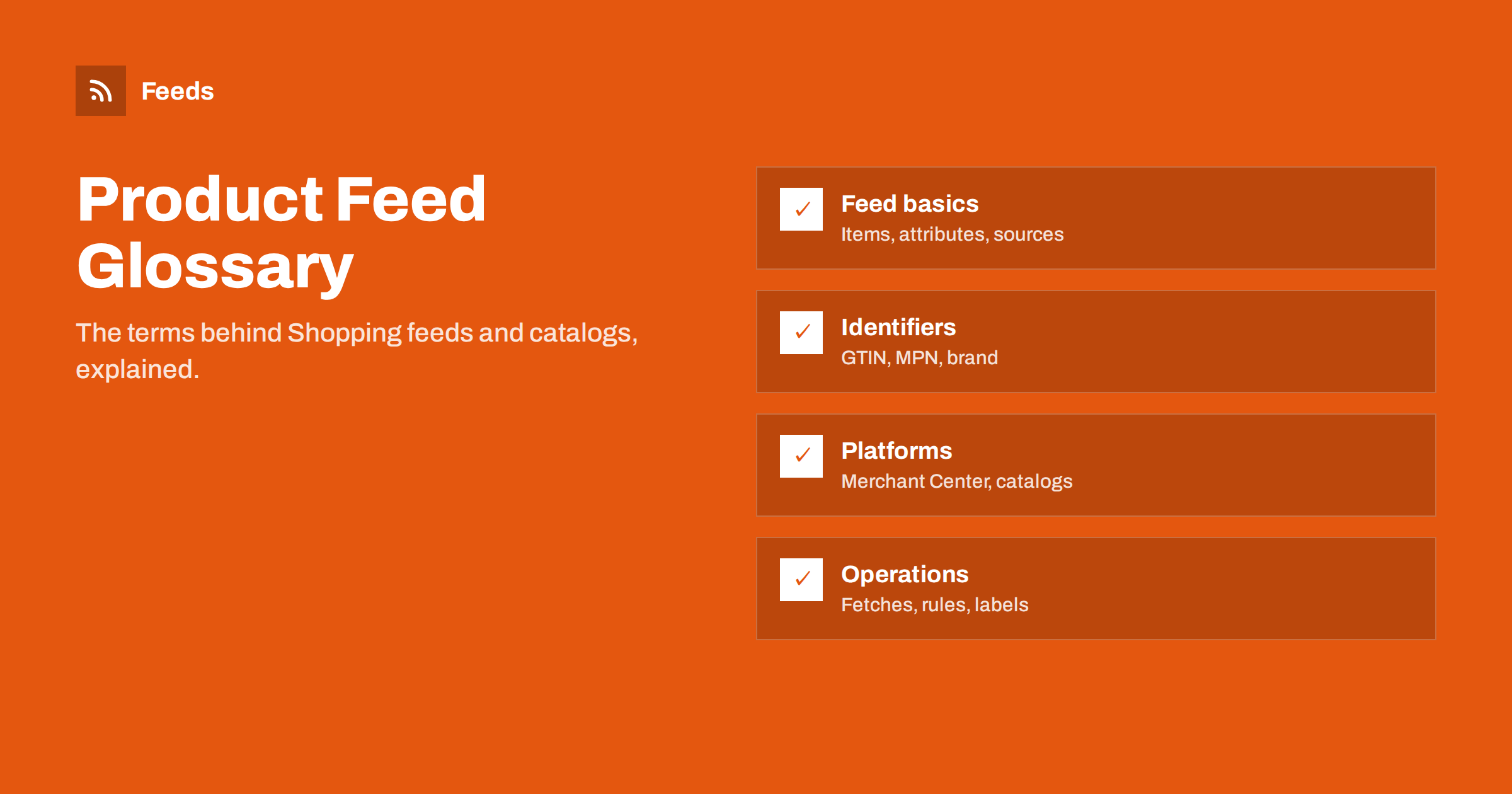
Short answer: Product feeds come with their own vocabulary. The core terms are simple: a feed is a structured file of items, each item is a purchasable product or variant, and attributes are the fields that describe it, such as id, title, price and availability. Around them sit identifiers (GTIN, MPN, brand), platform concepts (Merchant Center, data sources, catalogs, product sets) and operational terms (fetches, rules, supplemental feeds, custom labels). This glossary explains more than 50 of the most common terms in plain English.
The terms are grouped by topic rather than alphabetically, because related terms make more sense together. Attribute names are written the way they appear in Google’s product data specification; Meta uses the same names for most of them.
Feed basics
- Product feed: a structured file or data source listing products with their attributes, read by shopping and advertising platforms.
- Item: one entry in a feed, usually one purchasable product or variant.
- Attribute: a field describing an item, such as title or price.
- Required attribute: an attribute an item must have to be accepted, such as id, title, link, image_link, price and availability.
- Optional attribute: an attribute that improves listings or control but is not required, such as product_type or custom labels.
- Feed format: the file type, typically XML, CSV or TSV, or a spreadsheet or API connection.
- XML feed: a feed in RSS 2.0 or Atom structure with product attributes in Google’s g namespace.
- CSV or TSV feed: a text table with a header row of attribute names and one row per item.
- Feed URL: the stable web address where a feed file is published for platforms to fetch.
- Source of truth: the system whose data is considered correct, usually the store, from which the feed is generated.
A useful mental model: the feed is the delivery mechanism, the store is the source of truth, and the platform keeps its own copy. When something looks wrong in a platform, the question is always which of these three is out of step.
Core product attributes
- id: a unique, stable identifier for an item, typically the SKU.
- title: the product name as shown in listings; the main signal for matching searches.
- description: plain-text details about the product.
- link: the URL of the product’s landing page.
- image_link: the URL of the main product image.
- additional_image_link: URLs of extra images, such as other angles.
- price: the regular price with an ISO currency code.
- sale_price: a discounted price, shown alongside the regular price.
- sale_price_effective_date: the start and end time of a sale price.
- availability: in_stock, out_of_stock, preorder or backorder.
- condition: new, refurbished or used.
These attributes carry most of the weight in every channel. Getting them right, especially price and availability matching the landing page, prevents most of the problems that platforms report.
Identifiers and classification
- GTIN: Global Trade Item Number, the number behind a barcode; includes UPC, EAN, JAN and ISBN.
- MPN: manufacturer part number, used when no GTIN exists.
- brand: the brand of the product, not the store name for resold goods.
- identifier_exists: set to no when a product genuinely has no GTIN or MPN, such as handmade goods.
- item_group_id: a shared value that groups variants of the same product.
- google_product_category: a category from Google’s fixed product taxonomy.
- product_type: your own category path, used for structure and reporting.
- Variant attributes: color, size, material, pattern, gender and age_group, which distinguish variants and are required for apparel in many countries.
Identifiers answer “what exactly is this product”, while classification answers “what kind of product is it and where does it belong”. Platforms use the first for matching and the second for understanding and structure.
Google Merchant Center terms
- Merchant Center: Google’s platform for managing product data for free listings and Shopping ads.
- Data source: a configured input of product data in Merchant Center, such as a scheduled file fetch.
- Primary feed or source: the source that creates products with all required attributes.
- Supplemental feed or source: a source that adds or overrides attributes for existing products by ID.
- Scheduled fetch: Merchant Center downloading a feed from a URL at set times.
- Diagnostics: reports of account and item issues, such as disapprovals and warnings.
- Disapproved: an item that cannot show in a destination because of an error or policy issue.
- Limited: an item that can show but with reduced performance, often due to missing data.
- Automatic item updates: a setting that updates price and availability from page structured data when they differ from the feed.
- Free listings: unpaid product listings on Google surfaces, fed by Merchant Center data.
- Misrepresentation: a policy covering misleading business, product or terms information, which can suspend an account.
Merchant Center terminology changes from time to time as Google redesigns the interface. Names like “feeds” and “data sources” have been used for similar concepts over the years, so older guides may use slightly different wording for the same thing.
Meta catalog terms
- Catalog: Meta’s container for product data used in ads and shops on Facebook and Instagram.
- Commerce Manager: Meta’s tool for creating and managing catalogs and their data sources.
- Data feed: a scheduled or uploaded file that fills a Meta catalog.
- Product set: a filtered group of catalog items used by ads, defined by rules on fields.
- Content ID: the product identifier sent with pixel events; it must match the catalog item id.
- Catalog ads: ads that show catalog products automatically, including retargeting based on viewed products.
Meta also uses Google’s attribute names in feeds, so most of the attribute vocabulary above applies to catalogs as well. The differences are mostly in how catalogs are organized and used in ads.
Operations and optimization
- Feed rules: transformations applied to feed data, such as building titles, excluding products or adjusting values.
- Custom labels: custom_label_0 to custom_label_4, free fields for grouping products by business logic.
- Exclusion: keeping a product out of a feed or destination, for example because it is sold out or restricted.
- excluded_destination: an attribute that keeps an item out of specific Google destinations.
- Mismatch: a difference between feed data and the landing page, typically in price or availability.
- Refresh: regenerating the feed file from store data.
- Feed label: a label used in Merchant Center to connect data sources with targeting and other settings, often matching a country or feed variant.
- Handling time: the time between an order and shipment, set in shipping settings; transit time is the carrier’s delivery time.
- Listing group: a subdivision of products in a Performance Max or Shopping campaign.
These operational terms describe how a feed is kept healthy over time. Most feed work, once the initial setup is done, happens here: adjusting rules, maintaining labels and checking that refreshes and fetches keep running.
A few terms that are often confused
| Terms | Difference |
|---|---|
| id vs GTIN | id is your identifier for the item; GTIN is the global barcode number of the product |
| product_type vs google_product_category | product_type is your structure; google_product_category is Google’s taxonomy |
| price vs sale_price | price is the regular price; sale_price is a temporary discounted price |
| Refresh vs fetch | Refresh regenerates the file; fetch is the platform downloading it |
| Disapproved vs limited | Disapproved items do not show; limited items show with reduced reach |
| Primary vs supplemental source | Primary creates products; supplemental only adds or overrides attributes |
Mixing up these pairs is behind many feed problems, such as putting SKUs in the GTIN field or expecting a supplemental sheet to create new products.
If you work with an agency or developer, sharing a glossary like this at the start of a project saves time. Many misunderstandings about feeds are really misunderstandings about words, and agreeing on terms early prevents them.
How Feeds helps
Feeds turns WooCommerce and Shopify stores, or a CSV link, into product feeds in Google’s XML format with the core attributes filled: id, title, link, image, price, availability and brand. The same file works as a Merchant Center data source and as a Meta catalog feed, refreshes automatically, and supports rules to skip out-of-stock products, rewrite titles and adjust prices. See the pricing page for plans.
Related reading
- What Is a Product Feed? A Plain-English Guide for Stores
- Google Product Feed Attributes: Required and Recommended
- How to Add a Product Feed to a Meta Catalog, Step by Step
The bottom line
Most product feed vocabulary comes down to a few ideas: items with attributes, identifiers that tell platforms what a product is, platform containers such as Merchant Center data sources and Meta catalogs, and operational tools such as fetches, rules and labels. Knowing the terms, and the differences between commonly confused pairs, makes documentation, diagnostics and conversations with agencies much easier.
GYIK
What is the difference between a product feed and a catalog?
A feed is the file or data source; a catalog is the platform’s stored copy of your products, which the feed fills and updates.
What does “item” mean in a product feed?
One purchasable product or variant. A shirt in three sizes is three items grouped by item_group_id.
Is the SKU the same as the GTIN?
No. The SKU is your internal code, often used as the feed id. The GTIN is the global barcode number assigned by the manufacturer.
What is a data source in Merchant Center?
A configured input of product data, such as a scheduled fetch of a feed URL, a Google Sheet or an API connection.
What are custom labels?
Five optional fields for grouping products by your own criteria, such as margin or season, used to structure campaigns and product sets.