ENEnglish
 LTLietuviškai
 DEDeutsch
 FRFrançais
 RUРусский
 ESEspañol
 PLPolski
 ITItaliano
 UKУкраїнська
 CSČeština
 PTPortuguês
 JA日本語
JA日本語 LVLatviešu valoda
 ETEesti
 HUMagyar
 IDBahasa Indonesia
 TRTürkçe
 HIहिन्दी
 ELΕλληνικά
 ARالعربية
 THไทย
THไทย VITiếng Việt
 RORomână
 MSBahasa Melayu
 BNবাংলা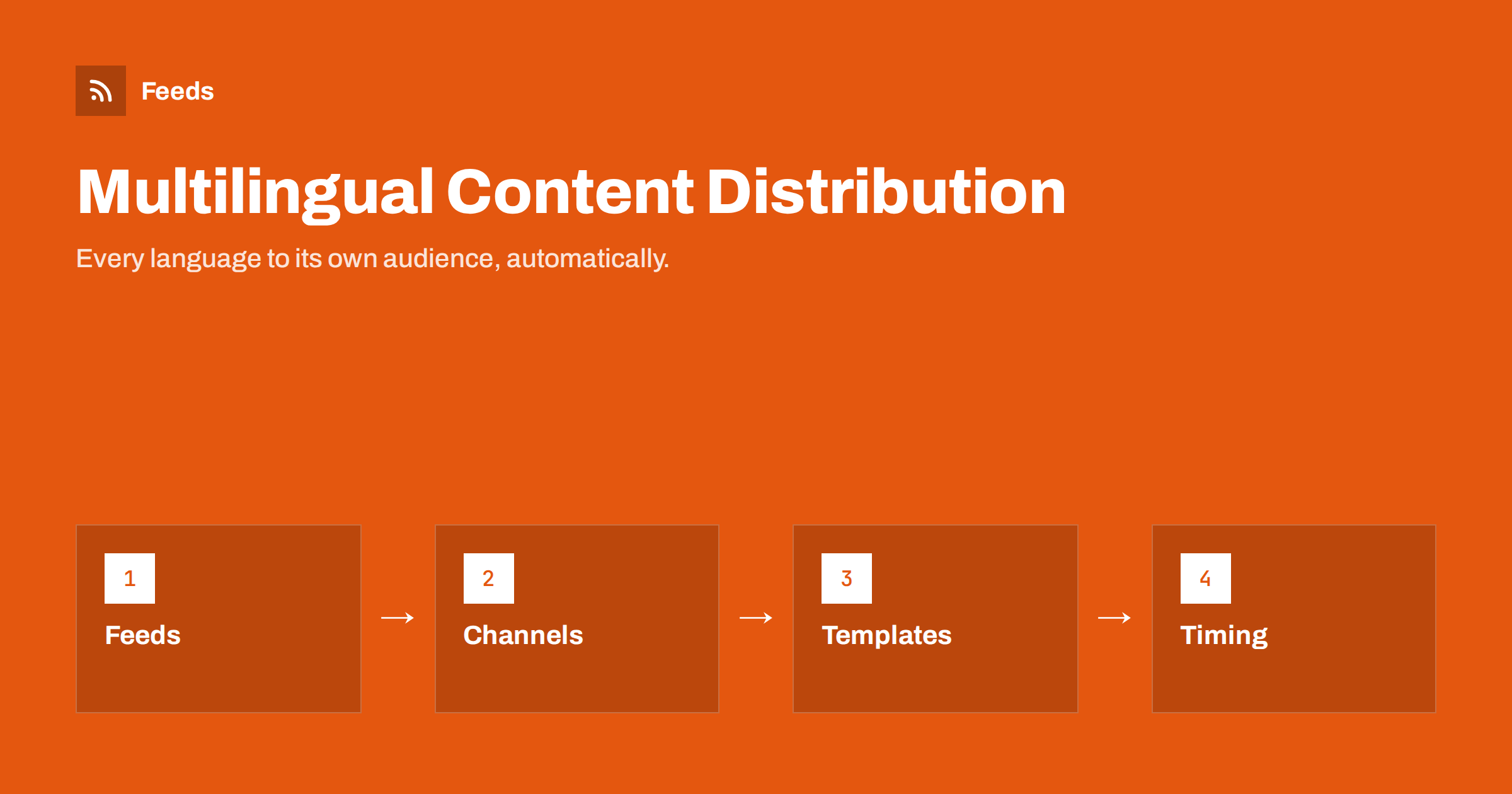
Short answer: To automate multilingual content distribution, give every language its own feed, typically from the language section of a multilingual site, and connect each feed only to the channels and lists for that language. Write templates in each language, schedule posts in each audience’s time zone and make sure every link points to the right language version. The most common mistake is feeding all languages into one channel, which confuses followers and hurts engagement.
Why multilingual distribution needs its own design
A multilingual website usually has a clear structure: a language switcher, language folders or subdomains, and translated versions of pages. Distribution often lacks that structure. A single feed containing all languages, connected to one company page, produces a timeline where English, German and Spanish posts alternate at random. Followers who speak one language see two-thirds of the posts as noise.
The same applies to newsletters, chat communities and partner feeds. People subscribe in the language they read, and they expect everything they receive to be in that language. Mixed-language distribution looks careless and tends to reduce engagement for every language involved.
Designing distribution per language solves this. It also makes it possible to adapt frequency, timing and tone to each market, which matters when your markets differ in size and habits.
Step 1: get one feed per language
Most multilingual setups can produce language-specific feeds:
- Language folders or subdomains in a CMS often have their own feed, for example
/de/feed/orde.example.com/feed/, depending on the translation plugin or platform. - Translation plugins for WordPress and similar systems typically filter feeds by language when accessed through the language’s URL. Check a few items to confirm.
- Separate sites per country naturally have separate feeds.
- Language category or tag feeds can serve when content is organised by language categories instead of true translation.
Open each language feed and check that every item is actually in that language, that links point to the correct language version and that titles and summaries are translated rather than falling back to the default language. Fallbacks are a common source of mixed-language posts.
If a language section of your site has no feed, or a partner’s local site does not offer one, a feed can be created from the page that lists the articles in that language.
Step 2: map feeds to channels
Create a simple map: for each language, which feed goes to which destinations.
| Bahasa | Feed | Tujuan |
|---|---|---|
| English | /feed/ | Global LinkedIn page, English newsletter, X account |
| German | /de/feed/ | German Facebook page, German newsletter |
| Spanish | /es/feed/ | Spanish Instagram, Spanish Telegram channel |
| Lithuanian | /lt/feed/ | Lithuanian Facebook page |
Where you have only one account on a network, such as a single global LinkedIn page, decide deliberately which language it uses. Many companies use English for global pages and local-language pages or showcase pages for major markets. LinkedIn also offers a way to add page information in multiple languages, but posts themselves are usually best kept in one language per page.
Step 3: write templates in each language
Templates contain fixed text, such as “New on our blog:” or “Read more”, and that text must be translated too. Ask a native speaker to write or check each template, including:
- Prefixes and calls to action.
- Hashtags, which often differ by language and market.
- Date and number formats if your template includes them.
- Tone, which can vary: formal address in some languages, informal in others.
Keep templates short. The less fixed text they contain, the fewer translation mistakes can slip in, and the more the article’s own translated title and summary carry the message.
Step 4: timing and frequency per market
Different languages often mean different time zones and habits. Schedule each language’s posts in its audience’s local time: a post in Spanish for Latin America should not go out at a time that suits Madrid but falls in the middle of the night for Mexico. If one language serves several regions with different time zones, choose a window that overlaps reasonably, or split channels by region.
Frequency can differ too. A large English audience may accept daily posts, while a smaller local audience may prefer a weekly digest. Translation delays also affect timing: if translations appear days after the original, the local feed naturally publishes later, which is fine as long as each channel stays consistent.
Step 5: check links and hreflang
Every automated post must link to the version in its own language. Check that feed item links point to translated URLs rather than the default language version. On the website side, pages should declare their language alternatives with hreflang annotations, as described in Google Search Central’s documentation for localised versions, so search engines show the right version to each user. That does not affect social posts directly, but it keeps the whole system consistent.
Also check link previews in each language. Open Graph tags must be translated along with the page, or previews will show the default-language title and description even though the post text is in another language.
Newsletters in several languages
Email needs the same separation, and it has an extra requirement: you must know which language each subscriber wants. There are two common setups.
- Separate lists per language. Each language has its own list and its own RSS campaign fed by that language’s feed. This is the simplest to automate and to reason about.
- One list with a language field. Subscribers choose a language at sign-up, and segments send each language its own campaign. This keeps one contact record per person, which helps if people switch languages or you run other campaigns across markets.
Either way, the sign-up form should appear in the visitor’s language and store the language choice. A form on the German version of your site should subscribe people to the German newsletter by default.
Translate every fixed element of the email template: the header, the introduction block, button labels, the footer, the unsubscribe text and legal information such as your address. Email platforms often have default texts in English that are easy to overlook in other languages. Send a test of each language version to a native speaker before activating the campaign.
Finally, remember that translated content often appears later than the original. If the German feed receives new items a week after the English one, the German digest will lag behind too. That is usually fine, but avoid referring to the same “this week” events across languages if the timing differs.
Curated content in several languages
For curated streams, such as a news channel for each market, sources are usually local. Collect local sources for each language, filter them with keywords in that language (including local terms and spellings), and keep each language’s stream separate. Automatic translation of third-party content can help internal teams understand foreign sources, but for public channels, sharing local-language sources is more natural than posting machine translations.
Feeds helps here: it creates RSS feeds from pages that list articles, including local news pages, association sites and partner sites that have no RSS in any language. Several sources can be merged into one feed per language, filtered by your keywords, with duplicates removed automatically. The feed for each language then goes into that language’s channels. See the pricing page for the number of feeds each plan includes.
Common mistakes
- One feed for all languages connected to one channel.
- Fallback content: untranslated titles or summaries appearing in a language feed.
- Links to the wrong language version from a correctly translated post.
- Templates translated by software without a native check, producing awkward or even embarrassing phrases.
- Same posting time for every market regardless of time zones.
- No owner per language, so problems in smaller markets go unnoticed for months.
Related reading
- How to Automate Social Media Posts from an RSS Feed
- How Often Should Automated Feeds Post to Social Media?
- How to Turn an RSS Feed into an Automatic Email Newsletter
- Content Automation for Agencies Managing Many Clients
The bottom line
Multilingual distribution works when each language is treated as its own channel system: its own feed, its own destinations, its own templates and its own schedule. Check language feeds for fallbacks and wrong links, have native speakers write templates, respect local time zones and give every language an owner. Then each audience receives a stream that feels made for them.
FAQ
Can one social media account serve several languages?
It can, but followers usually engage better when an account sticks to one language. If you must use one account, consider posting in the main language and linking to language versions, or create separate pages for major markets.
How do I get a separate RSS feed for each language?
Many multilingual CMS setups and translation plugins provide a feed per language through the language folder or subdomain. If not, a feed can be created from the page that lists articles in that language.
Should I auto-translate posts for other languages?
For public channels, native-language content and templates checked by a native speaker work better. Automatic translation is more suitable for internal understanding of foreign sources.
Why do some posts in my German feed appear in English?
The feed is probably showing fallback content for items that have not been translated yet. Check your translation plugin’s settings so untranslated items are excluded from language feeds.
How do time zones affect multilingual automation?
Each language audience may live in a different time zone. Schedule each language’s posts in local time so they appear when that audience is active.
Should each language have its own newsletter?
Usually yes, either as separate lists or as language segments of one list. Each language then receives an RSS campaign built from its own feed, with a fully translated template.