ENEnglish
 LTLietuviškai
 DEDeutsch
 FRFrançais
 RUРусский
 ESEspañol
 PLPolski
 ITItaliano
 UKУкраїнська
 CSČeština
 PTPortuguês
 JA日本語
JA日本語 LVLatviešu valoda
 ETEesti
 HUMagyar
 IDBahasa Indonesia
 TRTürkçe
 HIहिन्दी
 ELΕλληνικά
 ARالعربية
 THไทย
THไทย VITiếng Việt
 RORomână
 MSBahasa Melayu
 BNবাংলা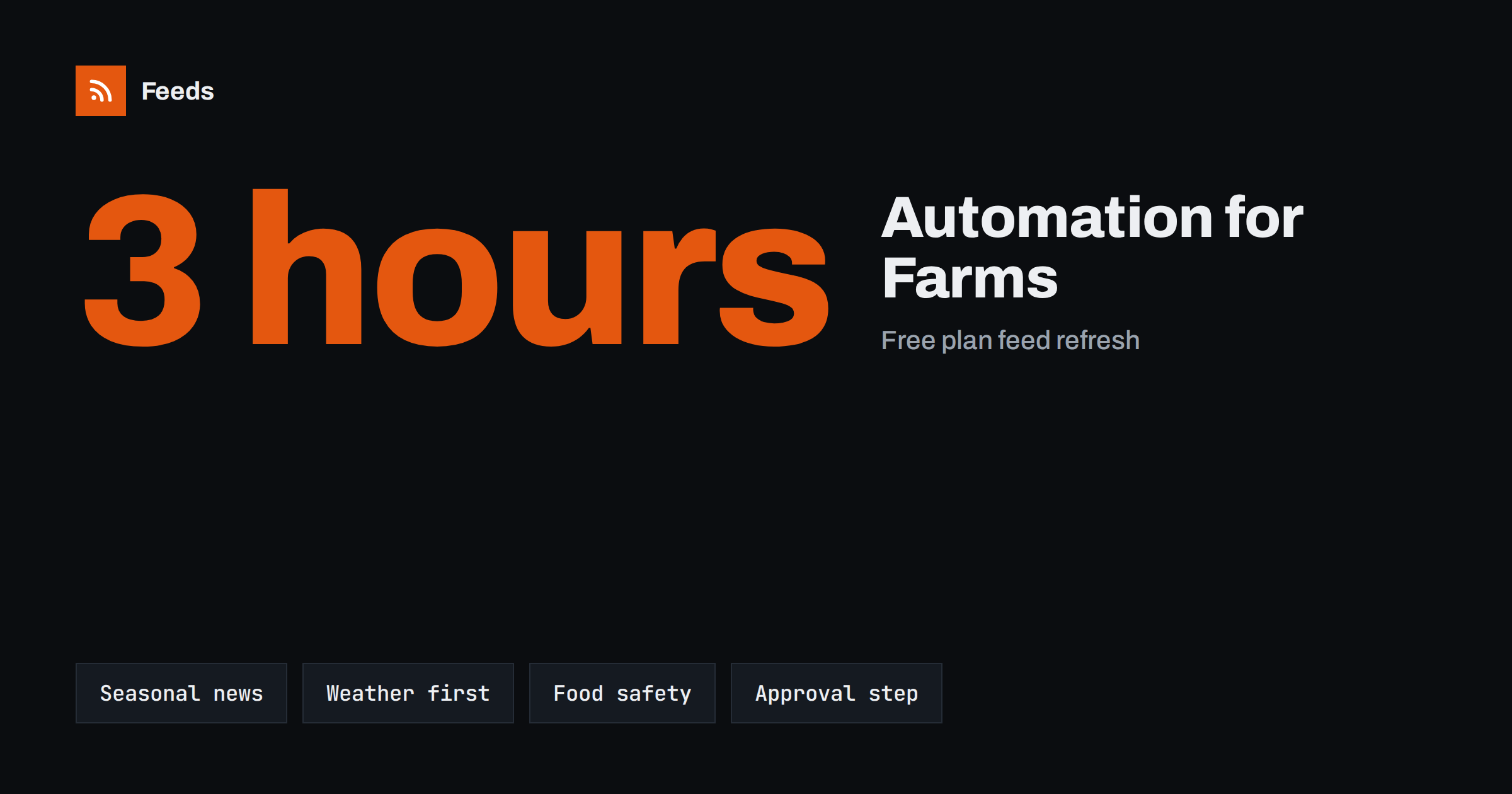
Short answer: Farms and local food producers can automate the repeating part of their communication: market days, seasonal produce, opening hours, events and local news. The work that must stay human is anything about stock, prices, weather damage or food safety. Collect your own news and a few trusted outside sources in feeds, send them to a queue, review each item and let the schedule do the rest. Keep it small, accurate and seasonal.
Why farms struggle with regular posting
A farm or a small food producer has a very busy day and an unpredictable calendar. The weather decides what can be harvested, the market decides what sells, and a good week can leave no time for writing. Yet customers expect to know what is fresh, where to find you this weekend and whether the farm shop is open. Posts appear in bursts and then disappear for weeks, which makes it hard for people to rely on the page.
Automation solves the rhythm, not the substance. It can remind customers that the market stall is open on Saturday, share a new recipe from your own blog, or pass on a local event that brings visitors. It cannot know that the strawberries ran out this morning. The general idea is explained in what is content automation, and the useful starting point for a small business is in building a content automation stack for a small business.
What is safe to automate
Choose content that stays true for days or weeks, and let the system handle it:
- Recurring schedules. Market days, delivery rounds, farm shop hours and the dates of seasonal openings.
- Your own blog and recipe posts. A feed from your site can share each new post once to your social pages.
- Local events. Fairs, open farm days and food festivals from the event pages of your region, which bring walk-in customers.
- Evergreen tips. How to store vegetables, how to cook a cut of meat, how a box scheme works.
- Behind-the-scenes updates. Photos of the season’s work, shared on a planned day.
An old post can be shared again when it is still correct, and the method for doing it without becoming repetitive is described in how to reshare evergreen content automatically.
What should stay manual
Some statements are risky when published by a schedule. Do not automate:
- Stock and availability. “We have eggs today” must be true at the moment people read it.
- Prices and special offers that depend on harvest or demand.
- Weather damage, closures and delays. These need a human voice and an exact time.
- Food safety and allergen information. Always written and checked by the responsible person.
- Replies to customers. Questions and complaints need a real answer.
A simple approval step handles this well, and the options are compared in full auto versus an approval queue. For a small farm the approval queue is usually the right choice: items arrive prepared, and one person approves or deletes them in a few minutes.
Weather and local alerts
Weather is the biggest outside factor for a farm. Official weather services and civil protection pages often publish warnings, and some provide feeds. Following them in a reader helps you decide when to change plans, and the sources and the approach are covered in weather and natural hazard alerts with RSS. Use these alerts as information for yourself first. A post to your customers about a storm or a road closure should be written by a person, with the right place and time.
The same approach works for local news about roads, markets and councils. A feed from the website of your municipality or your regional market can warn you about a changed market location before your customers ask. The idea is described in local news monitoring: follow your town’s sources with RSS.
Food safety notices
Producers and shops that sell food must pay attention to recalls and safety notices. Official food authorities publish notices about contaminated or mislabelled products, and following those pages with a feed is a cheap early warning, especially if you resell products from other producers or use bought-in ingredients. The method is explained in how to track product recalls and safety notices with RSS. Treat every match as a prompt for a human check, not as a message to publish.
Plan a simple weekly rhythm
A realistic plan for a small producer has four elements. First, a feed from your own blog or news page, so that each new article is shared once. Second, a short list of outside feeds: your region’s event calendar, the weather service and a local news source. Third, a weekly review slot, for example on Sunday evening, when you approve the items for the coming days. Fourth, a monthly look at what worked, so that you keep what customers read and drop what they ignore. A short measurement routine is described in how to measure whether content automation is worth it.
Keep the number of sources low. Five feeds that you really read are better than fifty that you ignore. Add keywords to filter out topics that do not matter to your farm, and remove sources that produce noise.
Photos and seasonality
Food businesses live on images, and seasonal photos are the strongest content you have. Take them in batches during the quiet hours, name them by season and use them through the year with fresh captions. Automation then pairs a stored photo with a planned message, and you do not have to be on your phone in the field. Make sure every image shows the real product, since customers will compare the picture with what they receive.
Box schemes, online orders and direct sales
Many small producers now sell directly: vegetable boxes, meat packs, cheese, honey or preserves ordered online and collected at the farm or delivered nearby. This is a good place for a different kind of automation. When your shop adds a new product, the same item can be announced once on your social pages without anyone retyping it. The pattern is explained in how to publish a new arrivals RSS feed for your online store and in how to share new shop products on social media automatically.
Direct sales have their own cautions. A product that sells out in an hour should not be promoted for a week, so use an approval step for anything with limited quantity, and write the order deadline into the text. Keep delivery areas and collection times accurate, and update the announcement or remove it when it is no longer true. If you also advertise your products in shopping listings, remember that the price and the availability in a product feed have to match the page, which is a separate task from social posting.
Customers also like a human touch with every product: the name of the field, the day of harvest, a short story about the animal or the variety. Store these notes with the product so that each automated announcement carries something specific and not just a name and a price.
How RSS Feed Creator helps
RSS Feed Creator turns the news page, event list or market page of a website into a clean RSS feed, even when the site has no feed of its own. It reads titles, images, summaries and dates, uses an existing feed when there is one, and shows a preview of the items before the feed is created. You can merge several sources into one feed (up to 10 on paid plans), keep only the items that contain your keywords and have duplicates removed automatically. Feeds refresh every 3 hours on the free plan and every 30 minutes on paid plans. The free plan allows up to 20 items per feed, and the details are on the pricing page.
Related reading
- Content automation checklist: 30 checks before you go live
- How to promote upcoming events automatically from a calendar
- Content automation for local businesses: a simple plan
The bottom line
For a farm or a local producer, automation is a way to keep a steady voice while the real work happens outdoors. Automate schedules, your own articles, events and evergreen tips. Keep stock, prices, weather damage and food safety under human control, and use an approval queue so that nothing false is published by accident. A small set of trusted feeds and a weekly review is enough.
FAQ
Can a small farm automate social media without losing its personal voice?
Yes, if you automate the schedule and keep the writing personal. Use your own photos and your own words, and let the system handle the timing and the sharing of articles you wrote yourself.
Should I automate posts about what is in stock today?
No. Stock changes during the day, and a wrong post causes disappointed visits. Write those messages by hand or check each one in an approval queue before it goes out.
Which outside sources are most useful for a food producer?
Local event calendars, regional market pages, the weather service and the notices of your food safety authority. Choose only the sources you will actually read.
How often should a farm post?
A steady, modest rhythm works better than bursts. Two or three useful posts a week are enough for most producers, with more only in the busiest season.
Do I need a website to use feeds?
It helps. A page with news, recipes or market dates can become a feed, and that feed can drive your scheduled posts. Without a site, you can still follow outside feeds for ideas and alerts.