ENEnglish
 LTLietuviškai
 DEDeutsch
 FRFrançais
 RUРусский
 ESEspañol
 PLPolski
 ITItaliano
 UKУкраїнська
 CSČeština
 PTPortuguês
 JA日本語
JA日本語 LVLatviešu valoda
 ETEesti
 HUMagyar
 IDBahasa Indonesia
 TRTürkçe
 HIहिन्दी
 ELΕλληνικά
 ARالعربية
 THไทย
THไทย VITiếng Việt
 RORomână
 MSBahasa Melayu
 BNবাংলা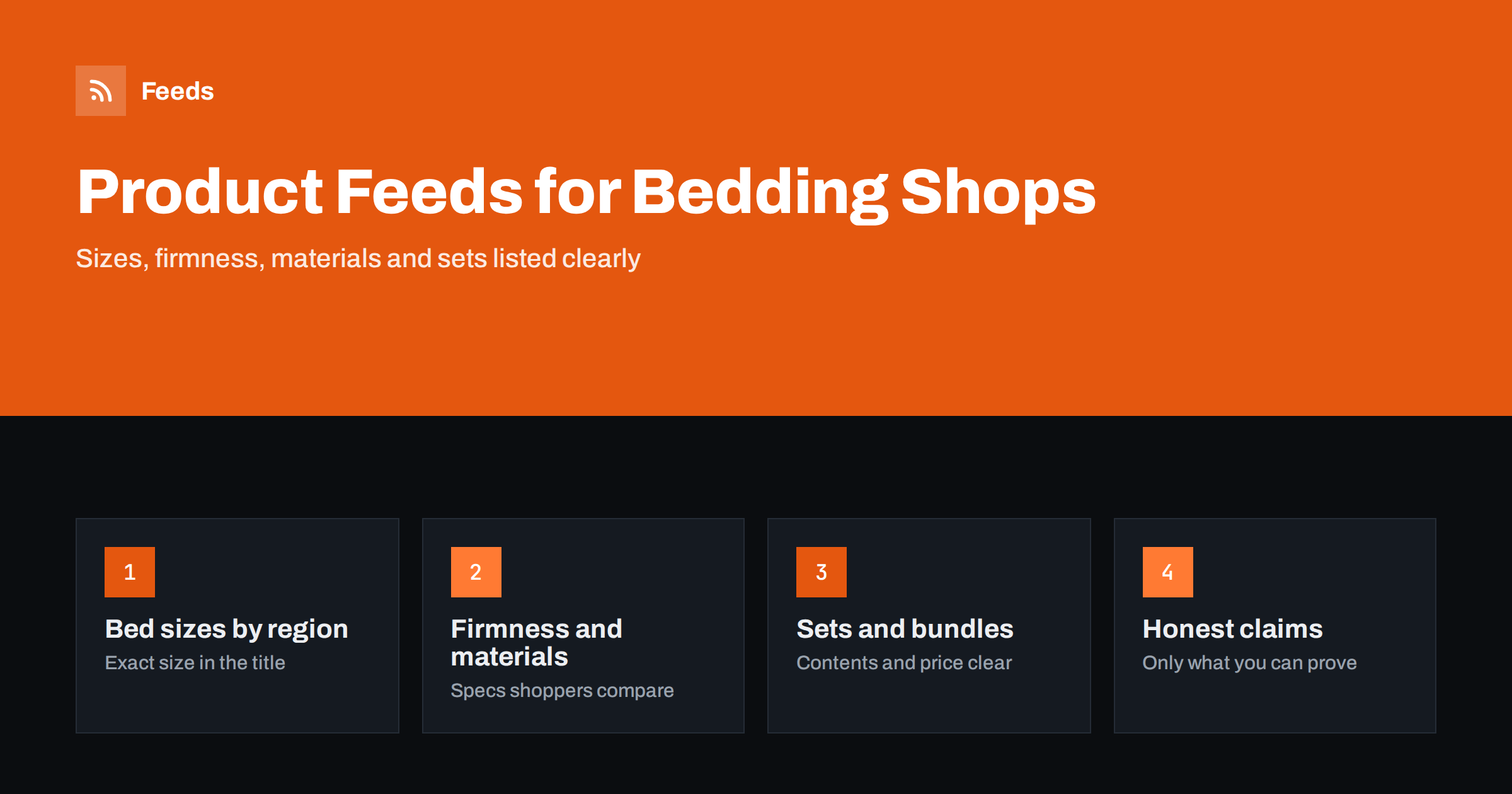
Short answer: A mattress or bedding feed works when the shopper sees the exact size, type and material before clicking. Put the product type, the size in the system your market uses, the firmness or thickness and the colour in the title, list each size as its own item grouped under one item_group_id, and give the real dimensions and materials. Keep every claim, such as hypoallergenic or organic, to what you can document.
What makes bedding feeds different
Bedding looks simple until you try to list it. A single duvet may come in five sizes, three fillings and two warmth ratings. A mattress has a size, a thickness, a firmness level, a construction type and often a choice of cover. The same bed size has different names in different countries, and shoppers compare these details carefully because the product is bought for comfort, not just for looks.
That means the data in the feed matters more than the photo. The platform needs enough structured information to match your product to a search for “king size memory foam mattress” or “cotton duvet cover double”, and the shopper needs enough information in the listing to decide whether to click. Clear, specific data improves both.
Bed sizes: use the system your customers use
Bed sizes are the first source of confusion. In the United States and Canada the common names are twin, full, queen and king. In the United Kingdom they are single, double, king and super king. In much of continental Europe sizes are given in centimetres, such as 90 by 200 or 160 by 200. The names overlap but are not identical, so a “king” in one country is a different size from a “king” in another.
- Use the size names and measurements your target country uses, and put the dimensions in the title or the description as well as the size field.
- If you sell in several countries, create a feed for each, with the sizes written the local way, instead of sending one feed everywhere.
- Be careful with fitted sheets and covers: the size of the mattress they fit, including depth, is often as important as the bed size.
Each size you sell should be its own item with its own id, price and availability. The general rules are in product variants and how item_group_id works. International feeds are covered in multi-country product feeds: currency, language and prices.
Titles that match how people search
A good bedding title says what the product is, what it is made of and which size it is. Useful formulas are:
- Mattress: brand, type, size, thickness, firmness. For example: “Brand Memory Foam Mattress, Queen, 25 cm, Medium Firm”.
- Duvet or pillow: brand, product, filling, size, warmth rating. For example: “Brand Cotton Duvet, Double, Hollow Fibre Filling, 10.5 Tog”.
- Bedding set: brand, material, colour, size, number of pieces. For example: “Brand Cotton Duvet Cover Set, King, White, 3 Pieces”.
Keep the title natural and avoid promotional words. More guidance on structure and length is in product feed title optimization.
Firmness, thickness, materials and other specifications
Shoppers filter and compare mattresses by firmness, thickness, construction and material. These values often do not fit in a title, so they belong in the product details and description. The product_detail attribute lets you pass structured specifications, such as filling type, cover material, care instructions or thickness, as described in product_highlight and product_detail.
The standard attributes help too. Use material for the main fabric or filling, color and pattern for the look, and the product dimension attributes for length, width and height where relevant. Be consistent across the catalogue: choose one way to write “medium firm” and use it everywhere, so that filters work.
Descriptions should answer the questions that come before a purchase: the construction, the layers, whether the cover is removable and washable, how the product is delivered and whether it arrives compressed in a box. The guide to writing product descriptions for shopping feeds explains how to do it without repeating the title.
Sets, bundles and multipacks
Many bedding products are sold as sets or packs: a duvet with two pillows, a sheet set, a pair of pillowcases, two matching pillows. Be exact about what the price covers. State the number of pieces and what they are, and do not list a set under the price of one item. If you also sell the parts individually, treat the set as its own product with its own id.
When a mattress is offered with a base or a topper, decide whether it is a bundle or two separate products, and keep the choice consistent between the feed and the product page. The rules for packs and sets are in bundles and multipacks in product feeds.
Categories and identifiers
Choose the most specific category from the Google product taxonomy for each product. In broad terms, mattresses sit in the furniture branch, while bedding such as duvets, pillows and sheets sits in the home and garden branch under linens and bedding. Using a vague category makes matching less accurate. The differences between the category and your own product type are explained in google_product_category vs product_type.
Branded products from established manufacturers usually have a GTIN, which you should include with the brand and part number. Products you make or private-label yourself may have none; in that case leave the GTIN empty and set identifier_exists to no. More in GTIN, MPN and brand in product feeds.
Images, claims and honesty
Bedding photos should show the product clearly on a clean background, with additional images for details such as stitching, layers and the cover. Lifestyle photos in a bedroom help, but they should not be the main image. Avoid text overlays, badges and watermarks, which platforms reject. The technical rules are in product feed image requirements for Google and Meta.
Claims need particular care in this category. Terms such as organic, hypoallergenic, orthopaedic, fire retardant, antibacterial or cooling imply specific properties and may be regulated. Use them only when you can document them with a certificate or a test, and use the exact wording from that document. Statements about health benefits can lead to disapproval and, more importantly, to unhappy customers. Trial periods and warranties belong on the product page and in your return policy settings, not as invented claims in titles.
Large products and delivery
Mattresses and bed frames are bulky and heavy, and delivery cost and time are part of the buying decision. Set shipping through your account’s shipping settings where you can, with different rules for large items and small items such as pillowcases. Provide package weights and dimensions if your rates depend on them, and keep delivery times realistic. The approach is explained in shipping in product feeds.
Returns deserve a thought as well. Mattresses and bedding are often returned because the size or firmness was not what the buyer expected, so the more precisely the feed and the product page describe the product, the fewer returns you will handle. Keep your return policy settings accurate in your merchant account, and make sure that the policy shown on the product page says the same thing.
Building and maintaining the feed
Bedding catalogues are large because of the size matrix, so the feed should come from your store system rather than a manual spreadsheet. RSS Feed Creator creates Google Merchant Center and Meta catalog XML feeds straight from a WooCommerce or Shopify store, or from a CSV file link. It can skip out-of-stock products, apply title and price rules, and detects the currency automatically. The feed refreshes on its own and you see a preview before anything is created. See the pricing page for plan limits.
After the first upload, check the diagnostics for missing sizes, price mismatches and image issues, and repeat the check regularly. Sale periods and seasonal ranges such as winter duvets create frequent changes, so keep the update schedule in mind, as discussed in how often a product feed should update.
Related reading
- Product feeds for furniture and home goods stores
- Product feed checklist: 25 checks before you submit
- 12 product feed mistakes that quietly cost you sales
The bottom line
A bedding feed succeeds when the shopper can see the product type, the exact size in local terms, the firmness or filling and the material without opening the page. Use the right size system for each country, group sizes under one item_group_id, give real dimensions and materials, describe sets precisely and keep claims to what you can prove. Then keep the feed in step with your stock and prices.
FAQ
Should every mattress size be a separate product in the feed?
Each size should be a separate item with its own id, price and availability, grouped with the other sizes by one item_group_id. Shoppers then see the options as variants of one product.
Which size names should I use for an international shop?
Use the names and measurements of the country each feed targets. A king bed is a different size in different countries, so a separate feed per target country with local sizes avoids confusion.
Where do I put firmness and thickness?
Put the most important values in the title, for example thickness and firmness, and the full specification in the description and product_detail attributes. Write the same level the same way across the whole catalogue.
Can I use claims such as hypoallergenic or organic?
Only when you can back them up with a certificate or a test and you use the documented wording. Unsupported claims can lead to disapproval and complaints.
Do bedding sets need their own item?
Yes. A set sold as one product should be its own item with its own id and price, and the number and type of pieces should be stated clearly. Do not list a set at the price of a single piece.