ENEnglish
 LTLietuviškai
 DEDeutsch
 FRFrançais
 RUРусский
 ESEspañol
 PLPolski
 ITItaliano
 UKУкраїнська
 CSČeština
 PTPortuguês
 JA日本語
 LVLatviešu valoda
 ETEesti
 HUMagyar
 IDBahasa Indonesia
 TRTürkçe
 HIहिन्दी
 ELΕλληνικά
 ARالعربية
 THไทย
 VITiếng Việt
 RORomână
 MSBahasa Melayu
 BNবাংলা
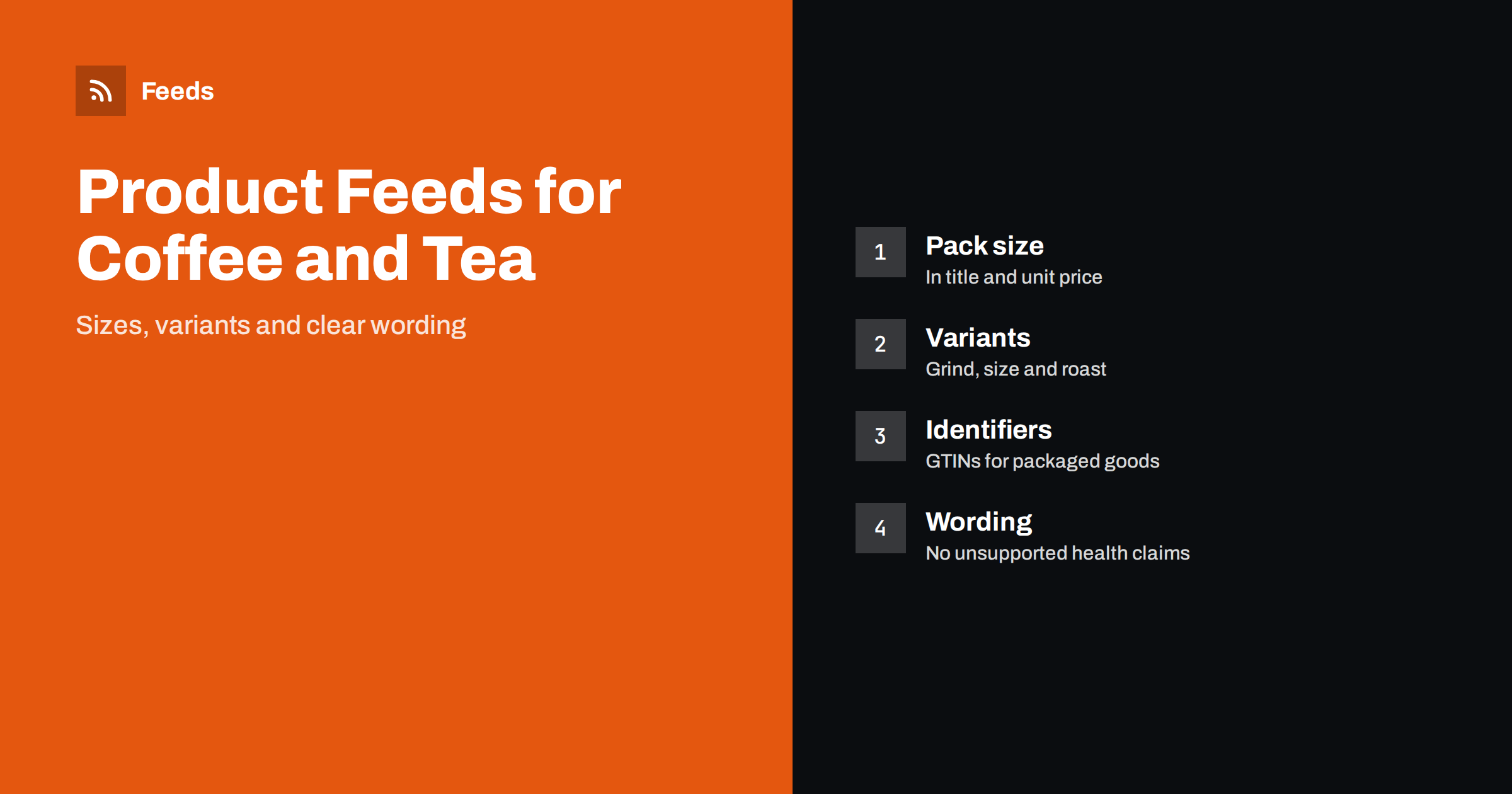
Short answer: A good coffee or tea product feed makes every pack easy to tell apart. Put the product type, origin or flavour and pack size in the title, give each size and grind its own variant, send real GTINs for branded packaged goods and describe the product in plain words without health promises. Keep price and stock identical to the product page, because a mismatch is the most common reason food and drink listings get disapproved.
Why coffee and tea feeds need extra care
Coffee and tea look simple, but the catalog behind them is not. One roast can be sold as whole beans or ground, in 250 g and 1 kg bags, as a single pack or a bundle of three. A tea can be loose leaf or in bags, with a different count in each box. If every one of those combinations is exported as a loose, similar-looking row, shoppers see near-identical ads and the platform struggles to group them.
The aim of the feed is simple: a shopper who sees the listing should know exactly what is in the bag, how much of it there is and what it costs per pack, before clicking. The sections below go through the fields that matter most for this kind of store. If you are new to feeds in general, what a product feed is and how it works is a good starting point.
Write titles that separate similar products
A product title in a feed is not the same as a title on a shelf. It has to work on its own in a list of other products. For coffee, a useful order is brand, product type, origin or blend name, roast, form and pack size. For tea, use brand, tea type, flavour, form and count or weight. Some examples of the pattern:
- Coffee: Brand Name Ethiopia Single Origin Coffee Beans, Medium Roast, 250 g
- Tea: Brand Name Earl Grey Loose Leaf Black Tea, 100 g
- Capsules: Brand Name Espresso Coffee Capsules, 50 Pack
Put the words a shopper would actually type near the front, and keep marketing words out. Terms such as “best” or “amazing” use up space and add nothing. More on this is in how to optimise product feed titles.
Handle sizes, grinds and roasts as variants
When one product comes in several sizes, grinds or roasts, each version is a separate row in the feed, and the rows are linked with a shared group identifier. The group lets shopping platforms treat them as one product with options. Without it, every version competes as a separate product. The practical rules are in how variants and item group IDs work.
Typical variant options for this kind of store are:
- Size or weight, such as 250 g, 500 g and 1 kg.
- Grind, such as whole bean, espresso, filter or plunger.
- Form, such as loose leaf, pyramid bags or capsules.
- Count, such as 20, 50 or 100 bags.
Make sure each variant has its own address that opens the right option, its own image if the pack looks different, and its own stock status. A shopper who clicks a 1 kg ad and lands on a page with the 250 g bag selected will often leave.
Identifiers: GTINs for packaged goods
Branded packaged coffee and tea normally carry a barcode, and the number printed on the pack is the GTIN. Send it exactly as printed, one per variant. A 250 g bag and a 1 kg bag of the same coffee have different GTINs. If you roast or blend your own product and it has no barcode, do not invent a number; follow the platform’s rules for products without identifiers instead. The background is explained in GTIN, MPN and brand in product feeds.
Brand is the other field to get right. For your own roasted products the brand is your shop name. For resold products it is the manufacturer, spelled the same way every time, because small spelling differences make the catalog look inconsistent.
Categories and product type
Platforms use a standard category tree to understand what you sell. Coffee and tea sit in the food and beverages branch, and brewing equipment such as grinders, kettles and espresso machines belongs to the kitchen and dining branch. Choose the most specific category you can. In addition, use your own product type field to copy your store’s category path, for example Coffee > Whole Beans > Single Origin. The difference between the two fields is covered in Google product category vs product type, and it helps later when you want to split campaigns by group.
Unit prices and pack sizes
Shoppers compare coffee and tea by the pack, but they also think in price per 100 grams. Where the rules of a country require or support a unit price, the feed needs the pack measure and a base measure. Even where it is not required, a clear weight in the title and description protects you from confusion. The details are in unit pricing in product feeds.
Bundles need the same care. A box of three bags is a different product from a single bag, with its own price, so give it its own row and say in the title that it is a multipack. Do not describe a bundle in the feed in a way that the product page does not show. Bundles and multipacks in product feeds explains how to label them.
Descriptions: plain facts, no health promises
A good description of a coffee or tea says what is in the pack and how it tastes or is used. Include the origin, roast level, flavour notes, ingredients for blends and flavoured teas, the weight and brewing suggestions. Add allergen information where it applies, and keep the text identical in meaning to the product page.
Be careful with health wording. Phrases such as “detox”, “burns fat” or “cures” are risky, and platforms can disapprove listings that make claims you cannot support. Describe the taste, the ingredients and the use, and leave medical promises out. If you want a deeper look at how such disapprovals happen, read Merchant Center misrepresentation.
Images, stock and freshness
The best image for a feed is a clear photo of the pack on a plain background, without extra text or badges. Lifestyle photos work well on the product page, but a clean pack shot is usually the safest main image. The platform rules and sizes are in product feed image requirements.
Freshly roasted batches sell out, and seasonal teas come and go. If your feed says a product is in stock when it is not, shoppers pay for clicks they cannot convert, and the platform may flag an availability mismatch. Update stock often, and decide how to handle sold-out items, as described in out-of-stock products in a feed. If your store sells subscriptions, make sure the price in the feed is the one a shopper sees at checkout for the option on the product page.
A short checklist before you submit:
- Every title shows product type, flavour or origin, and pack size.
- Variants share a group identifier and each has its own address.
- GTINs are copied from the pack, one per size.
- Price, tax treatment and availability match the product page.
- Descriptions contain facts only, with no health promises.
- Main images show the pack clearly on a plain background.
For a longer list, use the product feed checklist before every submission.
How RSS Feed Creator helps
RSS Feed Creator builds Google Merchant Center and Meta catalog XML straight from your store. WooCommerce and Shopify are read automatically, and any other store can use a CSV link. You can skip out-of-stock products, rewrite titles with rules and adjust prices, and the currency is detected automatically. The free plan includes product feeds with up to 50 products, enough to test a first range of coffees and teas. The Store plan covers one store with 3 product feeds and up to 2,000 products, and the details are on the pricing page.
Related reading
- Product feeds for grocery and food stores
- Merchant Center disapproved products: causes and fixes
- Product feeds for wine, beer and spirits stores
The bottom line
Coffee and tea feeds succeed when each pack is clearly described: a title with size and type, variants grouped properly, real GTINs and a price that matches the page. Keep the wording factual, keep stock current and review the checklist before you submit.
FAQ
Do coffee and tea need GTINs in a product feed?
Branded packaged products normally have a barcode, and that GTIN should be sent for each size or variant. Your own roasted or blended products may not have one, and in that case follow the platform rules for products without identifiers rather than inventing a number.
How should I list the same coffee in different sizes?
Create one row per size and grind and link them with a shared group identifier. Each row needs its own address, price, stock status and, if the pack differs, its own image.
Can I use health claims in coffee or tea descriptions?
It is safer not to. Claims such as “detox” or “burns fat” can lead to disapproval if they cannot be supported. Describe the origin, taste, ingredients and brewing instead.
Should capsules and brewing equipment be in the same feed?
They can share a feed, but they need different categories and attributes. Use a specific category for each group and your own product type to keep campaigns separate.
How often should the feed update for a small roastery?
Update it whenever stock or prices change, and at least daily for products that sell out quickly. A stale feed causes availability and price mismatches.