ENEnglish
 LTLietuviškai
 DEDeutsch
 FRFrançais
 RUРусский
 ESEspañol
 PLPolski
 ITItaliano
 UKУкраїнська
 CSČeština
 PTPortuguês
 JA日本語
JA日本語 LVLatviešu valoda
 ETEesti
 HUMagyar
 IDBahasa Indonesia
 TRTürkçe
 HIहिन्दी
 ELΕλληνικά
 ARالعربية
 THไทย
THไทย VITiếng Việt
 RORomână
 MSBahasa Melayu
 BNবাংলা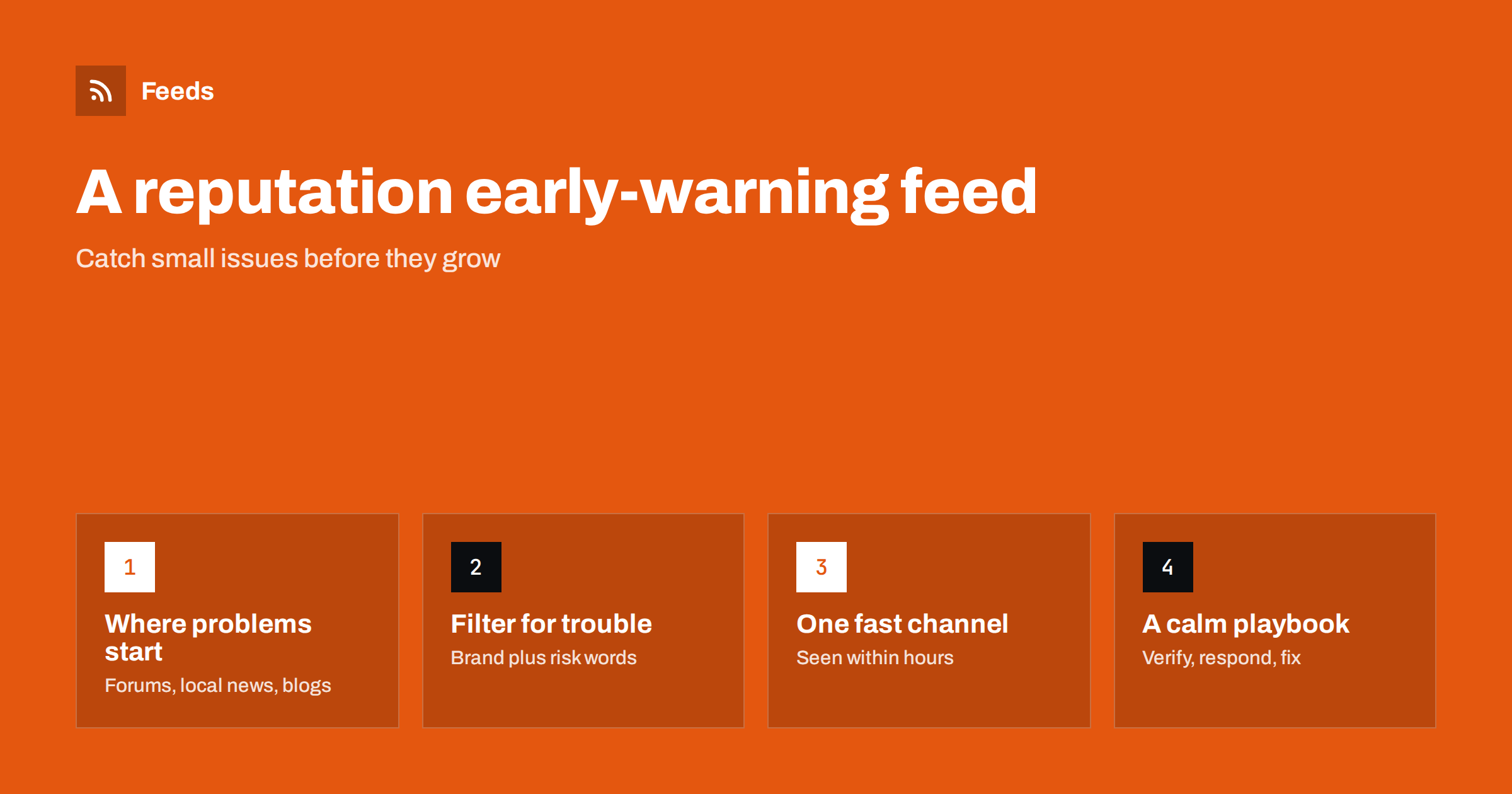
Short answer: Build one feed that combines the places where reputation problems usually start, such as customer forums and communities, local and trade news, consumer and complaint sites that publish public lists, and industry blogs. Filter it for your brand, product and executive names, and optionally for risk words like complaint, scam, recall, lawsuit and outage. Deliver it to a channel someone checks several times a day, and agree in advance on a simple playbook: verify, decide, respond, fix the cause.
Reputation crises rarely begin as crises. They start as one angry forum thread, a local news story about a delivery problem, a blog post from a disappointed customer or a complaint that nobody answered. At that stage they are easy to handle: a quick, helpful response and a fix usually end them. They become crises when they are left alone long enough to spread. An early-warning feed is simply a way to see these small signals while they are still small.
It is also a source of honest feedback. Many customers who complain publicly never contact the company directly. The issues they describe, from confusing instructions to slow deliveries, are often problems other customers experience silently. Seeing them early gives you a chance to fix the cause, not just the individual case.
Early warning versus media monitoring
Media monitoring is about coverage in general: what the press writes about you, your competitors and your market, usually reviewed daily or weekly and summarized for reports. An early-warning feed has a narrower job: surface potential problems quickly enough to act. It focuses on:
- Sources where customers speak directly, not just journalists.
- Negative or risky signals rather than all mentions.
- Speed of attention, measured in hours rather than days.
Many organizations run both, sharing some sources but with different filters and delivery. If you already have a media monitoring setup, the early-warning feed can reuse its source feeds and simply add community sources and stricter, faster delivery.
Step 1: Choose the sources where problems start
| Source | Why it matters | Feed options |
|---|---|---|
| Customer communities and forums | Customers describe problems in detail, and others join in | Many forums offer category feeds; others can be generated |
| Local news | Incidents at stores, sites or events are reported locally first | Some section feeds; generated feeds for the rest |
| Trade press | Industry insiders report problems with suppliers and partners | Section feeds are common |
| Consumer and complaint sites with public lists | Structured complaints about companies | Varies; respect each site’s terms |
| Independent blogs in your niche | Detailed critical reviews spread through search and links | Most blogs have feeds |
| Regulators’ enforcement and warning pages | Official warnings or actions naming companies | Often list pages without feeds |
Social media platforms are important too, but they are usually better covered with their own tools, since most do not offer public feeds. Your early-warning feed covers the open web around them, where stories often end up after they start elsewhere.
Step 2: Get feeds and merge them
Use existing feeds where available, particularly for forums, blogs and news sections. Create feeds from list pages that have none, such as local news sections, community boards and regulators’ warning lists, and check each preview. Merge everything into one early-warning feed. Duplicates across sources are removed automatically when items share a link.
Include the sources your own customers actually use. Ask the support team where customers mention having read or posted about you, and look at referral data in your analytics for forums and blogs that send visitors. A small, well-chosen set of sources is more useful than a long list of general sites where your brand rarely appears.
Step 3: Filter for risk
An early-warning feed needs two layers of filtering: relevance to you, and signs of trouble.
- Relevance: your brand names, product names, key executives, store or site locations, and common misspellings.
- Trouble: words like complaint, problem, refund, scam, fraud, unsafe, recall, lawsuit, outage, data breach, boycott, strike, closure.
The simplest approach is a feed filtered for relevance only, read quickly for tone. If volume is high, add the trouble words as a second, stricter feed for the fastest channel. Test both on real items for a couple of weeks, and remember that sarcasm and indirect complaints do not always contain obvious words. For your most important community sources, reading every item that mentions your brand is safer than relying on trouble words alone.
Step 4: Deliver it where it will be seen quickly
Speed is the point, so delivery matters. Send the early-warning feed to a team channel or reader that the responsible person checks several times a day, with a named backup for holidays and busy periods. Keep it separate from general news, so it does not get buried. Out of hours, decide whether anything warrants an immediate response; for most businesses, a same-day response is enough.
Agree who can respond publicly and who needs to be informed. In small companies this may be the owner alone; in larger ones, communications, customer service and legal may all have a role. Clarity about roles is what allows a fast response without mistakes.
Step 5: Agree on a response playbook
Seeing an issue early helps only if you respond well. A short playbook, agreed in calm times, prevents both panic and paralysis.
- Verify: is the report accurate? Check with the relevant team before saying anything publicly.
- Assess: is it a single customer issue, a pattern or a real risk? Who needs to know?
- Respond: where appropriate, reply publicly and helpfully, or contact the person directly. Be factual and courteous; avoid arguing.
- Fix the cause: pass the underlying problem to whoever can fix it, and follow up.
- Record: keep a log of issues, responses and outcomes. Patterns in the log are valuable feedback.
Review the log every quarter. Recurring themes, such as delivery delays in one region or confusion about one product feature, usually point to operational problems that are cheaper to fix than to keep explaining.
A worked example
A regional chain of fitness studios sets up an early-warning feed covering two local news sites in each of its five cities, a popular regional forum’s health and fitness board, three fitness blogs and the consumer protection authority’s list of warnings. The forum and most local news sections have no feeds, so the marketing manager generates them. The merged feed is filtered for the chain’s name, its studio names and the founder’s name, and delivered to a channel the manager and the operations lead both watch.
One Tuesday morning, a forum thread appears in which several members complain that a studio’s showers have been broken for two weeks. The manager checks with the studio, learns that a repair was delayed, posts a short, honest reply in the thread with the repair date and a small goodwill gesture for members, and asks operations to review how facility problems are escalated. The thread ends with members thanking the studio for responding. Without the feed, the first sign might have been a local news story or a wave of cancellations.
Common mistakes
- Only monitoring major media. By the time a problem reaches major outlets, the early-warning window has closed.
- Treating every negative item as a crisis. Most are ordinary customer issues. Handle them well, and they stay small.
- Responding defensively. Arguing in public spreads the story. Acknowledge, help, fix, and move detailed conversations to a private channel where possible.
- No backup. Early warning that stops when one person is away is not early warning.
- Silent sources. Forums and local news sites change platforms. Check that feeds still find items.
How Feeds helps
Feeds turns forums, local news sections, community boards and warning lists into RSS feeds even when they publish none, using existing feeds where they exist and showing a preview before anything is created. You can merge all sources into one early-warning feed and keep only items with your words, with duplicates removed automatically. Feeds refresh on their own, with shorter intervals on paid plans, and paid plans alert you if a feed stops finding items. See the pricing page.
Related reading
- Media Monitoring with RSS: Track Brand Mentions in the News
- How to Monitor Forums and Community Sites with RSS Feeds
- How to Reduce Noise in RSS Alerts Without Missing Anything
The bottom line
Reputation problems are easiest to solve when they are small. Collect the places where they start into one feed, filter for your names and signs of trouble, deliver it to someone who looks several times a day, and respond with a calm, agreed playbook. The aim is not to control what people say, but to hear it early and put things right.
FAQ
What is a reputation early-warning feed?
It is a filtered feed of sources where problems about your brand tend to appear first, such as forums, local news and blogs, delivered quickly to someone who can respond.
How is it different from media monitoring?
Media monitoring covers coverage broadly and is often reviewed daily or weekly. An early-warning feed focuses on potential problems and is checked several times a day.
Which words should I filter for?
Your brand, product and executive names first, then trouble words such as complaint, refund, scam, recall, outage or lawsuit. Test filters on real items, since complaints do not always use obvious words.
Can RSS cover social media?
Most major social platforms do not offer public feeds, so they are usually monitored with their own tools. An RSS early-warning feed covers the open web around them.
How should we respond to a negative post?
Verify the facts, respond helpfully and politely where appropriate, fix the underlying cause and record what happened. Avoid public arguments.