ENEnglish
 LTLietuviškai
 DEDeutsch
 FRFrançais
 RUРусский
 ESEspañol
 PLPolski
 ITItaliano
 UKУкраїнська
 CSČeština
 PTPortuguês
 JA日本語
 LVLatviešu valoda
 ETEesti
 HUMagyar
 IDBahasa Indonesia
 TRTürkçe
 HIहिन्दी
 ELΕλληνικά
 ARالعربية
 THไทย
 VITiếng Việt
 RORomână
 MSBahasa Melayu
 BNবাংলা
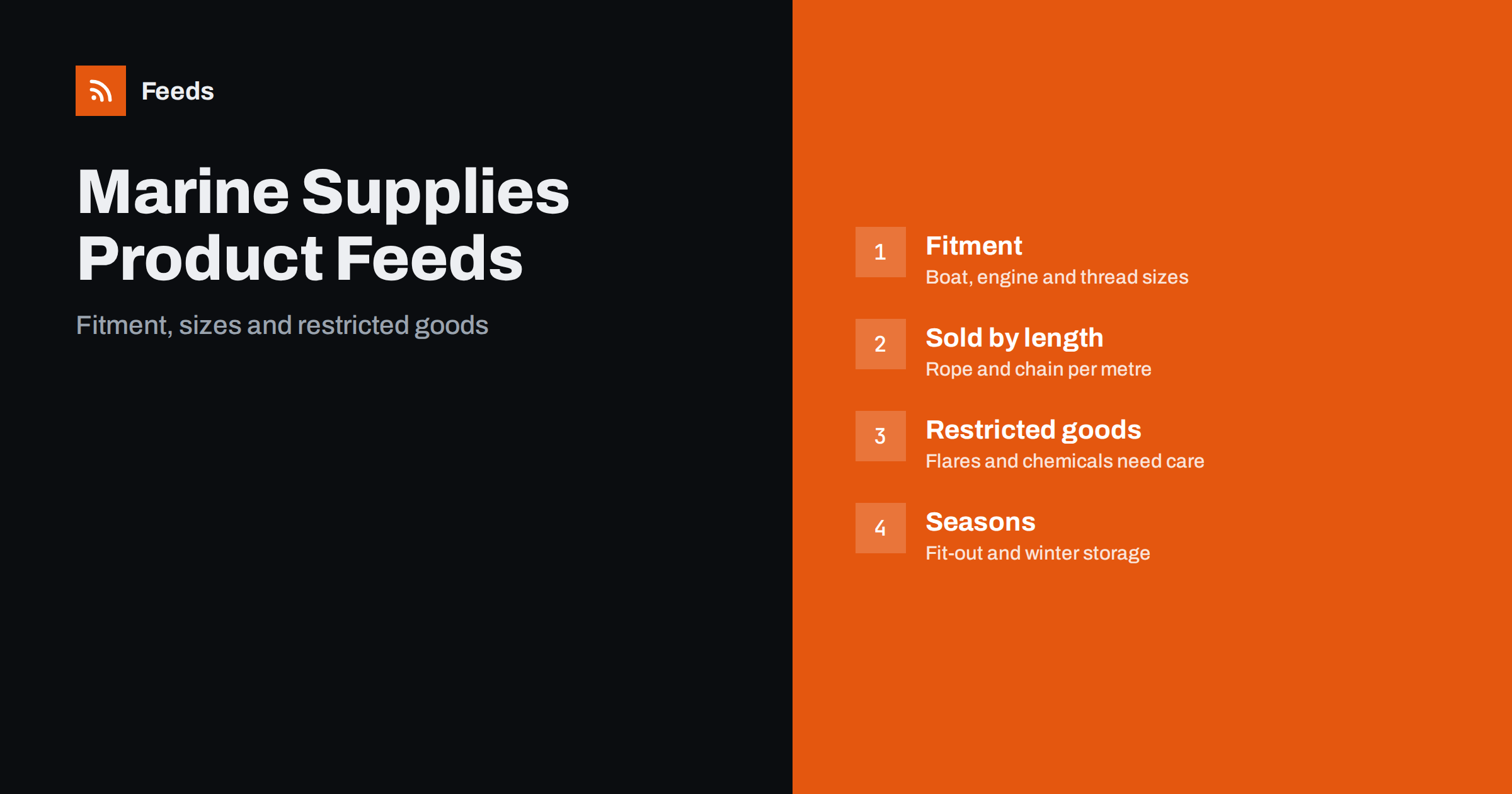
Short answer: A marine supplies feed works when each product clearly says what it fits, in which size it comes and how it is sold. Include the brand and part number, put the key fitting or size in the title, handle items sold by length with unit pricing, treat restricted goods such as flares and chemicals according to platform and carrier rules, and keep stock and shipping information honest through the busy spring season.
What makes marine products different
Boating is a hobby and a trade in which parts must fit. A fuel filter must match the engine, a fender must suit the length of the boat, a rope must have the right diameter for the cleat and a trailer part must match the axle. Customers often arrive with a model number or a measurement, and they leave the moment the page does not tell them whether the item fits.
Marine stores also have strong seasons. Demand rises in spring when boats are prepared for the water, drops in winter and returns in bursts around events and holidays. A feed that is refreshed and accurate in March matters more than one that is perfect in December. In general terms, the same discipline applies as in other fitment-driven categories, such as the one described in product feeds for auto parts stores.
Identifiers: brand, part number and barcode
Most marine products from established makers have a brand, a part number and, in many cases, a barcode number. Send all three whenever they exist. Buyers search by part number, and platforms use these identifiers to match your product to a known item.
- Brand. Use the manufacturer name, not the name of your shop or your own product line.
- Part number. Copy it exactly. In engines and electronics a single character can mean a different model.
- Barcode. Take it from the manufacturer. Do not invent codes for private label items. A product without a code should say so rather than carry a false one.
The way these three fields work together is described in GTIN, MPN and Brand: product identifiers in feeds explained.
Fitment in titles and details
A product that fits only some boats or engines needs that information in the title or in the product details. Typical fitment facts are the engine make and model range, the size or power of the engine, the hull type, the thread size of a fitting, the diameter of a hose or the length range of a boat the item is designed for.
- Write what the product is first, then its main size, then what it fits.
- Use ranges only if the manufacturer publishes them, and never claim a fit you have not confirmed.
- If a part fits dozens of models, put the full list on the product page and summarise it in the feed.
More title formulas are in product feed title optimization. A wrong fitment claim is not only a feed problem. It becomes a return, a refund and a bad review, so confirm the data with the supplier.
Sizes, colours and variants
Many marine products come in several sizes: fenders in different diameters, life jackets by weight range, cleats by length, anchors by weight and shackles by pin size. Each size is a variant of the same product. Give every variant its own part number, price, image and stock, and link the variants with one shared group identifier so that the platform shows them as options of one product. The details are in product variants in feeds: how item_group_id works.
For wearable items, such as foul-weather jackets and boots, add the standard clothing fields, including size, colour and gender, as explained in apparel product feeds. Describe the size in the same way on the page and in the feed, because a sizing mismatch is a common cause of returns.
Rope, chain and other goods sold by length
Rope, chain, cable, hose and some fabrics are often sold by the metre or in fixed reels. This creates two questions for the feed: what is the sellable unit and what is the price of it? If a customer buys one metre at a time, the feed price is the price of one metre and the quantity is chosen on the page. If the product is sold only as a 20 metre reel, the feed price is the price of the reel.
Platforms can show a price per unit of measure, which helps shoppers compare a reel of one length with another. In the Google product feed this is done with unit pricing fields. Use them where they are required or helpful, and keep the figures equal to those on the page. An explanation is in unit pricing in product feeds.
Restricted and regulated goods
Some marine products are subject to special rules, and ignoring them can lead to disapproved ads or even account problems:
- Pyrotechnic signals. Distress flares and similar items are restricted by shopping and advertising platforms in many places, and by carriers for shipping. Check the current policies before you include them in a feed, and expect that some channels will not accept them.
- Fuel, solvents, paints and chemicals. Many are classed as dangerous goods for transport. They may need special packaging, may be limited to certain destinations and are sometimes restricted in advertising.
- Antifouling and similar coatings. Rules for what can be sold and used differ between countries, and the information on the product page must be accurate.
- Safety equipment. State only the approvals and standards that the product actually carries, as written on the product or its documentation.
Avoid exaggerated safety language. A sentence that implies a life jacket will guarantee rescue is a claim you cannot support. Stick to the facts: the rated buoyancy, the weight range and the approval marking. The wording rules that platforms apply to listings are discussed in Merchant Center misrepresentation.
Shipping bulky and heavy items
A marine store ships everything from a small shackle to an outboard engine, a dinghy or a 25 kg anchor. Rates and delivery times must match what the feed or account says, or the platform will flag the mismatch. Use the product weight, state oversize items clearly and set realistic delivery times, because customers who buy before a weekend on the water have little patience. Decide where your shipping rules live in shipping in product feeds: account settings vs attributes.
If you sell to several countries, remember currency, tax and different restrictions on dangerous goods. The article on multi-country product feeds and currency covers the basics.
Seasonal stock and clear availability
Some items sell out in spring and are not restocked until the next year. Mark them as out of stock when they are, and use pre-order or back-order values only when the date and the terms are real. Do not leave unavailable products live because of the season, since a shopper who sees a product and cannot buy it will blame the shop. If you plan to promote winter storage or spring fit-out ranges, prepare the products and the feed in advance, using the planning method from Black Friday product feed prep, which applies to any peak period.
How RSS Feed Creator helps
RSS Feed Creator builds Google Merchant Center and Meta catalog XML straight from your store. WooCommerce and Shopify are read automatically, and any other store can use a CSV link. You can skip out-of-stock products, rewrite titles with rules, which helps when you want the size and fitment in every title, and adjust prices. The currency is detected automatically. Check the preview and the Merchant Center diagnostics to confirm that the fields you rely on, such as part numbers, arrive as expected. The free plan includes product feeds with up to 50 products, and the Store plan covers one store with 3 product feeds and up to 2,000 products. The details are on the pricing page.
Related reading
- Product Feeds for Sports and Outdoor Stores: What to Include
- Out-of-Stock Products in Your Feed: Keep, Mark or Remove?
- Product Feed Checklist: 25 Checks Before You Submit
The bottom line
For marine supplies, put the brand, part number and fitment in front of the shopper. Handle sizes as variants, treat goods sold by length with unit pricing, check the rules for flares and chemicals before you list them and keep stock and shipping honest through the busy season. A smaller feed with accurate fitment data is better than a large one with guesses.
DUK
What fitment information should a marine product feed include?
Include the engine make and range, the size or power, the boat length range, the thread or pipe size and similar facts that decide whether a part fits. Use only data confirmed by the manufacturer or supplier.
How do I list rope or chain sold by the metre?
Make the sellable unit clear. If customers buy by the metre, the feed price is the price per metre, and unit pricing can help shoppers compare. If only fixed reels are sold, the price is for the reel.
Can I advertise flares and marine chemicals?
Often only with restrictions. Platforms and carriers limit pyrotechnics and many chemicals, so check the current policies for each channel and country before you add them to a feed.
How should I handle sizes of life jackets and clothing?
Treat each size as a variant with its own part number and stock, group the variants and describe the size rule, such as the weight range, in the same way on the page and in the feed.
What should I do with seasonal products that sell out?
Mark them as out of stock until they return, or remove them from the feed. Use pre-order values only when you have a real date and clear terms for the customer.