ENEnglish
 LTLietuviškai
 DEDeutsch
 FRFrançais
 RUРусский
 ESEspañol
 PLPolski
 ITItaliano
 UKУкраїнська
 CSČeština
 PTPortuguês
 JA日本語
JA日本語 LVLatviešu valoda
 ETEesti
 HUMagyar
 IDBahasa Indonesia
 TRTürkçe
 HIहिन्दी
 ELΕλληνικά
 ARالعربية
 THไทย
THไทย VITiếng Việt
 RORomână
 MSBahasa Melayu
 BNবাংলা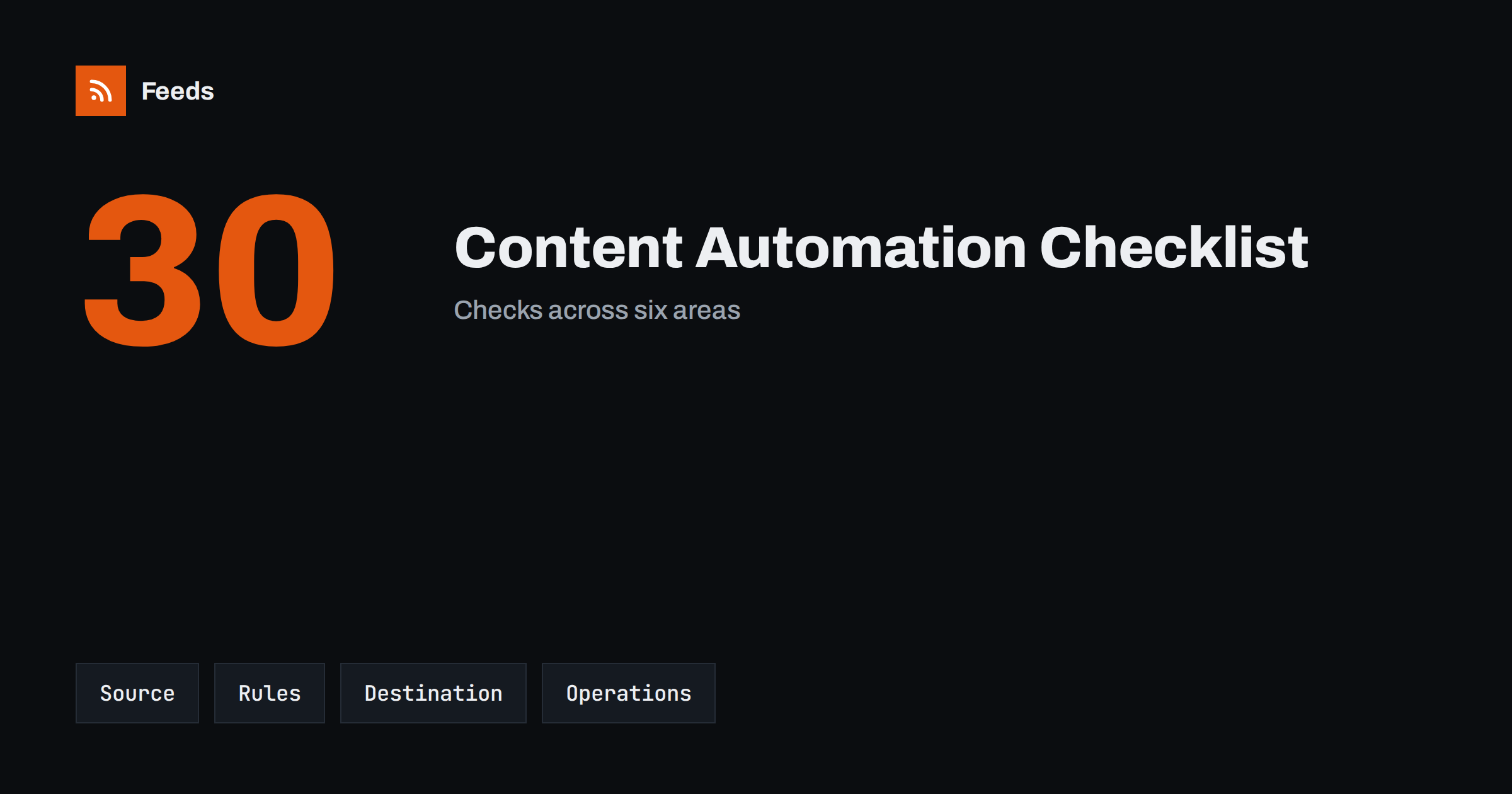
Short answer: Before switching on a content automation, check six areas: the purpose (what, for whom, how often), the source feed (valid, complete, stable links and images), the rules (filters, caps, posting windows, new items only), the destination (correct account, permissions, templates, previews), tracking (UTM parameters and analytics) and operations (owner, failure alerts, documentation and a review date). The 30 checks below take less than an hour and prevent most of the problems that make automation embarrassing.
How to use this checklist
Go through the list once for every new workflow, and again whenever you change its source, destination or tool. Not every point applies to every workflow; a team news channel needs fewer checks than a public social account. Mark items that do not apply rather than skipping them silently, so a colleague reviewing the setup can see they were considered.
The checks are grouped in the order a workflow runs: purpose first, then the source, the rules, the destination, measurement and ongoing operations. Problems in earlier groups tend to cause problems in later ones, so fixing things in this order saves time.
Keep a copy of the completed checklist with the workflow’s documentation. When something breaks months later, knowing exactly how it was set up is the fastest route to a fix.
Purpose (checks 1–4)
- The goal is written in one sentence. For example: “Share every new blog article on our LinkedIn page within a few hours of publication.” A clear goal settles later questions about filters and frequency.
- The audience is defined. Customers, prospects, colleagues or partners each need different content, tone and frequency.
- The expected volume is estimated. How many items per day or week will this workflow handle? The answer affects tool choice, costs and pacing.
- Someone has decided that automation is appropriate. Content that needs judgment every time, such as sensitive announcements or third-party material under your brand, may need an approval step instead.
Source feed (checks 5–10)
- The feed URL opens and returns valid XML. Run it through a feed validator once. Invalid feeds may work in one tool and fail in another.
- The newest items match the newest content on the site. If they do not, caching or plugin settings may be serving an old feed.
- Every item has a meaningful title. Titles are copied as they are; vague titles produce vague posts. If your team often writes short or playful headlines, agree on a rule that the title must make sense on its own in a social feed or an email.
- Links are canonical and stable. No session IDs or changing parameters, consistent HTTPS and trailing slashes, and a plan never to change URLs after publishing.
- Images are present in the feed or as Open Graph images on the linked pages, at a reasonable size. Check a few items without a featured image too, and decide whether they should be posted at all.
- The feed contains only what should be distributed, or you use a category feed or filter to narrow it. Sources without RSS have a created feed rather than an improvised scraper.
Rules (checks 11–16)
- “Only new items” is selected, so the archive is not published on the first run. If your tool has no such option, run the first check with the destination disconnected or in test mode, so existing items are marked as seen without being posted.
- Keyword or category filters include what belongs and exclude recurring noise.
- Duplicates are handled, especially when several sources feed one destination. Merge overlapping sources into one feed with duplicate removal rather than connecting each separately.
- A daily cap limits how many items can go out per destination. Decide what happens above the cap: items wait, are skipped, or are grouped into a digest.
- Minimum spacing and a posting window prevent bursts and night-time posts.
- A delay after publication of a few minutes lets images and metadata settle before networks cache the preview.
Destination (checks 17–22)
- The correct account or page is connected, such as the company page rather than a personal profile. With several brands or locations, double-check that each feed is linked to the right page; mix-ups here are very visible.
- The connection uses a business-owned role or shared account, not the personal account of someone who may leave.
- Each destination has its own template that suits its length limits and tone. Read ten generated posts in a row; if they feel monotonous to you, they will feel monotonous to followers.
- Link previews look right, confirmed with the network’s preview or debugging tool where one exists.
- Notification behaviour is sensible: no mass mentions in chat, silent posts for minor items in channels where that is possible.
- A test item has been published and checked on the live destination, on desktop and mobile, not only in the tool’s log.
Tracking (checks 23–25)
- UTM parameters are added in the posting tool or template, following your naming convention.
- Tagged links survive redirects on your site; open one in a private window to confirm.
- A baseline is noted, such as current traffic from the channel, so you can judge the workflow’s effect later. Without a before-and-after comparison, it is hard to tell whether the automation changed anything.
Operations (checks 26–30)
- An owner is named who checks the workflow and is contacted when it fails, plus a backup for holidays and absences.
- Failure notifications are on and routed to a shared inbox or channel.
- Source monitoring exists for feeds that may break when a page changes.
- The workflow is recorded in a register with source, filters, destination, template, tool, owner and creation date.
- A review date is set, for example quarterly, and a pause procedure is known for crises or major site changes.
The checks people skip most often
In practice, a handful of checks are skipped far more often than the rest, and they account for most incidents.
- Check 11, only new items. Forgetting it causes the classic archive flood on day one.
- Check 18, business-owned connection. Skipping it means the workflow dies when a freelancer or employee leaves.
- Check 22, live test. Tools report success while the post looks broken; only the real destination tells the truth.
- Check 27, failure notifications. Without them, stoppages are discovered weeks later by accident.
- Check 29, the register. Without it, nobody knows what runs where, and cleanup becomes guesswork.
If you only have ten minutes, do these five. They cost almost nothing to set up and protect against the failures that are most visible to customers and most annoying to fix after the fact.
It is also worth repeating a few checks after any significant change on your website. A redesign, a new theme, a CMS migration or a new SEO plugin can change feed URLs, item IDs, image tags and redirects all at once. Checks 5 to 9, 20 and 24 are the ones most likely to be affected. Running through them right after the change, and watching the next few automated posts closely, catches problems while they are still easy to fix.
Getting the source right with Feeds
Checks 5 to 10 and 13 are about the source, and they are where many workflows are weakest. Feeds helps with them directly. It creates RSS feeds from pages that list articles, with titles, images, summaries and dates, and uses a site’s own feed where one exists. You see a preview of the found items before a feed is created, so you can check titles and images upfront. Several sources can be merged, items kept or dropped by keyword and duplicates removed automatically. Feeds refresh on their own, and paid plans alert you when a feed stops finding items, which covers check 28. See the pricing page for plans.
Related reading
- What Is Content Automation? A Practical Guide for Small Teams
- 12 Content Automation Mistakes and How to Avoid Them
- RSS Automation Stopped Posting? A Step-by-Step Diagnosis
- How to Measure Whether Content Automation Is Worth It
The bottom line
Thirty checks sound like a lot, but most take a minute, and together they prevent nearly every common automation failure. Define the purpose, validate the source, set filters and pacing, connect the right account with proper templates, add tracking and make someone responsible with alerts and a register. Then publish a test item and look at the real result before you let the workflow run on its own.
DUK
Do I need to complete all 30 checks for every workflow?
Go through all of them, but mark the ones that do not apply. A private team channel needs fewer checks than a public social account or a customer newsletter.
What is the most important check?
Publishing a test item and checking it on the live destination. Many setup problems only become visible in the real post, not in the tool’s log.
How often should I repeat the checklist?
For every new workflow, and again whenever you change the source, the destination or the tool. A lighter review each quarter keeps running workflows healthy.
Why does it matter who connected the social account?
Connections made with a personal account stop working when that person loses access or leaves. Business-owned roles or shared accounts keep workflows running.
Where should the workflow register be kept?
Anywhere the team can find and edit it, such as a shared spreadsheet. What matters is that every workflow is listed with its source, destination, tool and owner.
Can the checklist be used for product feeds too?
Many checks apply, such as source quality, stable links, images, ownership and monitoring. Product feeds for shopping platforms also have their own required attributes, so combine this list with the platform’s feed specification.