ENEnglish
 LTLietuviškai
 DEDeutsch
 FRFrançais
 RUРусский
 ESEspañol
 PLPolski
 ITItaliano
 UKУкраїнська
 CSČeština
 PTPortuguês
 JA日本語
JA日本語 LVLatviešu valoda
 ETEesti
 HUMagyar
 IDBahasa Indonesia
 TRTürkçe
 HIहिन्दी
 ELΕλληνικά
 ARالعربية
 THไทย
THไทย VITiếng Việt
 RORomână
 MSBahasa Melayu
 BNবাংলা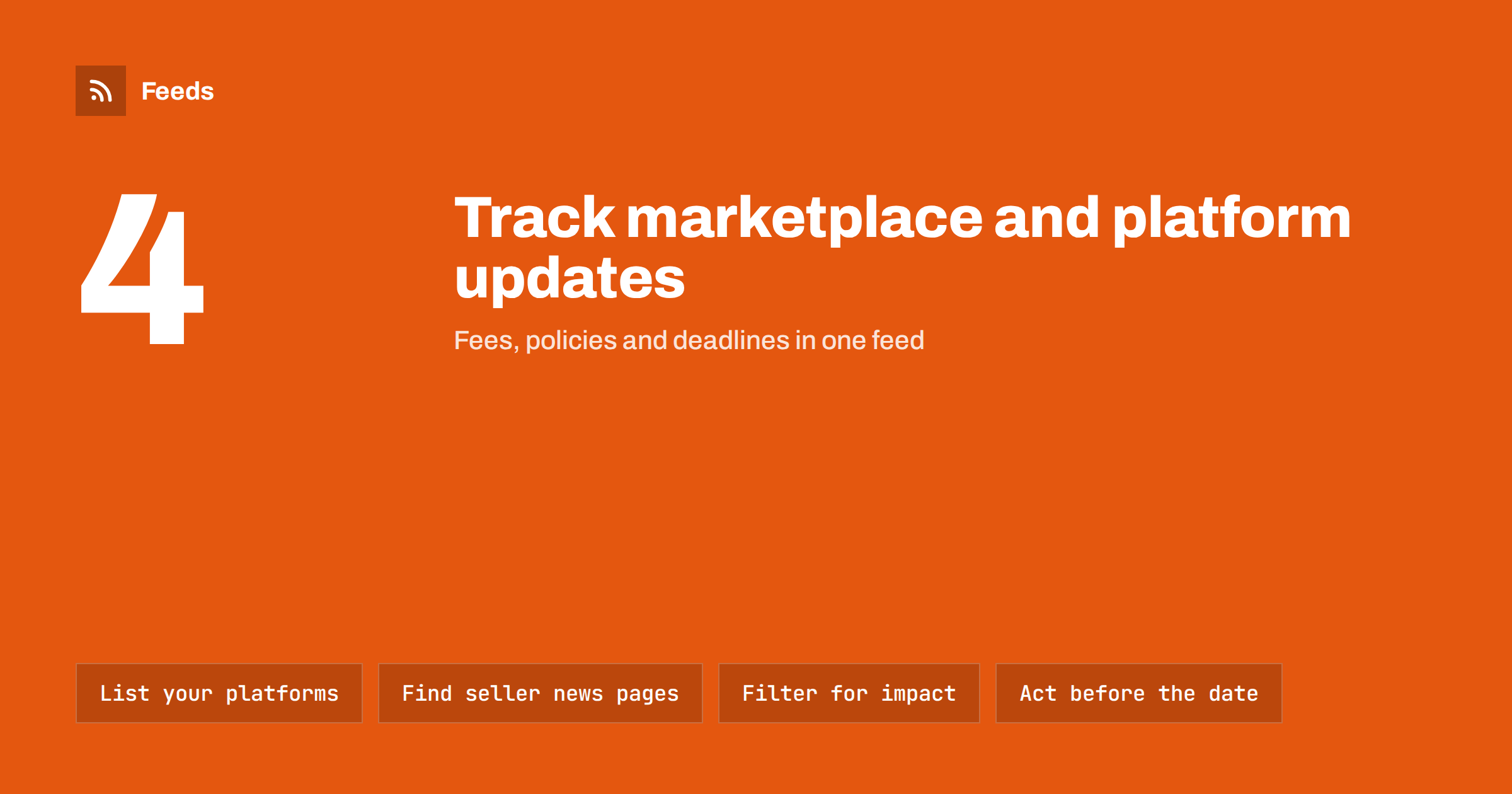
Short answer: Make a list of every platform you sell or advertise through, such as marketplaces, your shop platform, advertising and shopping platforms, payment providers and shipping services. For each, find the public seller news, announcements, policy update or changelog page, subscribe to its feed or generate one, and merge them into one seller-updates feed. Filter for words like fee, policy, required, deadline and deprecated, and put every change with a date into your calendar.
Online sellers live on other companies’ platforms. Marketplaces adjust fees and rules, shop platforms change features and apps, advertising platforms update policies and product requirements, payment providers change terms, and shipping services revise surcharges. Each change is announced, usually weeks in advance, but on a different page for each platform, often inside a seller portal or a help center news section that nobody checks regularly. Missing one can mean suspended listings, rejected ads or unexpected costs.
Larger sellers often have someone whose job includes watching platform news. Small sellers usually do not; the owner handles it between orders, customer questions and marketing. That is exactly why a single feed matters: instead of remembering to visit nine help centers, the owner reads one list of new announcements once or twice a week and knows nothing important slipped past.
Which platforms to cover
| Platform type | What changes | Where it is announced |
|---|---|---|
| Marketplaces | Fees, category rules, listing requirements, performance metrics | Seller news, policy updates, seller forums |
| Shop platform | Features, checkout changes, app and theme requirements | Changelog, product updates, developer news |
| Advertising and shopping platforms | Ad policies, product data requirements, account rules | Policy change logs, announcements |
| Payment providers | Fees, supported methods, compliance requirements | News, changelog, merchant notices |
| Shipping and fulfilment | Rates, surcharges, service changes | Customer notices, news |
| Tax and customs authorities | Rules for cross-border selling | News and guidance pages |
Step 1: Find the public announcement pages
Many platforms publish seller-relevant news in a public place, even if the full details live in a logged-in seller portal. Look for:
- “Seller news”, “announcements” or “what’s new” sections of help centers.
- Policy change logs, which some advertising and shopping platforms maintain as dated lists.
- Product update pages or changelogs of shop platforms.
- Developer or partner news, where technical changes are announced first.
- Official seller community boards, where platforms post announcements.
Spend a few minutes on each platform’s help center to find these pages; they are rarely linked prominently. Search the help center for “announcements” or “what’s new”, or look at the footer links. Once found, note the address in your source list so the search never needs repeating.
Announcements that exist only inside a logged-in seller portal cannot be followed with public feeds. For those, make sure the platform’s own notifications go to an inbox someone reads, and check the portal’s news section on a schedule.
Seller communities and independent trade publications for e-commerce can also help. They often summarize platform changes quickly and discuss their practical impact, and many of them offer feeds. Treat them as a second opinion, and confirm details on the platform’s own pages before acting.
Step 2: Subscribe or generate feeds
Some of these pages offer RSS, particularly changelogs, developer blogs and community boards. Help center news sections and policy change logs often do not. For those, create feeds from the list pages with a page-to-feed tool, and check the preview to confirm each item is one announcement or policy change with its own link.
If a policy change log is a single page with dated paragraphs rather than separate entries, a feed may not separate the changes cleanly. In that case, a page change monitor on that page is the better tool, or a combination of both. Whichever you use, check the first few items against the page to be sure nothing important is being skipped or merged together.
Step 3: Merge and filter for impact
Merge all platform feeds into one seller-updates feed. Busy platforms publish many items that do not affect you, so filter those sources for words that signal impact:
- fee, pricing, rate, surcharge
- policy, requirement, required, mandatory, compliance
- deadline, effective, starting, from
- deprecated, retired, no longer supported, removed
- your categories, countries and key features you use
Keep low-volume sources, such as your payment provider’s merchant notices, unfiltered. It is better to glance at an irrelevant notice than to miss a fee change.
Cross-border sellers
If you sell into several countries, add the news or guidance pages of the tax and customs authorities in your main markets, and the country-specific seller news of each marketplace. Rules on VAT collection, product labelling, packaging and extended producer responsibility vary by country and change regularly. These pages are usually plain lists without feeds, so generated feeds are the practical way to follow them. Filter them for words related to online selling, imports and your product categories, since tax authorities publish a great deal that does not concern e-commerce.
Deciding what affects you
Not every announcement needs action. A quick triage helps: does it apply to my country, my category, the features I use, and my size of business? Many platform rules have thresholds, for example applying only above a certain sales volume or only to certain product types. Write a one-line decision for each relevant item, such as “applies from June, update product data” or “does not apply, we do not sell in that category”. Over time, these notes become a record of how your business has adapted to each platform.
Step 4: Turn announcements into dated tasks
Most platform changes come with an effective date. The single most useful habit is to put that date, and a preparation task a couple of weeks earlier, into your calendar or task list as soon as you see the announcement.
- Read the announcement and decide whether it affects you.
- If it does, write down what needs to change: prices, listings, product data, settings, integrations.
- Assign an owner and a due date before the effective date.
- After the date, check that the change was handled.
For price and fee changes, also update your margin calculations. Small fee changes across many orders add up quickly. A short spreadsheet with each platform’s current fees and the date you last confirmed them makes these updates easy and gives you a clear picture of which channel is really most profitable.
Common mistakes
- Relying on platform emails alone. They are easy to miss among promotional messages from the same platform.
- Following only the main marketplace. Advertising, payment and shipping changes can hurt just as much.
- Reading without scheduling. An announcement read in March and forgotten by the May deadline is no help.
- Filtering low-volume sources. Critical notices may not contain your filter words.
- Not revisiting the list. When you add a new sales channel, add its announcement pages too.
A worked example
A small seller of home goods sells through its own shop, two marketplaces and a shopping ads platform, takes payments through one provider and ships with two carriers. The owner finds nine public announcement pages across these services; four have feeds, five are help center news pages without feeds, which she generates. Everything goes into one feed filtered for the impact words above, except the payment provider and carriers, which stay unfiltered.
Over a quarter the feed surfaces a marketplace fee change for her main category, a new product data requirement from the shopping ads platform and a carrier surcharge for remote areas. Each goes into her calendar with a preparation date. She adjusts prices before the fee change, updates product data before listings would have been limited, and changes her shipping rates in time. None of these came as a surprise, and the whole routine took her about fifteen minutes a week.
How Feeds helps
Feeds turns public help center news pages, policy logs and changelogs into RSS feeds when they have none, and uses existing feeds when they do, with a preview before anything is created. You can merge all your platforms into one seller-updates feed and keep only items with your words, with duplicates removed automatically. Feeds refresh on their own, and paid plans alert you if a feed stops finding items, which matters because help centers are reorganized often. See the plans.
Related reading
- How to Follow Software Changelogs and Release Notes with RSS
- How to Monitor SaaS Status Pages and Outages with RSS
- How to Track Product Recalls and Safety Notices with RSS
The bottom line
Platform changes are announced in advance, but scattered. List every platform you depend on, follow their public announcement pages through feeds, filter busy sources for words that signal impact, and convert every relevant announcement into a dated task. It is a small habit that prevents suspended listings, rejected ads and surprise costs.
DUK
How can I keep up with marketplace policy changes?
Follow the marketplace’s public seller news or policy update pages as feeds, together with your other platforms, and filter for words like fee, policy and deadline.
What if announcements are only inside the seller portal?
Public feeds cannot follow logged-in pages. Make sure the platform’s notifications reach an inbox someone reads, and check the portal news section on a schedule.
Which platforms should an online seller monitor?
Every marketplace and shop platform you sell through, advertising and shopping platforms, payment providers, shipping carriers, and tax authorities for markets you sell into.
Should I filter platform announcement feeds?
Filter busy platforms for impact words, but keep low-volume sources such as payment and carrier notices unfiltered so critical changes are not missed.
What is the most useful habit for platform changes?
Put each relevant change’s effective date and a preparation task into your calendar as soon as you see the announcement.