ENEnglish
 LTLietuviškai
 DEDeutsch
 FRFrançais
 RUРусский
 ESEspañol
 PLPolski
 ITItaliano
 UKУкраїнська
 CSČeština
 PTPortuguês
 JA日本語
JA日本語 LVLatviešu valoda
 ETEesti
 HUMagyar
 IDBahasa Indonesia
 TRTürkçe
 HIहिन्दी
 ELΕλληνικά
 ARالعربية
 THไทย
THไทย VITiếng Việt
 RORomână
 MSBahasa Melayu
 BNবাংলা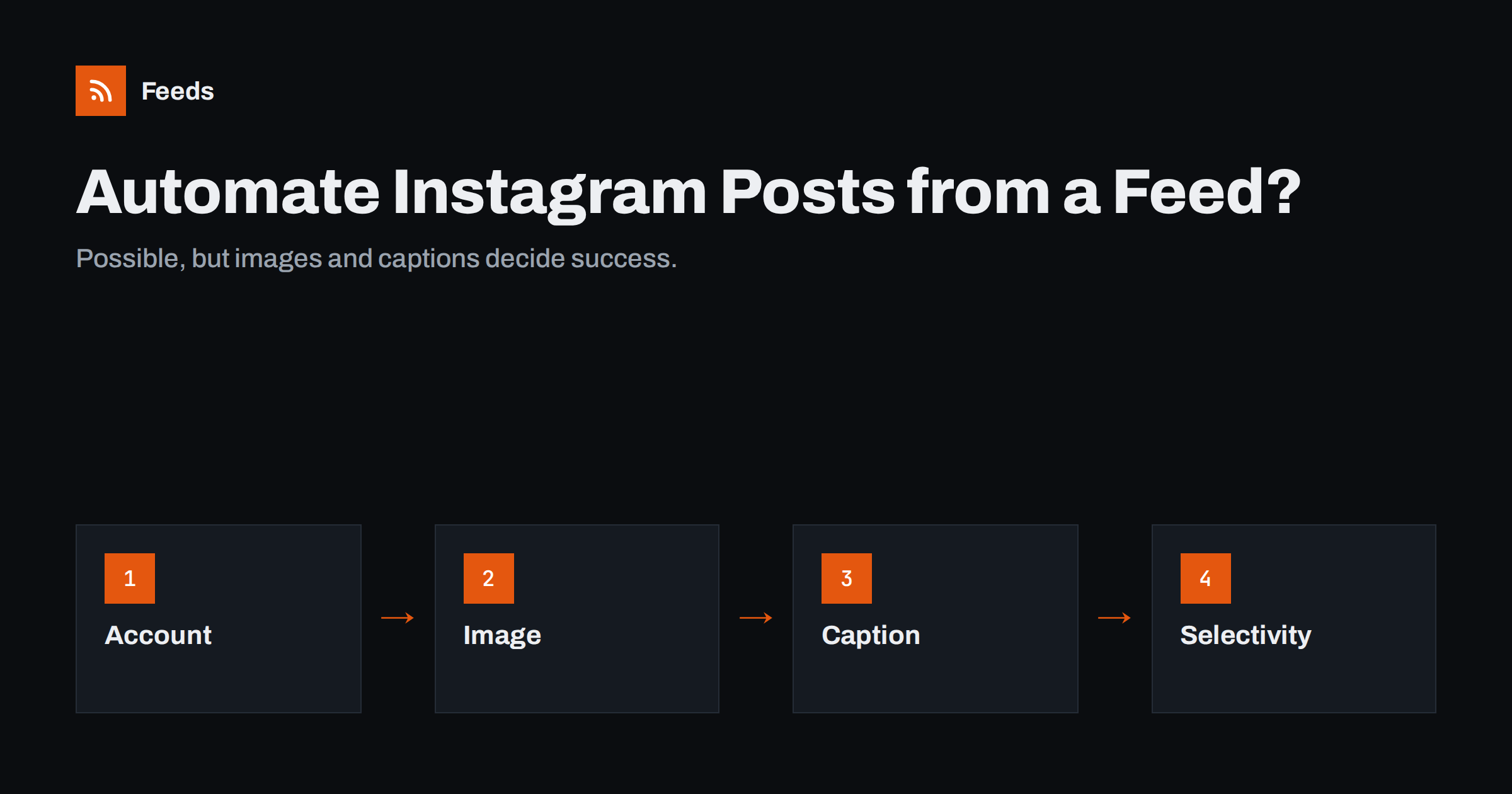
Short answer: Yes, you can automate Instagram posts from an RSS feed, but with more conditions than on other networks. You need an Instagram professional account (business or creator) connected to a posting tool that uses Meta’s official publishing API, every feed item must carry a usable image, and links in captions are not clickable, so the post has to work on its own. Because Instagram is so visual, most businesses get better results by automating selectively, such as new products or articles with strong images, rather than posting every feed item.
Why Instagram is different from other networks
On Facebook, LinkedIn, X or Telegram, an automated post can be little more than a link: the network builds a preview card, and readers click through. Instagram does not work that way.
- Image or video first. Every feed post needs visual media. There is no text-only or link-only post in the main feed.
- No clickable links in captions. A URL in a caption is just text. Traffic usually goes through a link in the profile, stories features or shopping tags.
- Aspect ratio limits. Images must fall within Instagram’s supported ratios, roughly from landscape to portrait, or they are cropped or rejected.
- High visual standards. Followers scroll past anything that looks like a generic blog thumbnail.
Instagram also treats the profile as a whole. Visitors often judge an account by its grid of recent posts, so every automated post becomes part of the brand’s first impression, not just a passing item in a timeline.
Finally, reach on Instagram depends heavily on engagement in the first hours after posting, and automated posts published at odd hours with generic captions tend to receive little of it.
These differences do not make automation impossible, but they change what a good automated workflow looks like.
What you need
- An Instagram professional account. Business and creator accounts can publish through Meta’s API; personal accounts generally cannot be automated this way.
- A connection to a Facebook Page or the setup your posting tool requires under Meta’s current rules.
- A posting tool that supports Instagram publishing through the official API. Avoid tools that ask for your Instagram password directly.
- A feed with images in a field the tool can read, such as
media:content,enclosureor an image in the item content. - Images that suit Instagram’s formats, ideally square or portrait.
Which feeds work well
Some kinds of content translate naturally to Instagram posts; others do not.
| Feed content | Fit for automated Instagram posts |
|---|---|
| New products with good photos | Good |
| Real estate listings, cars, rentals | Good, if photos are high quality |
| Recipes, travel, design articles | Good with strong featured images |
| Events with designed posters | Good |
| News headlines with stock photos | Weak |
| Text-heavy B2B articles | Weak; consider designed quote cards instead |
| Job listings | Weak individually; better as a weekly designed roundup |
Preparing images for automation
The image is the post, so make the source images Instagram-ready.
- Use a consistent featured image format. A square or 4:5 portrait version works best in the feed. If your site uses wide images, create an additional square version per item and put that in the feed.
- Keep the subject centred with margins, so crops do not cut important parts.
- Add minimal text on the image if you want the topic readable, for example a short title on a branded background. Keep it large and legible on a phone.
- Use high resolution. Instagram displays images at around 1080 pixels wide; small thumbnails look blurry.
- Check that images are publicly accessible over HTTPS, since the publishing API fetches them from their URL.
Writing captions without clickable links
Because the link will not be clickable, the caption must provide value on its own and tell people where to go.
- Start with the most interesting line, since only the first line or two show before “more”.
- Summarise the key point of the article or product in a sentence or two.
- Point to the link in bio or a link page, and keep that page updated with the latest items. Some link-in-bio tools can update automatically from a feed.
- Use relevant hashtags, which still help discovery on Instagram, but keep them focused; a handful of specific tags beats a wall of generic ones.
- Avoid raw URLs in the caption; they look messy and cannot be tapped.
Also think about your link-in-bio page as part of the workflow. If each automated post says “link in bio”, the page behind that link must show the new item near the top the moment the post appears. A simple page on your own website that lists your latest articles or products, updated automatically, does this well and keeps visitors on your own domain.
Setting up the workflow
- Connect the Instagram professional account to your posting tool.
- Add the feed and check that the tool detects an image for each item.
- Choose “new items only”.
- Write a caption template and add fixed hashtags per feed or category.
- Set a low daily cap, often one post a day or fewer.
- Consider draft or approval mode, so someone checks the image crop before it goes live.
- Test with one item and look at the post in the Instagram app.
Semi-automation: often the better approach
For many brands, the most effective Instagram workflow is not fully automatic. It is a pipeline where software does the collecting and preparation, and a person makes the final choice.
- Automatic drafts. New feed items become drafts in your posting tool, with image and caption pre-filled. Someone reviews them once a day, adjusts the crop or caption and schedules the best ones. This keeps nearly all of the time savings while protecting visual quality.
- Designed templates. Some teams use design tools with templates that take a title and image and produce a branded square graphic. The feed provides the text; the template ensures a consistent look. The result is then published automatically or approved first.
- Weekly carousels. Instead of one post per item, a weekly carousel can present five new articles, products or listings as slides. It is a single, richer post that followers can swipe through, and it avoids flooding the feed.
- Stories for the rest. Stories disappear after a day and are a natural place for less important items, reminders and quick updates. Scheduling tools that support stories let you use them without cluttering the main grid.
Whichever approach you choose, look at your profile grid as a visitor would every few weeks. If automated posts make it look inconsistent or cluttered, tighten the selection or switch to drafts. On Instagram, the overall look of the profile influences whether new visitors decide to follow.
Common problems
- Post failed: no media. The feed item has no image the tool can read. Add images to the feed or skip items without them.
- Image rejected or badly cropped. The aspect ratio is outside Instagram’s limits, or the subject sits at the edge. Use square or portrait images.
- Blurry images. The feed contains thumbnails instead of full-size images.
- Connection expired. Meta connections need periodic re-authorisation, especially after password or security changes.
- Low engagement. The content does not suit Instagram, or posts are too frequent. Post fewer, more visual items.
Where Feeds fits
For shops, Instagram’s shopping features rely on a product catalog rather than a posting feed. Feeds creates Meta catalog feeds from WooCommerce, Shopify or a CSV link, with rules for stock, titles and prices, which is the basis for tagging products in posts and running catalog ads. For content posts, Feeds turns pages that list items, such as a new arrivals page or a listings page, into RSS feeds with titles, images, summaries and dates, and you see the images in the preview before the feed is created. Plans are on the pricing page.
Related reading
- Why Automated Social Posts Lose Images and How to Fix It
- How to Share New Shop Products on Social Media Automatically
- How to Automate Social Media Posts from an RSS Feed
- How Often Should Automated Feeds Post to Social Media?
The bottom line
Automating Instagram from an RSS feed is possible with a professional account, an official posting tool and a feed that carries good images. Because captions cannot contain clickable links and the image carries the post, automate selectively: visual content, square or portrait images, value in the caption, a link-in-bio page and a low daily cap. For everything else, a hand-made post will usually serve you better.
DUK
Can I auto-post to a personal Instagram account?
Automated publishing through Meta’s official API is available for professional accounts, meaning business and creator accounts. Switching to a professional account is free in the app settings.
Why did my automated Instagram post fail?
The most common causes are a missing image in the feed item, an unsupported aspect ratio, an image URL that is not publicly accessible or an expired account connection.
Can automated Instagram posts include clickable links?
No. Links in captions are not clickable. Point readers to the link in your profile or a link page that lists your latest items.
How often should an automated Instagram account post?
Instagram rewards quality over quantity. For most businesses, one automated post a day or fewer, reserved for visual content, works better than posting every feed item.
Is a product catalog the same as automated product posts?
No. A catalog feed powers shopping features and ads, while automated posts publish selected items to your feed. Many shops use both.
Can I automate Instagram stories from a feed?
Some scheduling tools support publishing stories through Meta’s API, subject to its current rules. Stories are a good place for less important items, because they disappear after a day and do not clutter your profile grid.