ENEnglish
 LTLietuviškai
 DEDeutsch
 FRFrançais
 RUРусский
 ESEspañol
 PLPolski
 ITItaliano
 UKУкраїнська
 CSČeština
 PTPortuguês
 JA日本語
JA日本語 LVLatviešu valoda
 ETEesti
 HUMagyar
 IDBahasa Indonesia
 TRTürkçe
 HIहिन्दी
 ELΕλληνικά
 ARالعربية
 THไทย
THไทย VITiếng Việt
 RORomână
 MSBahasa Melayu
 BNবাংলা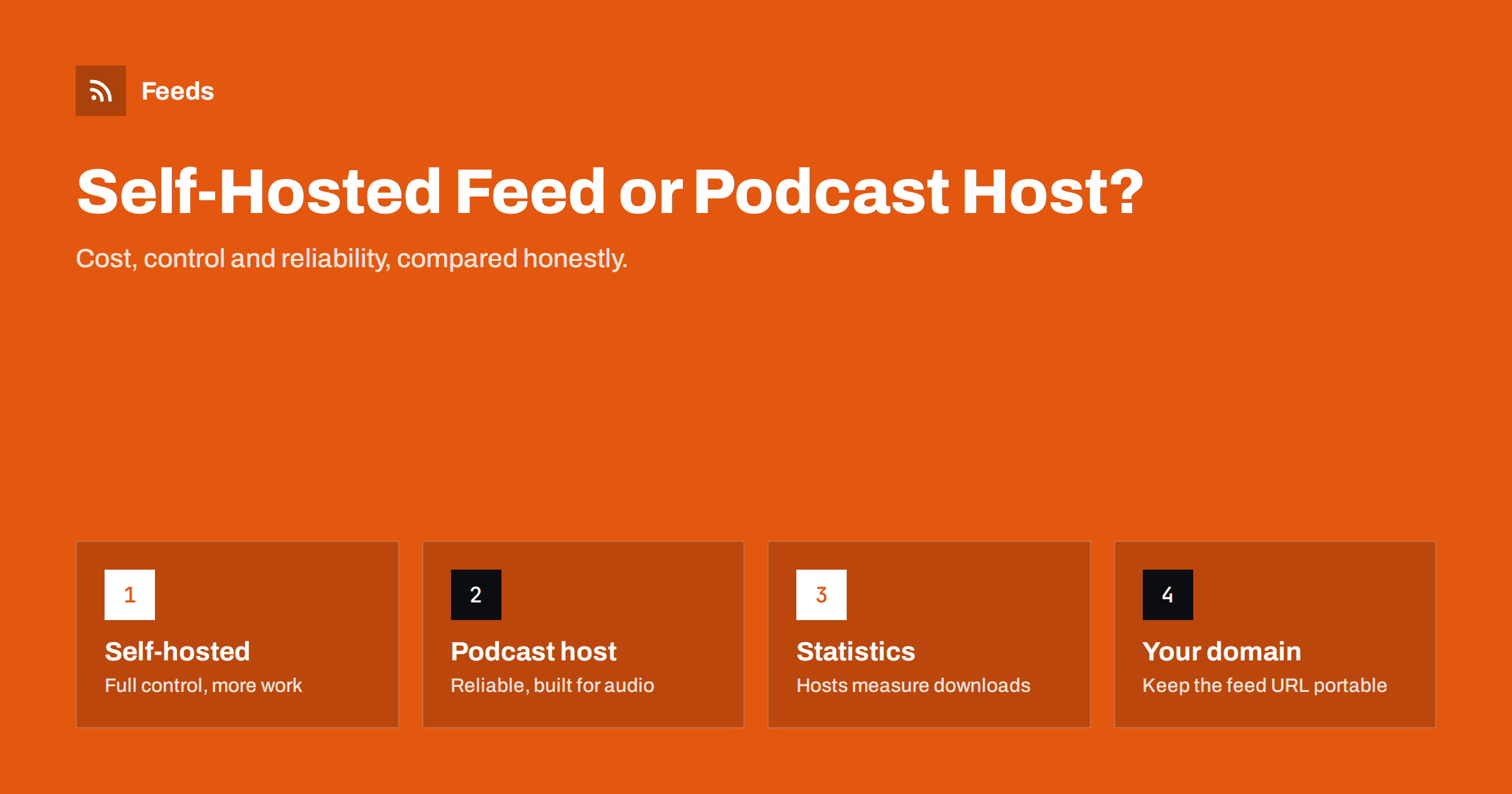
Short answer: For most podcasters, a dedicated podcast host is the better choice: it generates a compliant feed, serves audio reliably to many simultaneous listeners, provides download statistics and handles directory requirements. Self-hosting the feed and audio on your own website gives full control and can be cheap for small shows, but you take on bandwidth, range requests, validation and measurement yourself. Whichever you choose, keep the feed address on your own domain or make sure you can redirect it, so you are never locked in.
Every podcast needs two things: a feed that describes the episodes and somewhere to store the audio files. Podcast hosts bundle both, along with statistics and distribution tools. Self-hosters put the feed on their website, often with a WordPress podcasting plugin, and the audio on their web server or cloud storage. Both approaches can work well. The right choice depends on your show’s size, your technical comfort and how much control you want. This guide lays out the trade-offs so you can decide once and not regret it.
What a podcast host actually does
It is easy to think of a host as “storage for MP3s”, but it does more:
- Generates the feed with the iTunes and often Podcasting 2.0 tags, kept up to date as directories change their requirements.
- Serves audio at scale through infrastructure designed for large files, many simultaneous downloads and byte-range requests for seeking.
- Measures downloads, usually filtering bots and duplicate requests in line with industry measurement guidelines.
- Handles distribution: submitting to directories, refreshing them, and sometimes pushing updates instantly.
- Supports migrations with imports, redirects and the
itunes:new-feed-urltag. - Often adds extras: private feeds, dynamic ad insertion, transcripts, websites and embeddable players.
What self-hosting involves
Self-hosting means you are responsible for each of those jobs:
- Feed generation, usually through a podcasting plugin on WordPress or a template on a static site.
- Media storage and delivery, on your web server, a cloud storage bucket or a CDN.
- Byte-range support and HTTPS for every audio file.
- Statistics, via server logs, a plugin or a third-party measurement prefix.
- Validation and directory compliance, checked after every plugin or server change.
The appeal is understandable: one system, one login, the podcast living alongside the rest of your content, and no monthly fee to another company. None of this is difficult for someone comfortable with web hosting, but it is ongoing work, and problems often appear at the worst moment, such as when an episode suddenly becomes popular.
Side-by-side comparison
| Factor | Podcast host | Self-hosted |
|---|---|---|
| Setup effort | Low | Medium to high |
| Ongoing maintenance | Minimal | Plugin updates, server care, validation |
| Cost | Monthly fee, often tiered by uploads or downloads | Hosting and bandwidth; can be low for small shows |
| Reliability under load | Designed for it | Depends on your server or CDN |
| Download statistics | Built in, filtered | DIY, often less accurate |
| Feed control | Within the host’s options | Complete |
| Extras (private feeds, ads, transcripts) | Often included | Build or add yourself |
| Migration | Supported with redirects | Your responsibility |
Cost: look at the whole picture
Cost is often the first reason people consider self-hosting, and it deserves a careful look. Self-hosting looks cheaper because you may already pay for web hosting. But audio files are large, and bandwidth adds up: an hour-long episode is commonly tens of megabytes, multiplied by every download, including automatic downloads by apps for subscribers who never listen. Shared hosting plans often have fair-use limits that podcast traffic can exceed, and a traffic spike can slow down your whole website.
Cloud storage with a CDN solves the capacity problem, but bills then scale with downloads. For small shows with modest audiences, costs stay low either way. For growing shows, a host’s flat or tiered price is often simpler and more predictable. Include your own time in the comparison: an hour a month of maintenance has a cost too.
Statistics and advertising
If you plan to sell sponsorships, statistics matter. Advertisers generally expect download numbers measured in a consistent, industry-accepted way, with bots and duplicate requests filtered. Established hosts do this by default. Self-hosters can approximate it with log analysis or third-party measurement services that sit in front of the audio URLs, but it takes effort to produce numbers advertisers trust. Dynamic ad insertion, where ads are stitched into episodes at download time, is almost always a host feature.
Control and ownership
The strongest argument for self-hosting is control. You decide every tag in the feed, the exact URLs, and how long files are kept. You are not affected if a host changes its pricing, is acquired or closes. That concern is real, but it can be addressed without self-hosting:
- Use a host that lets you export everything, including audio and the feed.
- Keep a copy of your audio files and show notes locally.
- Make sure the host supports 301 redirects and
itunes:new-feed-urlif you ever leave. - Where possible, use a feed address on your own domain that points to the host, so a future move only changes where that address points.
With these in place, a host gives you most of the convenience with little lock-in. Before signing up, read the host’s documentation on leaving: how exports work, how long redirects stay active after cancellation, and whether episode GUIDs are preserved. A host that answers these questions clearly is usually a safe choice, and one that avoids them is a warning sign worth taking seriously.
A hybrid approach
There is no rule that you must choose one model for everything. Some podcasters combine the two: the host stores and serves audio and generates the directory feed, while the website shows episodes with a WordPress plugin that reads the host’s feed or API. Others host audio on a CDN and use a podcasting plugin for the feed, then add a measurement prefix for statistics. Hybrids can work well, but every extra moving part is one more thing to check when something breaks, so keep the setup as simple as your needs allow.
If you do self-host: a minimum setup
If self-hosting fits your situation, a few choices make it far more robust:
- Store audio on infrastructure built for large files, such as object storage behind a CDN, rather than on the same shared server as your website. Your site stays fast even when an episode is popular.
- Use one podcasting plugin or template for the feed, and do not let SEO or other plugins add competing podcast tags.
- Serve a separate podcast feed rather than turning your main blog feed into a podcast feed, so blog readers and podcast apps each get what they expect.
- Check byte-range support once for your storage and whenever you change it.
- Validate after every update of WordPress, the plugin or the server configuration.
- Back up audio files and the feed separately from the website backup, because audio archives are large and often excluded from standard backups.
- Write down the feed URL, storage location and settings, so someone else can take over or migrate the show later.
With this setup, a small self-hosted show can run reliably for years. The weak points are almost always the same: shared hosting limits, plugin conflicts and forgotten backups.
How to decide
- Just starting, want to focus on content: use a podcast host.
- Planning sponsorships: use a host with recognised statistics.
- Small internal or hobby show, technically confident, already on WordPress: self-hosting can be fine, with media on storage built for large files.
- Need private feeds or dynamic ads: a host that offers them.
- Strong ownership concerns: a host with full export plus a feed address on your own domain.
Whatever you choose, your feed can feed other channels: a website episode list, a newsletter section or a combined feed with your blog. Our tool, Feeds, can merge public feeds, including podcast feeds, into one RSS link with duplicate removal and keyword filters; it does not host audio. See the plans.
Related reading
- Podcast RSS Feeds Explained: How Episodes Reach Every App
- How to Move a Podcast Feed Without Losing Subscribers
- Podcast Feed Rejected? How to Fix the Most Common Errors
The bottom line
A podcast host handles feed generation, reliable audio delivery, statistics and directory compliance, which is why most shows should use one. Self-hosting offers full control and can be economical for small shows, at the cost of ongoing technical work. Reduce lock-in either way by keeping backups, choosing a host that supports exports and redirects, and ideally serving the feed from an address on your own domain.
DUK
Can I host a podcast on my own website?
Yes. A podcasting plugin or template generates the feed, and audio can be stored on your server or cloud storage. Make sure files are served over HTTPS with byte-range support and validate the feed regularly.
Is self-hosting a podcast cheaper?
For small shows it can be. As downloads grow, bandwidth and maintenance time add up, and shared hosting may not cope with spikes. Compare total cost, including your time.
Do podcast directories accept self-hosted feeds?
Yes, as long as the feed is valid, includes the required tags, and the audio files are reachable and correctly described. Directories do not care where the feed is hosted, only that it works reliably every time they fetch it.
How do I get reliable download statistics when self-hosting?
Analyse server logs with bot filtering, or use a third-party measurement service in front of your audio URLs. For advertiser-grade numbers, a host with recognised measurement is usually simpler.
How can I avoid being locked into a podcast host?
Keep copies of your audio and notes, choose a host that exports everything and supports 301 redirects with itunes:new-feed-url, and use a feed address on your own domain where possible.