ENEnglish
 LTLietuviškai
 DEDeutsch
 FRFrançais
 RUРусский
 ESEspañol
 PLPolski
 ITItaliano
 UKУкраїнська
 CSČeština
 PTPortuguês
 JA日本語
JA日本語 LVLatviešu valoda
 ETEesti
 HUMagyar
 IDBahasa Indonesia
 TRTürkçe
 HIहिन्दी
 ELΕλληνικά
 ARالعربية
 THไทย
THไทย VITiếng Việt
 RORomână
 MSBahasa Melayu
 BNবাংলা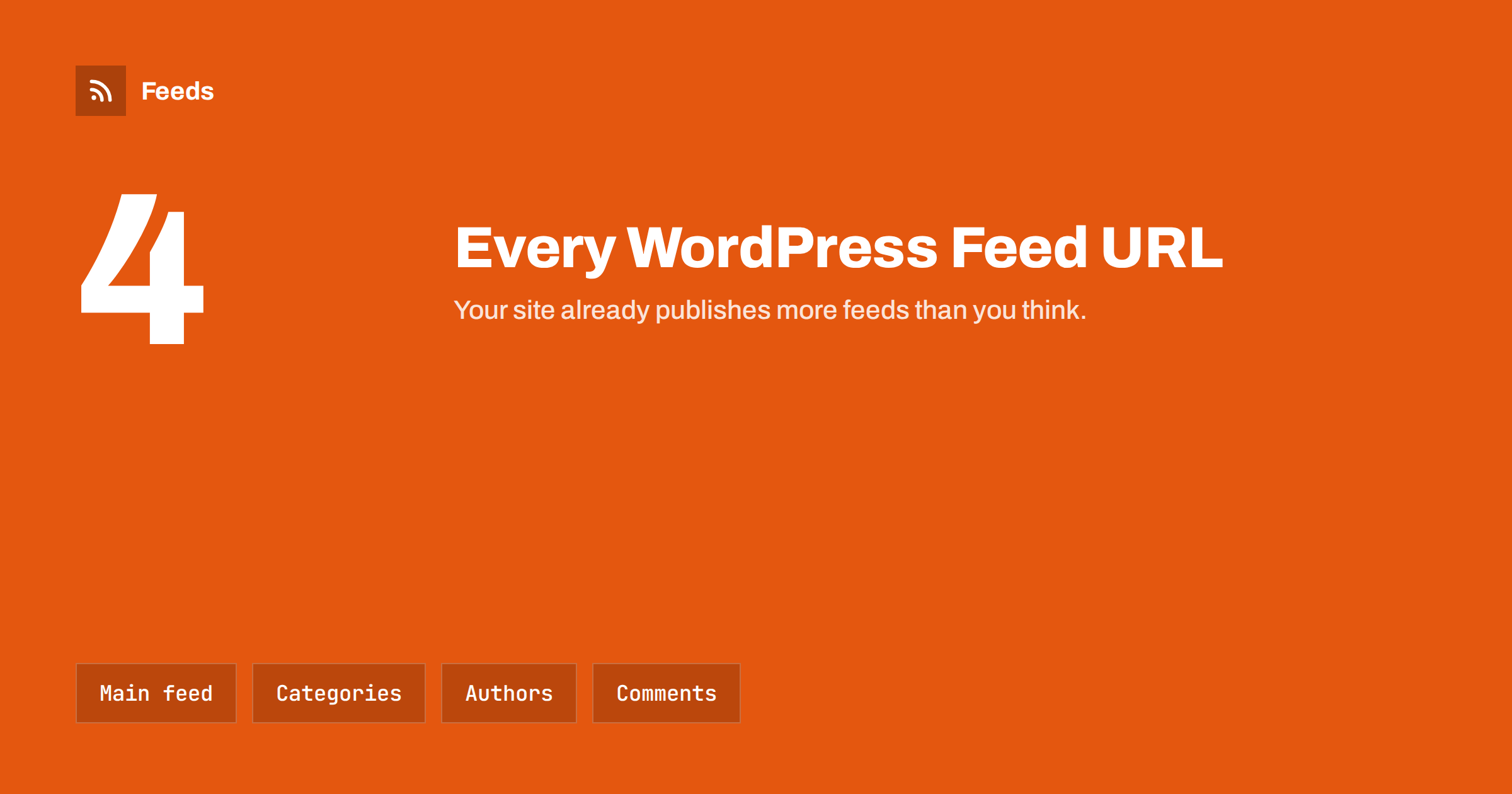
Short answer: Every WordPress site publishes its main RSS feed at /feed/, and also a feed for every category, tag, author, search and comment thread, simply by adding /feed/ to the end of the matching archive address. Atom and RDF versions exist too, at /feed/atom/ and /feed/rdf/. Knowing these addresses lets you give readers, newsletters and partners exactly the slice of content they need, without any plugin.
WordPress has shipped with feeds since its earliest versions, and it creates them automatically for almost every list of posts on your site. Most site owners only ever use the main one. That is a missed opportunity: a partner who only wants your “Events” posts, a newsletter that should include only one author, or a reader who follows only one topic can all be served by feeds that already exist. This guide lists them all, explains the two URL styles, and covers the pitfalls.
Pretty permalinks versus plain URLs
WordPress offers two ways of writing feed addresses, depending on your permalink setting under Settings → Permalinks:
- Pretty permalinks (any setting other than “Plain”): feeds live at readable paths like
/feed/or/category/news/feed/. - Plain permalinks: feeds use query strings like
/?feed=rss2or/?cat=5&feed=rss2.
The query-string form works on every WordPress site, even when pretty permalinks are enabled, which makes it a handy fallback when a rewrite rule or a security plugin interferes with the pretty paths. In the rest of this article we use the pretty form and mention the query form where it helps.
The main feeds
| Feed | Pretty URL | Query-string URL |
|---|---|---|
| All posts, RSS 2.0 | /feed/ | /?feed=rss2 |
| All posts, Atom | /feed/atom/ | /?feed=atom |
| All posts, RDF (RSS 1.0) | /feed/rdf/ | /?feed=rdf |
| All comments | /comments/feed/ | /?feed=comments-rss2 |
| One category | /category/slug/feed/ | /?cat=ID&feed=rss2 |
| One tag | /tag/slug/feed/ | /?tag=slug&feed=rss2 |
| One author | /author/username/feed/ | /?author=ID&feed=rss2 |
| Search results | /search/term/feed/rss2/ | /?s=term&feed=rss2 |
| Comments on one post | /post-slug/feed/ | /?p=ID&feed=rss2 |
If your category base or tag base has been changed in the permalink settings, replace category or tag in the paths with your own base. You may also see /feed/rss/, an old RSS 0.92 format that WordPress still answers for backwards compatibility; there is no reason to use it today.
Category and tag feeds: the most useful extras
Category feeds are the easiest way to publish topic-specific feeds. A few practical uses:
- Partners and syndication. Give a partner portal only your “Industry news” category rather than everything.
- Multi-topic blogs. Readers who care about only one topic can subscribe to that category and ignore the rest.
- Newsletters. An RSS-to-email campaign built on one category keeps a newsletter focused.
- Internal use. A “Press releases” category feed can power a news widget on another site.
You can also combine categories. The query form /?cat=3,7&feed=rss2 returns posts from either category, and a minus sign excludes one: /?cat=-12&feed=rss2 gives everything except category 12. Tags work similarly: /tag/seo+wordpress/feed/ requires both tags, while /tag/seo,wordpress/feed/ accepts either.
One caution: category and tag slugs sometimes change when someone tidies up the site’s taxonomy. When a slug changes, the old feed address stops working and every subscriber silently loses the feed. If you rename a category that partners or readers follow, add a permanent 301 redirect from the old feed address to the new one. Most redirect plugins handle this in a minute, and feed readers follow permanent redirects and update their stored address.
Author, search, date and comment feeds
Author feeds follow a single writer. They are useful for multi-author publications and for writers who want to show their own work elsewhere. The path uses the author’s username slug, visible on their author archive page.
Search feeds are a lesser-known gem. /?s=pricing&feed=rss2 returns the newest posts that mention “pricing”. It is a quick way to follow a keyword on a large site without asking the owner to create a category, although results depend on WordPress’s basic search, which matches words anywhere in the post.
Date archives also have feeds, such as /2026/08/feed/, but they are rarely useful because they stop changing once the month ends.
Comment feeds
WordPress publishes a site-wide comment feed at /comments/feed/ and a feed for each post’s comments at the post address plus /feed/. They help moderators follow discussion in a reader, and they let active commenters follow a thread. If comments are closed on your site, these feeds are usually empty, and some site owners disable them entirely to reduce noise and bot traffic. That is a reasonable choice, as long as you do it with a well-maintained plugin or a small snippet rather than by blocking the paths at the server, which can produce confusing errors.
Feeds for custom post types
If your site uses custom post types, for example “events”, “jobs” or “portfolio”, WordPress can publish feeds for them too:
- When the post type has an archive, its feed is usually the archive address plus
/feed/, for example/events/feed/. - The query form works everywhere:
/?post_type=events&feed=rss2. - Custom taxonomies behave like categories: the term archive address plus
/feed/.
Whether a custom post type appears in the main feed depends on how it was registered. By default, the main /feed/ shows only regular posts. Developers can include other types with the request or pre_get_posts filters, but test carefully, since the change affects every subscriber.
Telling readers and apps which feeds exist
A feed nobody can find does little good. WordPress adds autodiscovery links to the head of your pages, so browsers, readers and tools can detect the main feed and the comment feed automatically. On category, tag and author archives it also advertises the feed for that archive. This depends on your theme supporting automatic-feed-links, which nearly all modern themes do.
Beyond autodiscovery, consider a visible “Subscribe” or “RSS” link in the footer or on topic pages. People who use readers look for it, and partners appreciate a clear list of feed addresses on a contact or press page. If you publish several useful category feeds, a short page listing them with one line of explanation each is a simple, helpful touch.
How many items and how much text
Two settings under Settings → Reading control every one of these feeds:
- “Syndication feeds show the most recent” sets the number of items, 10 by default. Raising it to 20 or 30 helps readers that check infrequently and helps you if you publish in bursts.
- “For each post in a feed, include” chooses between full text and an excerpt. Full text is friendlier to readers; the excerpt gives more visits to your site and less to copy for scrapers.
Note that some themes and plugins override these settings, and caching layers may keep serving an older version for a while after you change them.
Troubleshooting when a feed URL does not work
- Returns a 404. Visit Settings → Permalinks and press Save to rebuild rewrite rules. Then try the query-string form to confirm the feed itself works.
- Shows old content. Clear page and CDN caches. Many caching plugins cache feeds separately.
- Shows an XML error. Usually a blank line or a PHP warning printed before the XML by a plugin or the theme’s
functions.php. Temporarily switching to a default theme helps find the culprit. - Redirects to the home page. Some SEO or security plugins disable feeds. Check their settings for an option such as “disable RSS feeds”.
- Empty feed. Check that the category or tag actually has published posts and that they are not excluded by a plugin.
When you need a feed WordPress does not offer
Built-in feeds are limited to what WordPress can query in one archive. If you want to combine your WordPress feed with a news page from a site that has no RSS, or keep only posts that mention certain words, our tool, Feeds, can help. It uses an existing feed when a site has one, can turn a page without RSS into a feed, and merges several sources into one feed with keyword filters and duplicate removal. It works from the outside, so nothing is installed on your WordPress site. Plans are listed on the pricing page.
Related reading
- What Is an RSS Feed? A Plain-English Guide for Site Owners
- RSS vs Atom: Which Feed Format Should Your Site Publish?
The bottom line
A WordPress site publishes dozens of feeds without any extra work: the main feed, Atom and RDF versions, and a feed for every category, tag, author, search, custom post type and comment thread. Add /feed/ to almost any archive address, or use ?feed=rss2 as a fallback. Pick the feed that matches each audience, set a sensible item count and content length, and your site becomes easy to follow and syndicate.
DUK
What is the default RSS feed URL in WordPress?
The main feed is your site address followed by /feed/. If pretty permalinks are off, use /?feed=rss2. Both return the same RSS 2.0 feed of your latest posts.
How do I get an RSS feed for one WordPress category?
Open the category archive page and add /feed/ to its address, for example /category/news/feed/. You can also use /?cat=ID&feed=rss2, where ID is the category’s numeric ID.
Why does my WordPress feed show only 10 posts?
That is the default under Settings → Reading, “Syndication feeds show the most recent”. Raise the number there. If nothing changes, a caching plugin or your theme may be overriding it.
Can I turn off WordPress comment feeds?
Yes. Many SEO and performance plugins have an option to disable comment feeds, or a developer can remove them with a small snippet. Doing it inside WordPress is cleaner than blocking the paths at the server level.
Does WordPress publish Atom feeds?
Yes. Every feed has an Atom version: add /atom/ after /feed/, for example /feed/atom/, or use ?feed=atom.