ENEnglish
 LTLietuviškai
 DEDeutsch
 FRFrançais
 RUРусский
 ESEspañol
 PLPolski
 ITItaliano
 UKУкраїнська
 CSČeština
 PTPortuguês
 JA日本語
JA日本語 LVLatviešu valoda
 ETEesti
 HUMagyar
 IDBahasa Indonesia
 TRTürkçe
 HIहिन्दी
 ELΕλληνικά
 ARالعربية
 THไทย
THไทย VITiếng Việt
 RORomână
 MSBahasa Melayu
 BNবাংলা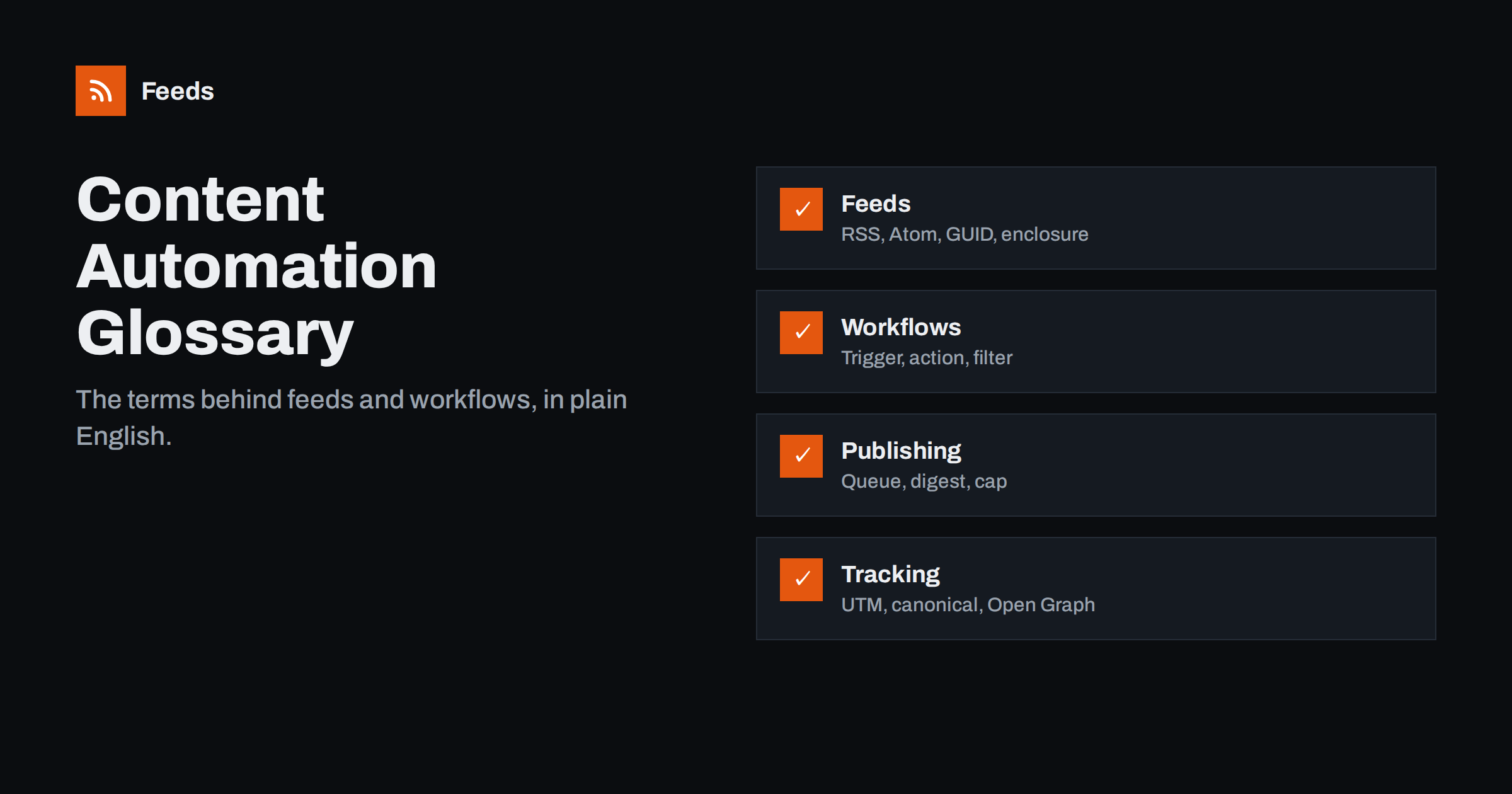
Short answer: Content automation has its own vocabulary, but most terms describe simple ideas. Feeds (RSS, Atom) list new items, each identified by a GUID; automation tools poll feeds or receive webhooks as triggers, apply filters and templates, and perform actions such as posting or emailing; publishing is paced with queues, caps and digests; and results are tracked with UTM parameters, while Open Graph tags and canonical URLs control how links look and which page counts as the original. The glossary below explains each term in a sentence or two.
How to use this glossary
The terms are grouped by topic rather than alphabetically, so related ideas sit together: feeds first, then workflows, publishing, social previews, tracking, email, product feeds and operations. If you are new to content automation, reading a group from top to bottom gives a quick overview of how that part works. If you only need one definition, search the page for the term.
Definitions are deliberately short and practical. Where a term has a formal specification, the explanation focuses on what it means for someone setting up or maintaining a workflow, not on every technical detail.
Feed terms
- Feed: a machine-readable list of the newest items on a website, such as articles, products or episodes. Software reads it to detect new content without visiting the site’s pages.
- RSS: the most widely used feed format, based on XML. Version 2.0 is the one most sites publish today.
- Atom: an alternative XML feed format, standardised by the IETF, with stricter rules. Most tools read RSS and Atom equally well.
- JSON Feed: a newer feed format using JSON instead of XML. Support is growing but less universal than for RSS.
- Item / entry: one element in a feed, usually representing one article, product or episode, with a title, link, date and description.
- GUID: the globally unique identifier of an RSS item. Tools use it to recognise items they have already processed, so it should never change.
- pubDate: the publication date of an RSS item. Wrong or missing dates cause ordering problems and missed items.
- Enclosure: an RSS element that attaches a file, such as an audio file for podcasts or sometimes an image.
- Media RSS: an extension that adds elements such as media:content and media:thumbnail, often used for images and videos in feeds.
- Full-text vs summary feed: a full-text feed includes whole articles; a summary feed includes only excerpts and links to the site.
- Category feed: a feed limited to one section, tag or category of a site, useful for sending only relevant content to a channel.
- Merged feed: one feed combining items from several sources, often with duplicates removed.
Workflow terms
- Workflow / automation: a set of steps that runs automatically when a condition is met, for example “new feed item, then post to LinkedIn”.
- Trigger: the event that starts a workflow, such as a new feed item, a form submission or a scheduled time.
- Action: what the workflow does, such as publishing a post, sending a message or adding a spreadsheet row.
- Filter / condition: a rule that decides whether an item continues through the workflow, often based on keywords or categories.
- Template: a pattern for the output, with placeholders such as title and link filled in for each item.
- Polling: checking a source at regular intervals for changes. RSS triggers work by polling.
- Webhook: an HTTP request that one system sends to another the moment an event happens, allowing near-instant workflows.
- WebSub: a W3C standard that lets feed publishers notify subscribers of updates through a hub, combining feeds with push delivery.
- Deduplication: removing repeated items, whether the same item seen twice or the same story from several sources.
- Run history: the log an automation tool keeps of each time a workflow ran, which steps succeeded and which failed. It is the first place to look when something stops working.
- Failure notification: an alert, usually by email or chat, that a tool sends when a workflow step fails, so problems are noticed quickly instead of weeks later.
- Task / operation: a unit of work counted by automation platforms for billing, usually each action or step run.
Publishing terms
- Queue: a list of posts waiting to be published in predefined time slots.
- Daily cap: the maximum number of automated posts allowed per destination per day.
- Posting window: the hours during which automated posts may go out, usually in the audience’s time zone.
- Digest: a single message or email that collects several items, for example all of the day’s new articles. Digests are the usual answer when a feed produces more items than a channel can comfortably absorb.
- Approval queue: a step where a person must approve items before they are published.
- Evergreen content: content that stays useful for a long time and can be reshared periodically.
- Posting tool: software that publishes content to social networks on your behalf, often with support for feeds, queues, templates and several accounts.
- Curation: selecting the most relevant items from many sources for an audience, ideally with added commentary.
Link preview and SEO terms
- Open Graph tags: meta tags such as og:title, og:description and og:image that tell social networks how to display a link preview.
- Twitter card tags: X’s own meta tags for link previews; X falls back to Open Graph when they are missing.
- Link preview / card: the box with an image, title and description that appears when a link is shared.
- Canonical URL: the preferred address of a page, declared with a link element, telling search engines which version is the original when content appears in several places.
- Syndication: republishing or distributing content on other sites or platforms, ideally with attribution and a canonical reference to the original.
- hreflang: annotations that tell search engines which language or regional version of a page to show to which users.
Tracking terms
- UTM parameters: tags added to links, such as utm_source, utm_medium and utm_campaign, so analytics tools can attribute visits to specific channels and campaigns.
- Attribution: assigning credit for a visit or conversion to the channel or campaign that brought it.
- Referrer: the page or app a visitor came from, as reported by the browser. Many app clicks arrive without a referrer, which is why UTM parameters matter.
- Conversion: an action that matters to your business, such as a sign-up, lead or purchase.
- Engagement: interactions with a post or page, such as clicks, reactions, replies or time spent reading.
Email terms
- RSS campaign / RSS-to-email: an email campaign that is built and sent automatically from new items in a feed.
- Opt-in: explicit permission from a subscriber to receive emails, required by law in many countries.
- Unsubscribe link: a required link in marketing emails that lets recipients stop receiving them; automated digests need one just like manual newsletters.
- Bounce: an email that could not be delivered, either permanently (hard bounce) or temporarily (soft bounce). High bounce rates hurt sender reputation.
- SPF, DKIM and DMARC: email authentication standards that help receiving servers verify your emails and improve deliverability.
Product feed terms
- Product feed: a structured file listing products with attributes such as ID, title, price, availability and image, used by shopping and advertising platforms.
- Catalog: the set of products a platform such as Meta holds for a business, usually filled from a product feed.
- Availability: a product feed attribute stating whether an item is in stock, out of stock or available for preorder. Keeping it current avoids advertising products customers cannot buy.
- Feed rules: transformations applied to product data before it reaches a platform, such as rewriting titles, adjusting prices or excluding out-of-stock items.
- GTIN: the Global Trade Item Number, a standard product identifier such as a barcode number, used to match products across platforms.
Where Feeds fits
In the vocabulary above, Feeds works at the start of the chain. It creates RSS feeds from pages that list items, merges several sources into one feed, applies keyword filters and deduplication, and creates product feeds for Google Merchant Center and Meta catalogs from WooCommerce, Shopify or a CSV link. Feeds refresh automatically, so the triggers in your workflows receive clean, current items. The pricing page has plan details.
Related reading
- What Is Content Automation? A Practical Guide for Small Teams
- What Is an RSS Feed? A Plain-English Guide for Site Owners
- Webhooks vs RSS Polling: Which to Use for Automation
- How to Track Traffic from Automated Posts with UTM Tags
The bottom line
Most content automation vocabulary describes a simple chain: a feed lists items identified by GUIDs, a trigger notices new ones, filters and templates shape them, actions publish them at a controlled pace, and tracking shows what they achieve. Knowing these terms makes it much easier to set up tools, read documentation and diagnose problems when a workflow misbehaves.
BUJ
What is the difference between RSS and Atom?
Both are XML feed formats that list new items. RSS is more widespread, while Atom is a formally standardised format with stricter rules. Most tools support both.
What is a GUID in a feed?
It is the unique identifier of an RSS item. Tools use it to remember which items they have already processed, so it must stay the same after publication.
What is the difference between polling and webhooks?
Polling means checking a source regularly for changes, as RSS tools do. Webhooks mean the source sends a notification immediately when something happens.
What are Open Graph tags?
They are meta tags in a page’s HTML that tell social networks which title, description and image to show when the page is shared.
What does a canonical URL do?
It tells search engines which address is the preferred, original version of a page, which matters when the same content appears in several places.