ENEnglish
 LTLietuviškai
 DEDeutsch
 FRFrançais
 RUРусский
 ESEspañol
 PLPolski
 ITItaliano
 UKУкраїнська
 CSČeština
 PTPortuguês
 JA日本語
JA日本語 LVLatviešu valoda
 ETEesti
 HUMagyar
 IDBahasa Indonesia
 TRTürkçe
 HIहिन्दी
 ELΕλληνικά
 ARالعربية
 THไทย
THไทย VITiếng Việt
 RORomână
 MSBahasa Melayu
 BNবাংলা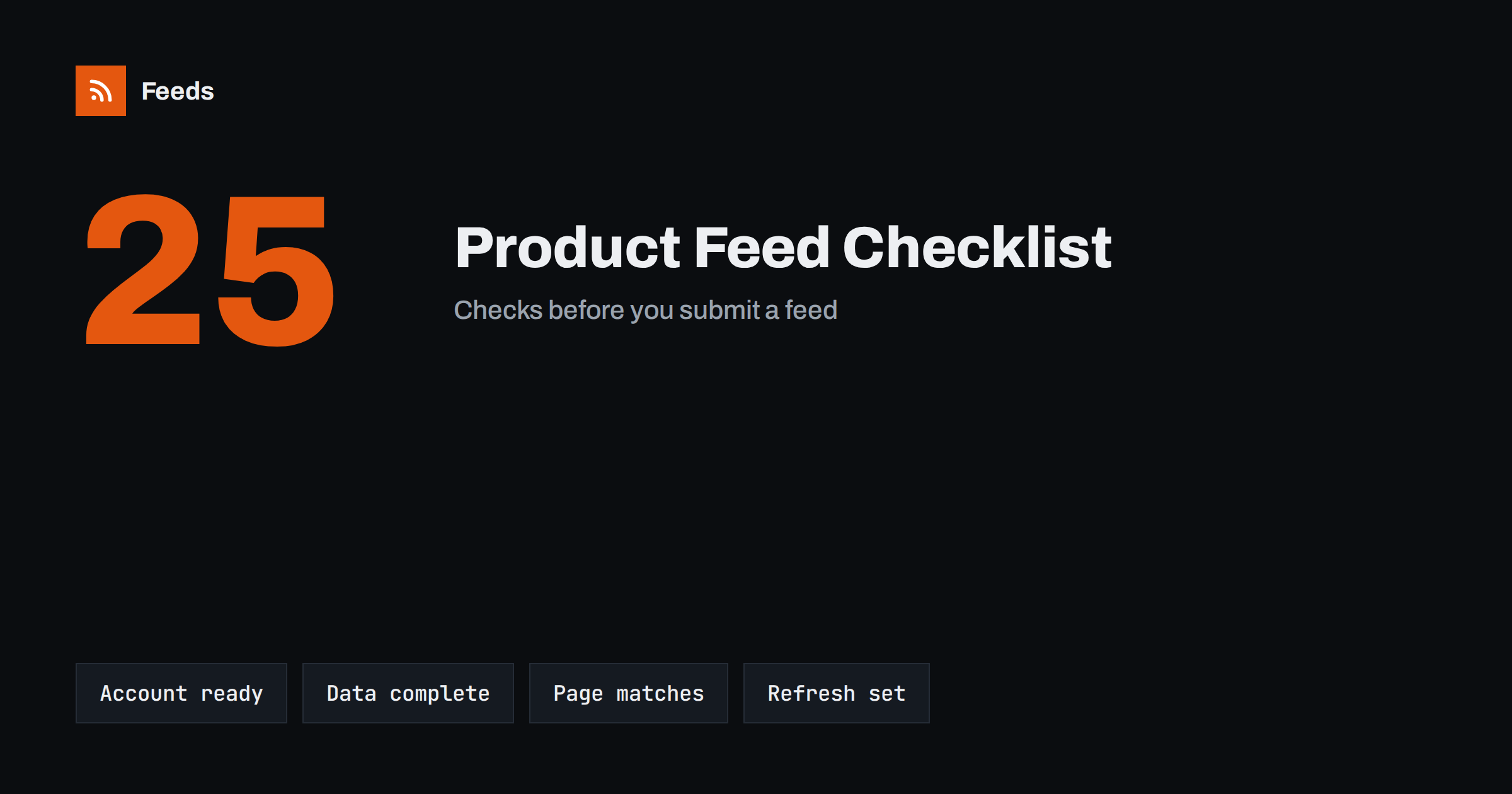
Short answer: Before submitting a product feed, check five areas: the account and website (verified domain, shipping, returns, contact details), the data (unique IDs, required attributes, identifiers, clean titles and descriptions), the offer (prices with tax and currency, availability matching the page), the media and links (real full-size images, links that open the exact variant), and the delivery (a stable feed URL with a scheduled refresh and fetch). The 25 checks below cover all five and catch most problems before the first review.
Why a checklist saves time
The first review of a new feed sets the tone for weeks. If the account has a missing return policy or the feed sends net prices in a country that requires gross prices, the result is a long list of disapprovals, a new round of fixes, and another wait for review. New Merchant Center accounts are also reviewed more carefully than established ones, so first impressions matter.
Most of the problems that show up in a first review are predictable. They come from the same handful of causes in store after store: tax settings, variant links, thumbnail images, empty brand fields, stale files. A checklist turns those lessons into a routine you can run in an hour, before anything is submitted.
Use the list below for a new feed, after a store migration or theme change, and before big promotions. You will not need every item every time, but skipping the list entirely is the most expensive option.
A practical tip: do the checks with two browser windows open, one showing the feed or its preview and one a private window on the store. Working product by product across both windows is slower than scanning a spreadsheet, but it catches the problems platforms actually check for, because it looks at the same things they do.
Account and website (checks 1 to 5)
- The website is verified and claimed in Merchant Center, on the same domain that product links use.
- Contact details are visible on the site: at least an email or phone number and a physical or registered address where required.
- Shipping costs and delivery times are published on the site and configured for each target country in the platform.
- A return policy is published and matches the return settings you enter in Merchant Center.
- Checkout works for a test order, with the payment methods and prices shoppers will see, and without password protection on the store.
These are account-level items. Problems here affect every product at once and take longest to resolve, so they come first.
It is also worth reading your own website the way a reviewer would. Are prices, shipping costs and taxes clear before checkout? Do product pages make exaggerated claims, such as health benefits or guaranteed results, that you cannot support? Is it obvious who runs the store? Account-level reviews look for trustworthiness, and a site that answers those questions plainly passes more easily.
Product data (checks 6 to 12)
- Every item has a unique, stable ID, ideally the SKU, and no two variants share an ID.
- Required attributes are filled for every item: id, title, description, link, image_link, availability, price.
- Brand is set for branded products, and it is the product’s brand, not your store name for resold goods.
- GTINs are real, stored as text, and present for products that have barcodes. identifier_exists is set to no only where no identifiers exist.
- Titles describe the product: product type and key attributes, no promotional text, no all caps.
- Descriptions are plain text without HTML, shortcodes or boilerplate about the store.
- Variants are separate items with item_group_id and their own color, size or other attributes.
Spot-check these on a sample that includes old products, new products and products from each category. Data problems often hide in one corner of the catalog, such as products created by a different import or by a different person.
Prices and availability (checks 13 to 17)
- Prices include tax where the target country requires it, and exclude it for the United States.
- Every price has an ISO currency code that matches the currency shown on the landing page.
- Sale prices are in sale_price with the regular price kept in price, and have effective dates where sales are scheduled.
- Availability matches the page for each variant: in stock, out of stock, preorder or backorder.
- Dynamic pricing such as member prices, currency switchers or quantity discounts does not change what an anonymous visitor sees compared with the feed.
The quickest test is to open five random items in a private browser window and compare the visible price and stock with the feed. If even one disagrees, find the cause before submitting.
If you sell in several countries, repeat these checks per country. A feed can be correct for your home market and wrong for every other one, because currencies, tax rates and shipping costs change the numbers. Check at least a few items per market using the market-specific links.
Images and links (checks 18 to 21)
- Main images are real product photos without text overlays, watermarks or placeholder graphics.
- Images are full-size, at least 800 by 800 pixels where possible, not theme thumbnails.
- Variant images match the variant, especially for colors.
- Links open the exact product and variant, over HTTPS, without redirects to the homepage or a category page.
Also make sure images and pages are reachable for crawlers: not blocked in robots.txt, not behind bot challenges, and fast enough not to time out.
One more link check is easy to forget: tracking parameters. If you add UTM parameters or other tracking to product links, make sure the landing page still loads the right variant with them attached, and that no redirect strips the variant selection along the way.
Feed delivery and refresh (checks 22 to 25)
- The feed lives at a stable URL that returns the file directly, without a login page or cookie wall.
- The file is valid: well-formed XML, or CSV with consistent columns and UTF-8 encoding.
- The feed refreshes automatically from live store data, at least daily.
- The platform fetch is scheduled shortly after the feed refresh, not left to manual uploads.
After setting up the schedule, trigger the first fetch manually and read the processing summary. The number of items read should match the number of items you expect. A lower number usually means some rows could not be parsed.
Finally, note down the feed URL, the refresh schedule, the fetch schedule and who is responsible for the feed. It sounds bureaucratic, but many feed problems persist simply because nobody knows where the file comes from or who can change it.
Checks that save you later
| Check | Problem it prevents | Typical cost if missed |
|---|---|---|
| Tax included correctly | Mass price mismatches | Most items disapproved |
| Variant links | Mismatches on variable products | Many variants disapproved |
| Full-size images | “Image too small” issues | Many items limited or rejected |
| Return policy | Account-level warning | Every product affected |
| Automatic refresh | Stale prices and stock | Growing mismatches over time |
Each row describes a problem that is trivial to prevent and slow to recover from. Checking them takes minutes.
After you submit
Submitting is not the end of the checklist. During the first week, check diagnostics daily, work from the largest patterns down, and fix problems at the source rather than in the platform. Once the account is stable, move to a weekly routine: diagnostics, a five-item spot check, and a look at any new warnings. Repeat the full checklist after major changes to the store, such as a platform migration, a new theme, a pricing plugin or a new market.
For agencies, the checklist doubles as an onboarding document. Running it together with a new client surfaces problems in their store that would otherwise be blamed on the campaigns later, and it sets clear expectations about who fixes what.
Keep the completed checklist with the date and any notes. When something breaks months later, knowing what was verified at launch narrows the search quickly.
How Feeds helps
Feeds covers several delivery checks for you: it publishes a Google product XML feed at a stable URL, generated from WooCommerce, Shopify or a CSV link, and refreshes it automatically. You see a preview of the products with titles and images before the feed is created, and rules can skip out-of-stock products, rewrite titles and adjust prices. See the pricing page for plans.
Related reading
- How to Set Up a Google Merchant Center Product Feed
- Merchant Center Disapproved Products: Causes and Fixes
- Product Feed Image Requirements for Google and Meta
The bottom line
A product feed that passes review on the first try is usually the result of an hour of checking, not luck. Verify the account and website, complete the data, make sure prices and stock match the pages, use real full-size images and exact links, and set up automatic refreshes and scheduled fetches. Then keep a light weekly routine.
FAQ
What is the most common reason a new feed fails review?
Price mismatches caused by tax settings and account-level issues such as missing return policies or contact details are among the most common.
How long does the checklist take?
For a small or mid-sized store, about an hour. Most checks are spot checks on a sample of products rather than every item.
Do I need to run the checklist again later?
Yes, after major changes such as a platform migration, theme change, new pricing plugin or new target country.
Can I submit the feed before everything is perfect?
You can, but account-level problems affect every product and slow down review. Fix those first; item-level warnings can be improved afterwards.
Does the same checklist apply to Meta catalogs?
Mostly yes. Meta also needs accurate prices, availability, images and links, plus IDs that match the content IDs sent by your pixel.