ENEnglish
 LTLietuviškai
 DEDeutsch
 FRFrançais
 RUРусский
 ESEspañol
 PLPolski
 ITItaliano
 UKУкраїнська
 CSČeština
 PTPortuguês
 JA日本語
JA日本語 LVLatviešu valoda
 ETEesti
 HUMagyar
 IDBahasa Indonesia
 TRTürkçe
 HIहिन्दी
 ELΕλληνικά
 ARالعربية
 THไทย
THไทย VITiếng Việt
 RORomână
 MSBahasa Melayu
 BNবাংলা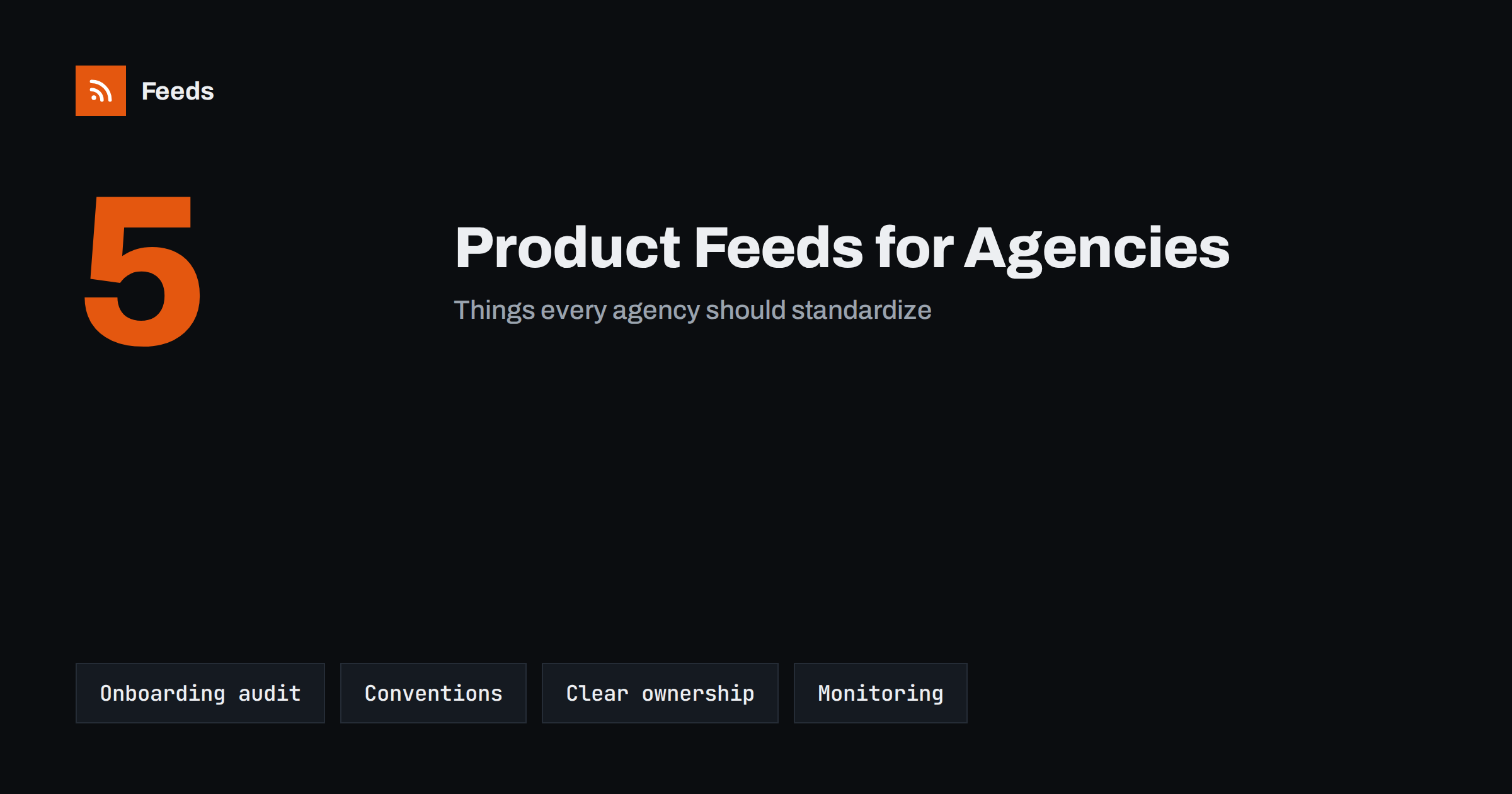
Short answer: Agencies that manage product feeds for several clients work best with one repeatable process: an onboarding audit of each store’s data and accounts, standard conventions for IDs, product types, custom labels and data source names, clear agreements about who fixes what in the client’s store, a feed setup that does not depend on the client’s server, and a weekly monitoring routine per client. Standardizing these five things turns feed work from firefighting into maintenance.
Why feeds are an agency problem
For an agency running Shopping, Performance Max or catalog ads, the product feed is the foundation of every campaign, but it is usually built from data the agency does not control. The client owns the store, the products, the prices and often the technical setup. When something breaks, such as a theme update that changes prices in structured data or a plugin that alters variant links, the campaign suffers first and the agency is asked why.
With one client, you can handle this case by case. With ten or thirty, ad hoc handling becomes a constant drain. Each store has its own platform, its own quirks and its own people, and the knowledge of how each feed works lives in someone’s head. When that person is on holiday, problems wait.
The answer is not a more heroic account manager. It is a process that treats every client feed the same way, so that knowledge is written down, problems are found early and responsibilities are clear.
Standardize 1: the onboarding audit
Every new client should start with the same audit, before any campaign changes. It covers:
- Accounts: Merchant Center and Commerce Manager access, ownership, website verification, shipping and return settings, existing account-level issues.
- Current data sources: which feeds, apps or integrations exist, who set them up, and when they last ran successfully.
- Data quality: IDs, identifiers, titles, images, variant handling, prices with tax, availability.
- Consistency: a sample of items compared across feed, landing page and platform.
- Diagnostics: current disapprovals and warnings, grouped by cause.
The result is a short written report with a prioritized list of fixes and who owns each one. It sets expectations with the client from day one: some improvements are in the agency’s hands, others require the client’s developer or store manager. It also protects the agency, because it documents the state of the data before the agency touched it.
Many agencies turn the audit into a template: a shared checklist, a sample size per check and a standard format for findings. That makes audits comparable across clients and quick to run again later, for example after a client migrates to a new platform.
Standardize 2: conventions
Conventions make accounts readable to anyone on the team. Agree on them once and apply them to every client where possible:
- Item IDs: prefer the variant SKU; never change IDs of an existing account without a migration plan.
- product_type: generated from the store’s category path, without “Home” prefixes.
- Custom labels: the same meaning per label number across clients, for example label 0 for margin band, label 1 for price range, label 2 for performance.
- Data source names: a pattern such as “Primary – XML – store” and “Supplemental – labels – sheet”.
- Documentation: one page per client describing sources, schedules, rules and contacts.
When every account uses the same label meanings, reporting templates and campaign structures can be reused across clients, and a new team member can understand an account in minutes.
Conventions should leave room for exceptions. A client with a very different business model, such as a rental service or a marketplace with thousands of sellers, may need its own label scheme. Document the exception clearly on the client page, so that nobody assumes the standard applies.
Standardize 3: ownership and access
Most feed problems are fixed in the client’s store, not in the feed tool. Agree in advance who does what:
| Area | Usually owned by | Examples |
|---|---|---|
| Product data in the store | Client | GTINs, brands, images, variant data |
| Website and checkout | Client or their developer | Prices with tax, policies, structured data |
| Feed generation and rules | Agency | Mappings, title rules, exclusions, labels |
| Platform settings | Agency, with client approval | Shipping, data sources, schedules |
| Account ownership | Client | Merchant Center and business accounts |
Accounts should belong to the client, with the agency added as a user. That avoids painful transfers if the relationship ends and keeps the client in control of their own business assets.
Write these responsibilities into the service agreement or onboarding document. When a price mismatch appears because the client’s developer changed tax settings, a clear division of responsibilities turns a potential dispute into a routine ticket.
Standardize 4: a setup that does not depend on the client’s server
Feeds generated by plugins inside client stores are exposed to everything that happens there: plugin conflicts, updates, hosting limits and caching rules. When an agency manages many stores, those risks multiply. An external feed setup, where the feed is generated outside the store from its public data or an export, isolates the feed from most of these problems and lets the agency manage all feeds in one place.
Whichever setup you choose, keep it consistent across clients where possible. Ten different feed plugins configured in ten different ways are much harder to support than one approach used everywhere.
A consistent setup also simplifies pricing and scoping. When every client feed is built the same way, the agency knows how long onboarding takes and what ongoing maintenance costs, instead of estimating from scratch for each store.
Standardize 5: monitoring
A weekly routine per client catches most problems before they cost money:
- Check diagnostics in Merchant Center and issues in Commerce Manager for new patterns.
- Confirm the last successful fetch and item count for each data source.
- Spot-check three top-selling items across feed, page and platform.
- Review any changes the client made to the store that week.
- Log findings and actions in the client’s documentation.
Set up notifications so failed fetches and new account issues reach the agency immediately, not only during the weekly check. For large clients or promotion periods, increase the frequency.
Offboarding and handover
Client relationships end, and feeds should survive that. A clean handover protects both sides and reflects well on the agency. Prepare it as a standard step, not an afterthought:
- Hand over the client documentation page: sources, schedules, rules, label meanings and known issues.
- Make sure the client owns every account and that feed URLs will keep working, or agree a transition date for any feed hosted under the agency’s tools.
- Export rules and mappings in a readable form, so the next team can reproduce them.
- Remove agency users from accounts only after the client confirms access and continuity.
An abrupt switch-off of a feed that campaigns depend on can stop a client’s Shopping ads overnight. Planning the handover avoids that and leaves the door open for future work.
Communicating with clients about feed issues
Clients rarely think about their product feed until ads stop running. Explaining feed issues in business terms helps: “40 products are not showing because their prices on the website include a discount that the feed does not see” is more useful than an error code. Include a short feed health summary in regular reports, such as the share of approved items and the main open issues, so feed quality becomes a visible part of performance.
When a fix requires the client’s developer, send a precise request: the affected products, what the platform sees, what it should see and an example URL. Precise requests get fixed faster.
Over time, these summaries also show the value of feed work. A chart of approved items rising from 70% to 98% over a quarter, next to the revenue from Shopping campaigns, makes the case for continued investment better than any explanation.
How Feeds helps
Feeds lets agencies create product feeds for client stores without installing anything on them: WooCommerce and Shopify stores are read from their public data, other platforms through a CSV link. Each feed is a Google product XML file that Merchant Center and Meta can fetch, refreshed automatically, with rules to skip out-of-stock products, rewrite titles and adjust prices. Plans for several stores are listed on the pricing page.
Related reading
- Product Feed Checklist: 25 Checks Before You Submit
- Custom Labels in Product Feeds: A Practical Guide
- Feed Plugin, Channel App or Feed Service: How to Choose
The bottom line
Agencies scale feed management by standardizing: the same onboarding audit, the same conventions for IDs, product types and labels, clear ownership of fixes, a feed setup that does not depend on each client’s server, and a weekly monitoring routine. Clients keep ownership of their accounts, and feed health becomes a visible part of reporting.
FAQ
Who should own the Merchant Center account, the agency or the client?
The client. The agency should be added as a user. That keeps the client in control and avoids difficult transfers later.
How often should an agency check client feeds?
Weekly as a routine, with notifications for failed fetches and new account issues, and more often during promotions.
Should agencies use the same custom label meanings for all clients?
Where possible, yes. Shared conventions make reporting templates and campaign structures reusable and accounts easier to understand.
What should an onboarding feed audit include?
Account settings, existing data sources, data quality, consistency between feed and pages, and current diagnostics, with a prioritized fix list.
How should agencies request fixes from client developers?
With precise examples: affected products, what the platform sees, what it should see and example URLs. Precise requests are fixed faster.