ENEnglish
 LTLietuviškai
 DEDeutsch
 FRFrançais
 RUРусский
 ESEspañol
 PLPolski
 ITItaliano
 UKУкраїнська
 CSČeština
 PTPortuguês
 JA日本語
JA日本語 LVLatviešu valoda
 ETEesti
 HUMagyar
 IDBahasa Indonesia
 TRTürkçe
 HIहिन्दी
 ELΕλληνικά
 ARالعربية
 THไทย
THไทย VITiếng Việt
 RORomână
 MSBahasa Melayu
 BNবাংলা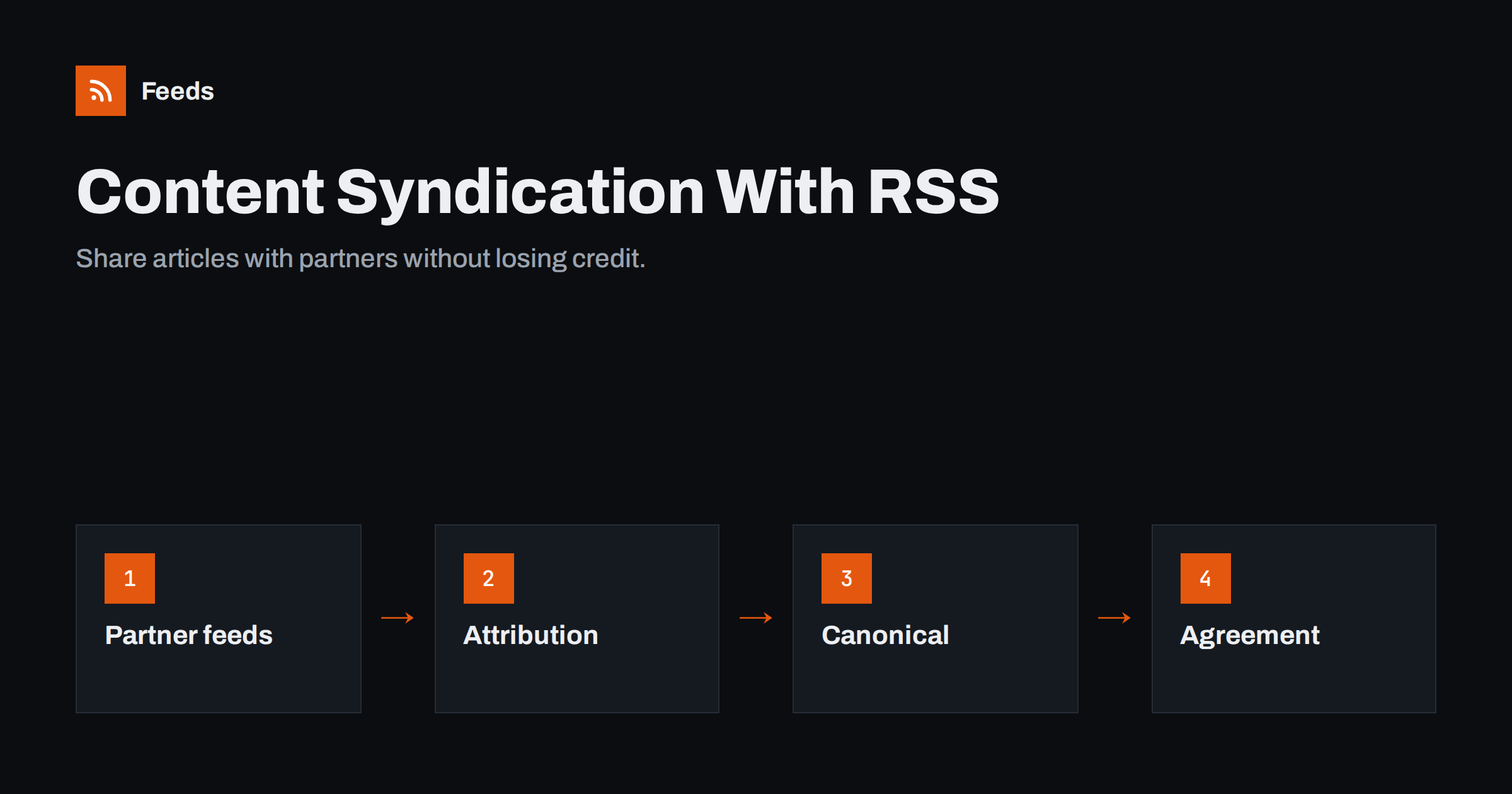
Short answer: To syndicate content with RSS, give each partner a dedicated feed, usually a category or custom feed, that contains only the articles they may use, in the agreed length. Include a clear attribution line and a link to the original in every item, ask partners to use a canonical link or noindex on republished full text, and write down the rules: what may be republished, how quickly, with which images, and how corrections are handled. RSS handles the delivery; the agreement protects your content.
Syndication is one of the oldest uses of RSS and still one of the most practical. A trade association shares members’ news on its portal, a regional newspaper republishes stories from partner sites, a software company displays its partners’ latest articles in a customer dashboard, a university pulls faculty news into department pages. In each case the alternative, copying and pasting or emailing articles around, is slow and error-prone. A feed makes syndication automatic. This guide covers how to plan it, what to put in the feed, and how to protect attribution and search visibility.
What syndication with RSS looks like
There are three common patterns, and they have different requirements:
- Headline syndication. The partner shows your titles, short summaries and images, linking to your site for the full article. Low risk, easy to set up, and the most common form.
- Full-text republication. The partner publishes your complete article on their site. Valuable for reach, but it raises questions of attribution, duplicate content and image rights.
- Aggregation. A portal combines feeds from many sources into one stream, such as an industry news page. Usually headline-level, sometimes with filtering by topic.
Decide which pattern applies to each partner before building anything, because it determines what the feed must contain. It also determines the risks: headline syndication almost always benefits the original publisher, because every item sends readers back, while full-text republication trades clicks for reach and needs clearer rules. Many publishers start with headlines and offer full text only to a few trusted partners.
Plan feeds by audience, not by site
A single feed for everyone is simple, but it forces every partner to accept everything you publish, and it makes any change to your main feed a change for all of them at once.
Most sites publish one main feed and forget about it. For syndication, you usually want more control:
- List your partners and what each should receive: all news, one topic, only press releases, only articles in one language.
- Map each to a feed. Category or tag feeds often cover it:
/category/press-releases/feed/on WordPress, a Views feed display in Drupal, a section feed in a static generator. - Use an opt-in category where needed, such as “Syndicate”, so editors choose deliberately which articles go to partners.
- Keep feed URLs stable, and document them for partners. Changing a URL breaks their import without warning.
What to include in a syndication feed
| Element | Headline syndication | Full-text republication |
|---|---|---|
| Title and link | Required | Required |
| Permanent guid | Required | Required, so partners avoid duplicates |
| Publication date | Required | Required |
| Summary | Good, hand-written excerpt | Short summary for list views |
| Full HTML content | Not needed | Clean HTML in content:encoded |
| Image | Featured image with rights cleared | All images with rights cleared |
| Author and categories | Helpful | Helpful for attribution and filtering |
| Attribution line | Optional | Essential, with link to original |
Keep the HTML clean: no scripts, no embedded forms, no layout-specific classes. Partners’ systems usually strip unknown markup, and complex HTML may render badly on their pages.
Attribution and links back
Every syndicated item should say clearly where it came from. Include a line at the end of the content, such as “This article was first published on [Site name]”, with an absolute link to the original URL. Benefits:
- Readers on the partner’s site can find you.
- If the feed is scraped by others, the copies still credit and link to you.
- It removes any ambiguity about ownership.
Keep the wording short and consistent, and make sure the link is the canonical URL of the article, not a tracking link that may expire. On WordPress, many SEO plugins provide a setting for content added before or after each feed item, which is the easiest way to add this line automatically.
Protecting search visibility
When partners republish full text, search engines see the same article on two sites. Usually they pick the original, but not always, especially if the partner’s site is larger than yours. To reduce the risk:
- Ask partners to add a canonical link to your original URL on the republished page. This is the clearest signal.
- Alternatively, ask them to noindex republished articles, so only your version competes in search.
- Delay full-text syndication by a day or more, so your original is indexed first.
- Offer headline syndication to partners who cannot meet these conditions.
Search engines’ guidance on syndicated content has shifted over the years; in recent guidance Google has leaned towards asking partners to block indexing of syndicated copies, while cross-domain canonical links remain widely used. Check the current documentation before you sign an agreement, and put whichever approach you choose into writing.
Put the rules in writing
A simple syndication agreement, even a one-page email that both sides confirm, prevents most disputes. Cover:
- Which feed or feeds the partner may use, and for what.
- Whether full text may be republished, and whether edits are allowed.
- Attribution and linking requirements, including canonical or noindex.
- Image rights: many photos are licensed only for your site, so syndication may require different images or none.
- Corrections and removals: how quickly partners must update or remove an article when you do.
- How either side can end the arrangement.
Image rights deserve special attention. Stock and agency photos are frequently licensed per site; putting them in a syndication feed can create licensing problems for your partner and for you.
Syndication in different organisations
The same technique serves very different goals. A few typical set-ups, and what matters most in each:
- Trade associations and chambers collect members’ news for a portal or newsletter. Headline syndication is usual; the main challenge is that many members have no feed, and the association needs one clean stream filtered to relevant topics.
- Local and regional media networks share stories between titles. Full text is common, so canonical or noindex rules, image rights and correction procedures matter most.
- Franchises and multi-location businesses publish central news on every local site. A central feed per topic, imported by each local site, keeps messages consistent.
- Software and platform companies show partner or marketplace news inside their product. Short summaries, clean images and stable guids matter, because in-app lists are unforgiving of broken items.
- Universities and public bodies distribute news from central communications to faculties and departments, often in several languages. One feed per language and topic keeps each audience’s pages relevant.
Whatever the setting, the questions are the same: who receives what, in what form, under which rules. Answer them first, and the technical setup becomes a matter of choosing the right feed URLs.
Running syndication smoothly
- Validate feeds after template or plugin changes; a broken feed stops every partner at once.
- Keep guids permanent, or partners will republish old articles as new.
- Handle corrections by updating the original; most partner imports pick up changes only if they re-check existing items, so notify them for important corrections.
- Monitor partner pages occasionally to confirm attribution and links still appear.
- Keep a list of feed consumers, so you can inform them before changes.
Building a syndication hub from several sources
On the receiving side, a portal or association often needs one stream from many members, some of whom have no feed at all, and only on certain topics. Our tool, Feeds, creates feeds from public pages that list articles, uses members’ existing feeds where they exist, and merges several sources into one feed with duplicates removed and keyword filters applied. The result is a single RSS link that the portal can import. Plans and source limits are on the pricing page.
Related reading
- Full Text or Summary? Choosing What Your RSS Feed Shows
- Does an RSS Feed Help SEO? What Feeds Really Do for Search
- How to Merge Multiple RSS Feeds into One Clean Feed
The bottom line
RSS makes content syndication automatic: one well-planned feed per audience delivers articles to partners without copying and pasting. Include permanent identifiers, clean HTML, rights-cleared images and an attribution line with a link back, protect search visibility with canonical links or noindex for full-text republication, and agree the rules in writing. Done this way, syndication extends your reach without costing you credit.
FAQ
What is content syndication with RSS?
It is sharing your articles with partner sites, portals or apps through a feed they import automatically. Partners can show headlines linking to you or, by agreement, republish full articles with attribution.
Does syndicating full articles hurt my SEO?
It can, if search engines choose the partner’s copy as the original. Ask partners to add a canonical link to your article or to noindex their copy, and consider delaying full-text syndication.
Should I give partners my main feed?
Often it is better to give them a dedicated category or custom feed containing only the content they may use. That keeps control with you and lets the main feed change without affecting partners.
Can partners use the images in my feed?
Only if you have the rights to share them. Many stock and agency photos are licensed for one site. Agree on image use in writing, or syndicate without images where rights are limited.
How do I stop partners republishing old articles as new?
Keep each item’s guid permanent. Partner import tools use it to recognise items they have already imported, so changing guids makes old articles look new.