ENEnglish
 LTLietuviškai
 DEDeutsch
 FRFrançais
 RUРусский
 ESEspañol
 PLPolski
 ITItaliano
 UKУкраїнська
 CSČeština
 PTPortuguês
 JA日本語
JA日本語 LVLatviešu valoda
 ETEesti
 HUMagyar
 IDBahasa Indonesia
 TRTürkçe
 HIहिन्दी
 ELΕλληνικά
 ARالعربية
 THไทย
THไทย VITiếng Việt
 RORomână
 MSBahasa Melayu
 BNবাংলা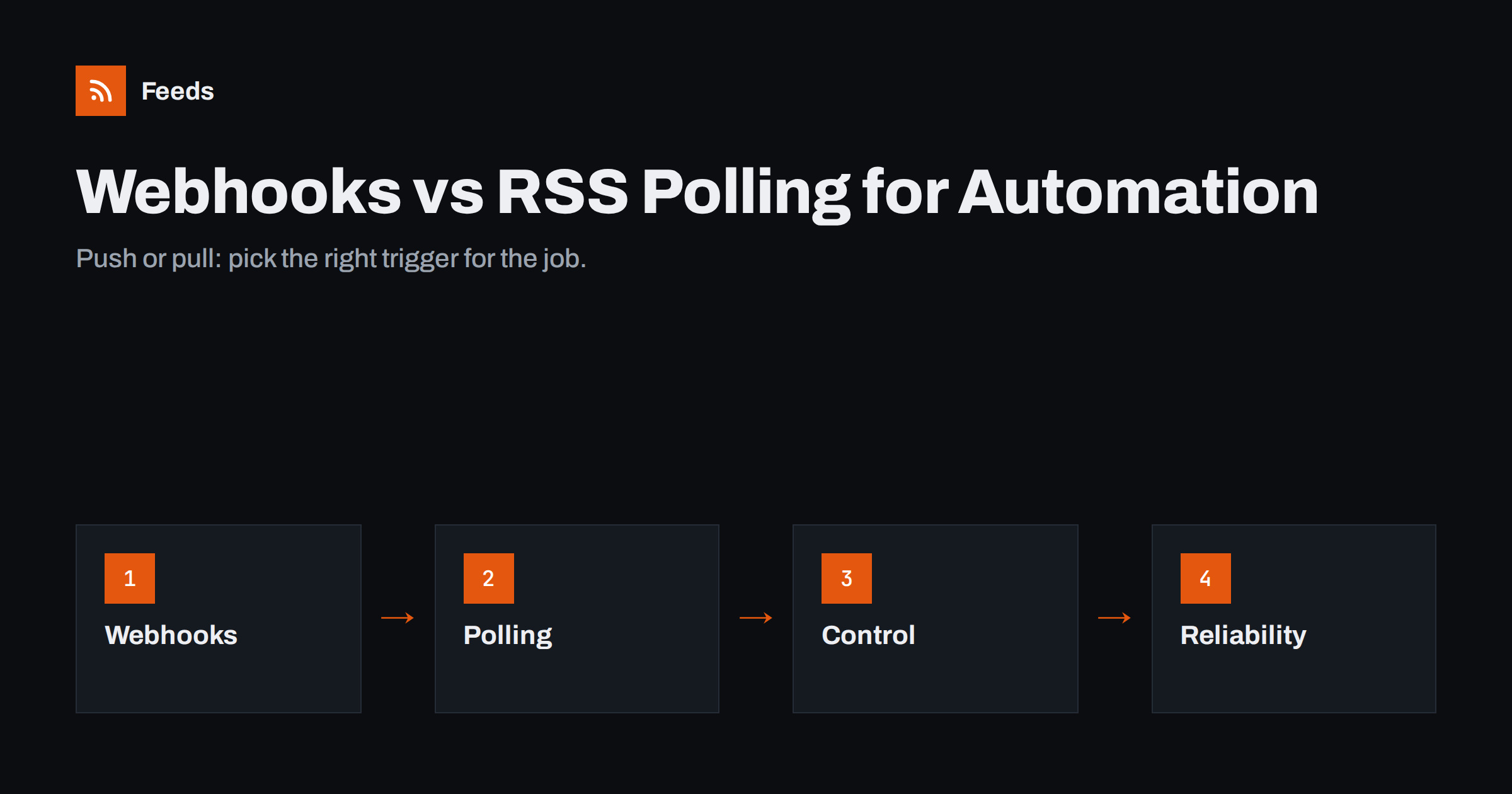
Short answer: Webhooks push a notification to your system the moment something happens, while RSS polling means your system checks a feed at intervals and picks up new items. Webhooks are faster and more efficient but require the source system to support them and you to run a reachable endpoint; RSS polling works with almost any website, including ones you do not control, and is simpler to recover after failures. For content distribution, polling a feed is usually good enough; for time-critical events in systems you own, webhooks are better.
Two ways to learn that something changed
Every automation begins by noticing that something happened: a new article was published, a product was added, an order came in. There are fundamentally two ways to notice.
Pull (polling): your tool asks the source “anything new?” at regular intervals. RSS is the classic example. The feed always lists the latest items, and your tool compares them with what it has already seen.
Push (webhooks): the source tells your tool when something happens. When an event occurs, the source sends an HTTP request with details of the event to a URL you registered in advance.
A useful analogy: polling is checking your mailbox every hour; a webhook is the courier ringing your doorbell. The courier is faster, but only works if the sender uses a courier and you are home to answer the door.
How RSS polling works in practice
A feed is a file on the source website that lists recent items with IDs, titles, links and dates. An automation tool downloads it on a schedule, for example every 15 minutes or every hour, and compares the item IDs with its stored list. New IDs trigger the workflow.
Polling has characteristics that matter for design:
- Latency equals the interval. With hourly checks, an item can wait up to an hour before your workflow sees it.
- Works with sites you do not control. Any public feed can be polled, without asking the site owner for anything.
- Naturally recovers. If your tool is down for a few hours, it catches up on the next check, as long as the items are still in the feed.
- Some wasted requests. Most checks find nothing new. Well-behaved clients use HTTP caching headers such as ETag and Last-Modified so unchanged feeds cost very little.
How webhooks work in practice
With webhooks, you give the source system a URL, often called an endpoint, and choose which events it should report. When such an event happens, the source sends a request to your endpoint, usually a POST with a JSON body describing the event. Your system processes it and replies with a success status.
Characteristics:
- Near-instant. The notification arrives seconds after the event.
- Efficient. No repeated checking; requests happen only when something changes.
- Requires support from the source. The source system must offer webhooks, and you usually need an account or admin access to configure them.
- Requires a reachable endpoint. Your receiver must be online and publicly accessible over HTTPS.
- Delivery can fail. If your endpoint is down, events may be retried for a while, then lost, depending on the source’s retry policy.
- Security matters. Endpoints should verify signatures or secrets so that nobody can send fake events.
Many platforms support outgoing webhooks: e-commerce systems for orders and products, form builders for submissions, code hosting services for commits and releases, and some CMSs for publish events. Chat tools such as Slack and Discord accept incoming webhooks, which is why they are popular destinations.
Side-by-side comparison
| Aspect | RSS polling | Webhooks |
|---|---|---|
| Speed | Depends on interval, minutes to hours | Seconds |
| Works with third-party sites | Yes, any public feed | Only if they offer webhooks to you |
| Setup on the source | None | Configuration and access needed |
| Infrastructure you need | A tool that polls | A public, always-on endpoint |
| Recovery after downtime | Automatic if items are still in the feed | Depends on retries; events can be lost |
| Data included | Standard fields: title, link, date, summary | Whatever the event payload contains |
| Typical use | Content distribution, monitoring | Transactions, real-time alerts |
When RSS polling is the better choice
- Distributing published content. A blog post appearing on social media 20 minutes after publication makes no practical difference to anyone.
- Following sites you do not own. News sites, competitors, regulators and partners will not set up webhooks for you, but many publish feeds, and feeds can be created for those that do not.
- Simple, low-maintenance setups. No server to run, no endpoint to secure.
- Digests and summaries. If you send a daily email anyway, instant delivery is irrelevant.
- Resilience. A feed is a list of recent state, so a missed check is not a lost event.
When webhooks are the better choice
- Time-critical events such as orders, payments, security alerts or support tickets.
- Systems you control that offer webhook support, such as your shop or form tool.
- Events without a public list, such as a customer signing up, which would never appear in a feed.
- High-frequency sources where polling often enough would be wasteful.
Three everyday scenarios
Sharing your blog posts on social media
Your CMS may be able to send a webhook on publish, and some posting tools can receive it. But nearly every posting tool can also poll your blog’s RSS feed. Since a post appearing on LinkedIn ten or thirty minutes after publication changes nothing for readers, polling is the simpler, sturdier choice. It also survives CMS plugin changes that might silently break a webhook.
Alerting the team about new orders
An online shop wants a chat message for every large order. Orders never appear in a public feed, and a delay of an hour would defeat the purpose. This is a textbook webhook case: the shop platform sends an order event, an automation checks the order value and posts to the channel within seconds.
Following regulator announcements
A compliance team needs to know when a regulator publishes new guidance. The regulator will not configure a webhook for one company, and its website may not even have a feed. The workable approach is polling: use the regulator’s feed, or create one from its news page, and check it every hour or so. Guidance documents are not measured in seconds, and polling works without any cooperation from the source.
The pattern is clear. Ask two questions: do I control the source, and does a delay of minutes matter? If you control it and seconds matter, use webhooks. Otherwise, polling a feed is usually the pragmatic answer.
Combining both: the hybrid pattern
Many robust systems use both. Webhooks deliver events quickly, and a periodic poll of a feed or API acts as a safety net that catches anything a failed webhook missed. Another hybrid is WebSub (formerly PubSubHubbub), a W3C recommendation in which a feed publisher notifies a hub when the feed changes and the hub pushes the update to subscribers. It combines the reach of feeds with push-style speed, though support depends on the publisher and the subscribing tool.
In automation platforms, you often see this choice directly: some triggers are labelled “instant” (webhooks) and others are “polling”. Instant triggers are generally preferable when available; polling triggers work with more sources.
Where feeds come from when sites have none
The biggest weakness of polling is that it needs a feed, and many sites you want to follow have none. That usually pushes people towards fragile scraping scripts.
Feeds creates an RSS feed from any page that lists articles, so polling-based tools can watch it like any normal feed. It uses the site’s existing feed where there is one, can merge several sources, filter by keywords and remove duplicates. Feeds refresh automatically, and an out-of-date feed is also refreshed when it is read, which helps keep polling results current. Paid plans alert you if a page changes and a feed stops finding items. The pricing page lists refresh intervals per plan.
Related reading
- Zapier vs Make vs IFTTT vs n8n for RSS Automation
- How Often Do RSS Feeds Update? Refresh Intervals Explained
- How to Post RSS Feed Items to Discord Automatically
- What Is Content Automation? A Practical Guide for Small Teams
The bottom line
Use webhooks for time-critical events in systems you control, and RSS polling for content distribution and following sources you do not own. Polling is simpler and self-healing; webhooks are faster and more efficient but need an endpoint and support from the source. For most content automation, a well-maintained feed polled every few minutes to an hour is the practical choice, with webhooks reserved for events where seconds matter.
FAQ
Is RSS polling bad for the source website?
Not when done sensibly. Reasonable intervals and HTTP caching headers such as ETag and Last-Modified mean unchanged feeds cost the server very little.
Can I get webhooks from a site that only has RSS?
Not directly from the site. A hub using WebSub can push feed updates if the publisher supports it, or an automation tool can poll the feed and then call your webhook for each new item.
How fast is RSS polling?
It depends on the interval your tool uses. Intervals between a few minutes and a few hours are common, so items appear with at most that much delay.
Are webhooks secure?
They can be. Use HTTPS, keep endpoint URLs private and verify the signatures or shared secrets that most providers include with each request.
What happens if my webhook endpoint is down?
Many providers retry failed deliveries for a limited time. If your endpoint stays down longer, events can be lost, which is why a periodic polling safety net is useful.
Do automation platforms support both webhooks and RSS?
Yes. Platforms such as Zapier, Make and n8n offer RSS triggers that poll feeds and webhook triggers that receive pushed events. Instant triggers are usually webhook-based, while RSS triggers run on a schedule.