ENEnglish
 LTLietuviškai
 DEDeutsch
 FRFrançais
 RUРусский
 ESEspañol
 PLPolski
 ITItaliano
 UKУкраїнська
 CSČeština
 PTPortuguês
 JA日本語
JA日本語 LVLatviešu valoda
 ETEesti
 HUMagyar
 IDBahasa Indonesia
 TRTürkçe
 HIहिन्दी
 ELΕλληνικά
 ARالعربية
 THไทย
THไทย VITiếng Việt
 RORomână
 MSBahasa Melayu
 BNবাংলা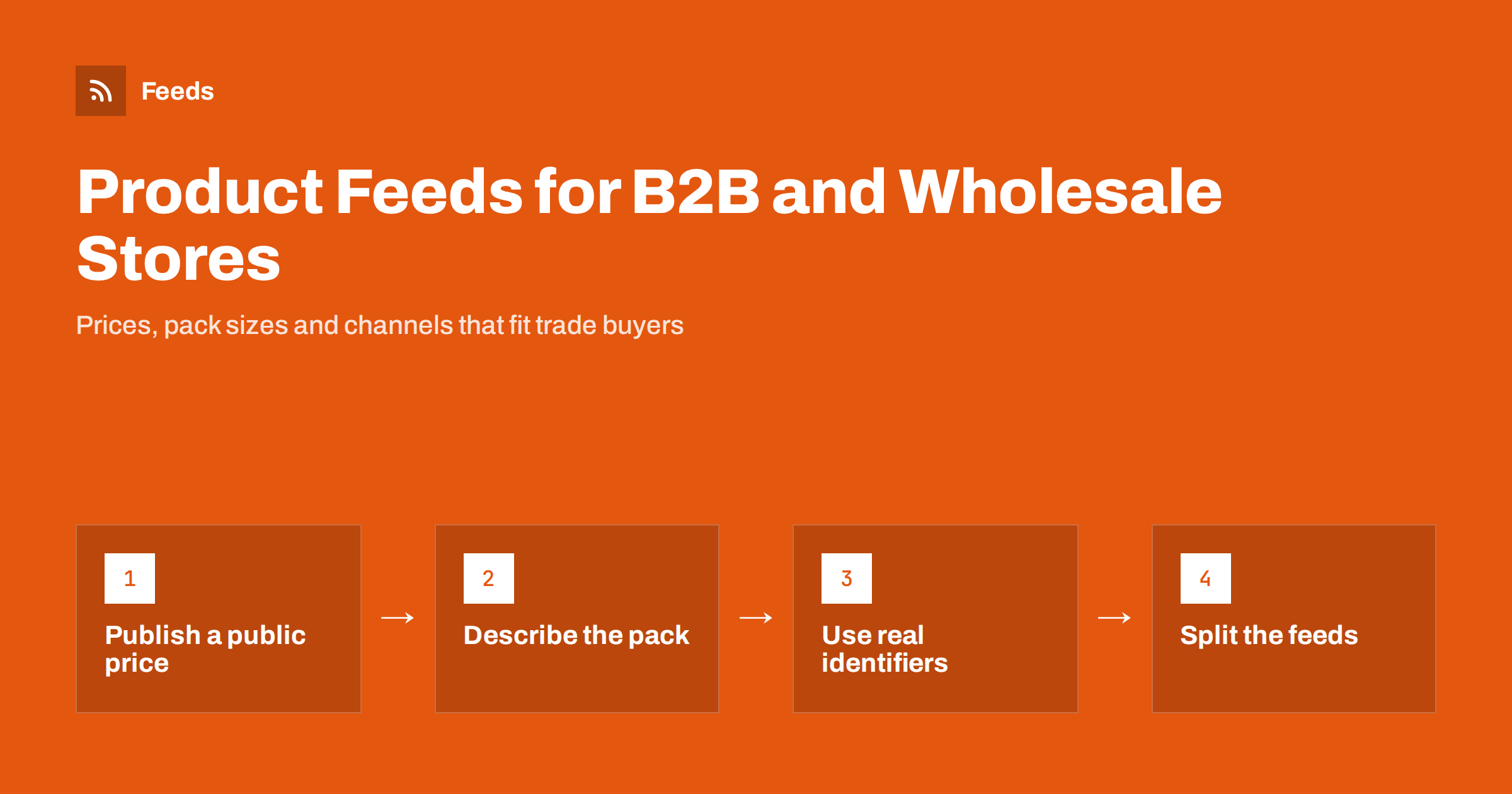
Short answer: B2B and wholesale stores can use product feeds successfully, but only for products with a price that anyone can see on the landing page. Describe the selling unit clearly (single item, case, pallet), include brand, MPN and GTIN where they exist, state minimum order quantities on the page and keep trade-only prices out of public ad feeds. For many wholesalers the best setup is two feeds: a public one for shopping channels and a separate one for partners, marketplaces or resellers.
Do product feeds make sense for B2B at all?
Product feeds were built for shopping ads aimed at consumers, so wholesalers often assume they are not relevant. In practice, many business buyers search exactly like consumers: an office manager looking for printer toner, a café owner looking for takeaway cups, a contractor looking for a specific fitting by part number. If your products can be bought online at a visible price, shopping channels can reach these buyers.
Feeds are also useful beyond ads. Wholesalers send product data to resellers, marketplaces and comparison sites, and a regularly refreshed feed replaces spreadsheets that go out of date the day they are emailed. Our overview of product feeds for marketplaces covers that side.
Even if you never run ads, a clean feed is a good health check for your catalogue: missing brands, unclear units and empty descriptions become visible the moment you try to export them in a standard format.
The main question is not whether you are B2B, but whether your product data and pages meet what each channel expects.
Public prices versus login-only prices
Shopping platforms compare the price in your feed with the price a visitor sees on the landing page. If prices appear only after logging in, the platform cannot verify them, and the products are usually disapproved or limited. This is the single biggest obstacle for wholesale stores.
- Show a public list price for products you want to advertise, even if trade customers get a lower price after login. The feed should use that public price.
- Keep negotiated prices out of public feeds. Customer-specific or tiered pricing belongs in your shop, your price lists or a private partner feed, not in an ad feed.
- Do not hide the add-to-cart button. A product page that says “log in to buy” is a weak landing page, even if the price is visible. See product landing page requirements.
If your whole catalogue is gated, consider making a selected range public, for example best sellers or entry products, and advertising only that.
Prices with or without VAT
Trade buyers are used to net prices, while consumer shopping ads in many countries are expected to show the price the buyer actually pays. Rules differ by country and channel, so check the requirements for each target market before you decide which price goes into the feed.
Practical points:
- Be consistent: the feed price, the landing page price and the checkout must match for the same visitor.
- If your site switches between net and gross prices, make sure the default view a new visitor sees is the one your feed uses.
- Use price rules in the feed rather than editing your shop, if a channel needs a different presentation.
Our article on VAT and tax in product feed prices explains the common setups.
Pack sizes, cases and minimum order quantities
Wholesale products are often sold in quantities: a box of 100, a case of 12, a pallet. A feed that shows “Paper cups – 4.90” without saying it is a sleeve of 50 confuses buyers and can trigger price mismatch problems.
| How you sell | What to put in the feed | What the page must show |
|---|---|---|
| Single items | Normal item with unit price | Price per item |
| Fixed packs (box of 50) | Pack in the title; multipack value where supported | Pack contents and pack price |
| Cases of mixed items | Bundle flag where supported | Contents of the case |
| Minimum order quantity | Price for the minimum quantity, or exclude | The minimum clearly near the price |
| Price per unit of measure | Unit pricing attributes | Price per kg, litre or metre |
The details of each are in bundles and multipacks in product feeds and unit pricing in product feeds. If a product can only be bought in large minimum quantities that a typical searcher would not expect, it is often better to leave it out of ad feeds than to show a price that looks wrong.
Identifiers: part numbers matter in B2B
Business buyers search by part number far more often than consumers. Accurate identifiers help platforms match your item to these searches and to the right product listing.
- Brand: the manufacturer’s brand, not your shop name, unless you make the product.
- MPN: the manufacturer part number, exactly as the manufacturer writes it.
- GTIN: the barcode number, where the product has one. Use the GTIN of the unit you actually sell; a case usually has a different GTIN from a single item.
Put the part number in the title as well when buyers search for it. More on this in GTIN, MPN and brand identifiers.
Titles and descriptions for trade buyers
Trade buyers want specifications, not lifestyle copy. A good B2B title includes the product type, brand, model or part number, key specification and pack size, for example “Nitrile Gloves, Powder-Free, Size L – Box of 100”. Descriptions should list the specifications buyers compare: dimensions, materials, compatibility, certifications you can document, and what is included.
Specifications also help the platform decide which searches your product is relevant for. A title that only says “Gloves L” competes for almost nothing, while one that names the material, the size and the pack matches the exact query a purchasing manager types. If your catalogue has thousands of items with similar names, build titles with a rule from structured fields, such as brand, product type, key attribute and pack size, instead of editing them one by one. Rules are easier to keep consistent and can be changed in one place when you learn what works.
Avoid claims you cannot support, such as certifications you do not hold, and avoid internal codes that mean nothing outside your company.
One feed or several?
Wholesalers with both retail and trade customers usually do better with separate feeds:
- Public shopping feed: products with public prices and normal quantities, optimised titles, out-of-stock items excluded.
- Partner or reseller feed: the full catalogue with trade data, shared privately with resellers or marketplaces. Many partners accept a CSV or XML link they can download on a schedule.
- Country feeds: if you sell to several countries with different currencies or tax rules.
Our guide to splitting a catalogue into multiple product feeds explains how to organise them, and the CSV product feed guide helps when a partner asks for a spreadsheet format.
Common B2B feed mistakes
- Feeding login-only prices into shopping channels.
- Unclear selling units, so a case price looks like an item price.
- Shop name as brand for products made by other manufacturers.
- Stale stock because the feed is exported manually once a month.
- Sending partners an email attachment instead of a feed link that updates itself.
- Advertising products with long lead times as in stock, which leads to cancelled orders and unhappy first-time customers.
How Feeds helps wholesale stores
Feeds creates Google Merchant Center and Meta catalog XML straight from WooCommerce or Shopify, or from a CSV link for other platforms. It reads public store data, the same information a visitor can see, which suits the public-price rule of shopping channels. You can skip out-of-stock products, rewrite titles to add pack sizes or part numbers, and adjust prices with rules, while the currency is detected automatically. The Business plan covers several stores and lists marketplace formats on request. You can try it with your store and compare plans on the pricing page.
Related reading
The bottom line
Product feeds work for B2B and wholesale when the advertised products have public prices, clear selling units and accurate identifiers. Keep trade-only pricing out of public feeds, describe packs and minimums plainly, use part numbers in titles, and give partners a feed link instead of a spreadsheet. Separate feeds for public and partner use keep both sides clean.
FAQ
Can I advertise products whose prices are only visible after login?
Generally not in shopping ads, because the platform must be able to see the same price as in the feed on the landing page. Show a public price for the products you want to advertise, or leave gated products out of ad feeds.
Should a wholesale feed use prices with or without VAT?
It depends on the country and the channel. Many consumer shopping channels expect the price the buyer actually pays, so check the rules for each target market and make the feed, page and checkout consistent.
How do I list a product sold only in boxes of 100?
Make the box the item: put the pack size in the title, use the box price, and use the multipack attribute where the channel supports it. The landing page must clearly show that the price is for the box.
Which GTIN should I use for a case of items?
Use the identifier of the unit you actually sell. A case often has its own GTIN that differs from the single item, so check the packaging or ask the manufacturer.
Can I share a product feed with resellers?
Yes. A feed link that refreshes automatically is usually better than emailed spreadsheets, because resellers always download current prices and stock. Keep it separate from your public shopping feed if it contains trade data.