ENEnglish
 LTLietuviškai
 DEDeutsch
 FRFrançais
 RUРусский
 ESEspañol
 PLPolski
 ITItaliano
 UKУкраїнська
 CSČeština
 PTPortuguês
 JA日本語
JA日本語 LVLatviešu valoda
 ETEesti
 HUMagyar
 IDBahasa Indonesia
 TRTürkçe
 HIहिन्दी
 ELΕλληνικά
 ARالعربية
 THไทย
THไทย VITiếng Việt
 RORomână
 MSBahasa Melayu
 BNবাংলা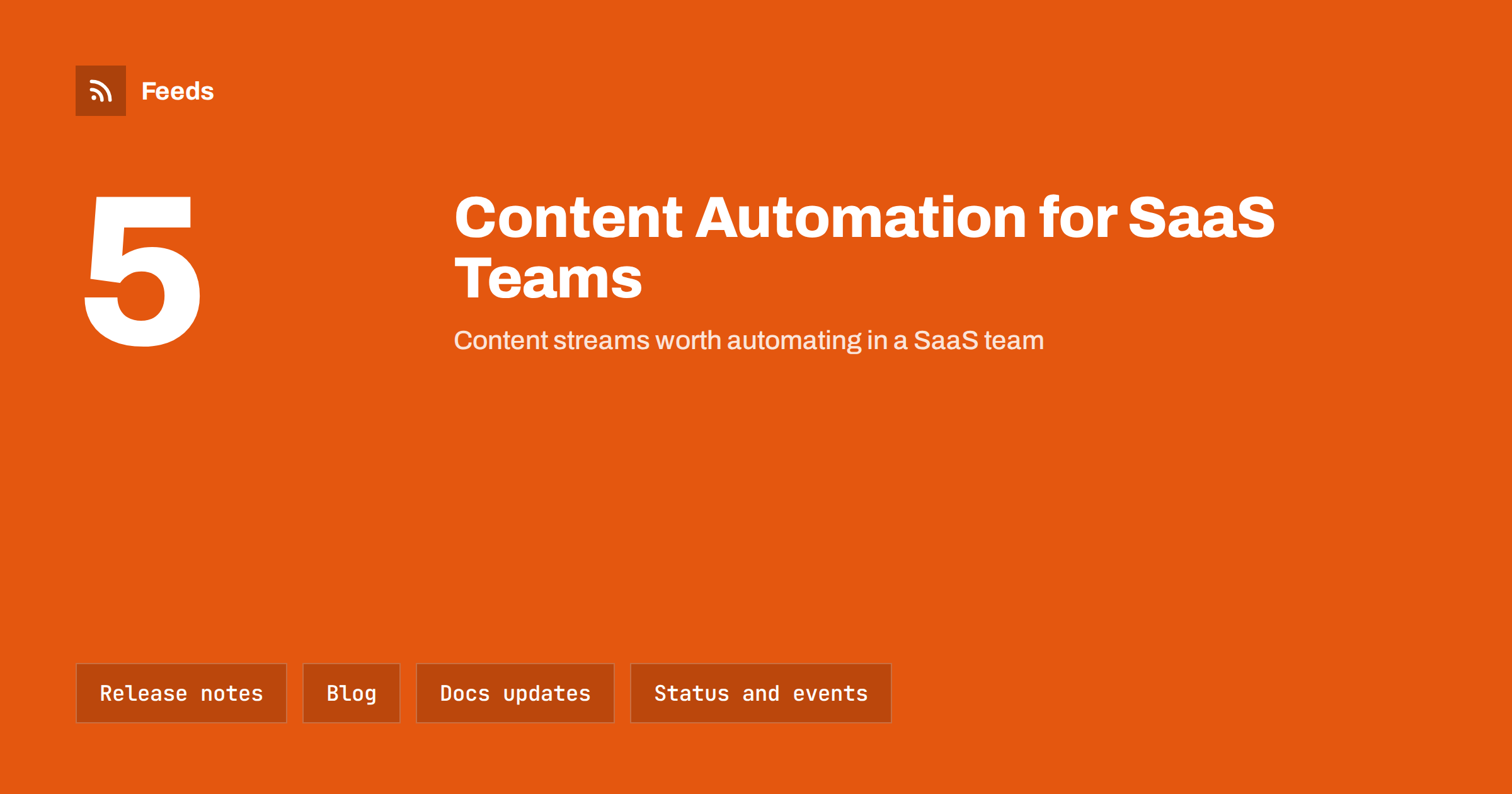
Short answer: a SaaS company produces several streams of content that follow the same pattern every time: blog posts, release notes, documentation updates, status incidents, webinars and job openings. Each stream can be published as a feed and routed automatically to the right audience: social profiles and newsletters for prospects, in-product and community channels for customers, and team chat for sales and support. Automate the distribution, keep the writing and the judgment human, and start with release notes, because they are the stream most teams forget to share.
Why SaaS teams are good candidates for automation
Software companies publish more often than most businesses, but in many small pieces spread across different tools. A typical team might have a blog in a CMS, release notes in a changelog tool, help articles in a help centre, incidents on a status page and events on a webinar platform. Each piece is useful to someone, yet very few of them reach everyone who would care.
The result is familiar: a feature ships, the release note goes live, and customers only find out weeks later when support mentions it. Sales keeps pitching the old limitation. The social profile posts twice a month because nobody has time to write about every update. Content automation fixes the distribution part of this problem without adding more writing work.
It also helps that SaaS content is structured. A release note has a title, a date, a link and a category. A status incident has a state and affected components. That structure is exactly what feeds carry, which makes the content easy to route by rules.
Map your content streams first
Before choosing tools, list what you publish and where it lives. A simple inventory usually looks like this:
- Blog: thought leadership, tutorials, comparisons, company news. Audience: prospects and customers.
- Release notes or changelog: new features, improvements, fixes. Audience: customers, sales, support, partners.
- Documentation and help centre: new and updated articles. Audience: customers, support, integrators.
- Status page: incidents and maintenance. Audience: customers, support, account managers.
- Events and webinars: upcoming sessions and recordings. Audience: prospects and customers.
- Careers page: open roles. Audience: candidates and the team’s own networks.
For each stream, write down whether it already has an RSS feed. Blogs almost always do, many changelog tools and status pages do, help centres and careers pages often do not. The guide on publishing a changelog RSS feed customers will follow explains what a good changelog feed contains.
Route each stream to the right audience
The key design decision is not which tool to use but who should see what. A useful routing plan looks like this:
| Stream | External destinations | Internal destinations |
|---|---|---|
| Блог | LinkedIn, X, other social profiles, monthly newsletter | Marketing channel |
| Release notes | Customer newsletter, community forum, social for major releases | Sales, support and success channels |
| Docs updates | Developer community, integrator mailing list | Support channel |
| Status incidents | Status subscribers (handled by the status tool) | Support and account management channels |
| Events | Social profiles, newsletter | Sales channel for invites |
| Job openings | LinkedIn, job boards, employee sharing | All-staff channel |
Internal routing is often the quickest win. Sending release notes and incidents into team chat takes minutes to set up and immediately improves how sales and support talk to customers. See how to send RSS feed updates to a Slack channel and how to monitor status pages with RSS for the mechanics.
Use filters so channels stay relevant
Not every release note deserves a social post. A fix for a rare export bug matters to the three customers who reported it, not to your LinkedIn followers. Filters let you send the same feed to several destinations with different rules:
- By category or label: only items tagged “New feature” go to social; everything goes to the support channel.
- By keyword: items mentioning “API”, “webhook” or “SDK” go to the developer community.
- By exclusion: items containing “internal”, “beta” or “hotfix” never go to public channels.
Filters work best when the source is consistent. Agree on a small set of labels or title prefixes for release notes, and the automation can do the rest. If your changelog tool does not offer labels in its feed, keyword rules on the title are a reasonable substitute.
Automate the parts nobody enjoys
Once streams and routes are clear, these automations usually pay off first:
- New blog post to social profiles. Each new article is shared with a short template and a tracked link.
- Release notes to team chat. Sales and support see every change the day it ships.
- Monthly product digest. An email tool builds a newsletter from the month’s release notes and blog posts; a person writes the introduction.
- Docs updates to support. Support agents see new and changed help articles and can link them in replies.
- Job openings to social. New roles are posted automatically and employees can reshare them.
- Competitor and market monitoring. Competitors’ changelogs and blogs are collected into one filtered feed for product managers.
Add UTM parameters to automated links so you can see which streams bring visitors and signups. The guide on tracking automated posts with UTM tags shows a simple naming scheme.
What to keep manual
Automation should move content, not replace the decisions that make it good. Keep these in human hands:
- Major launch announcements. A big release deserves a hand-written post, visuals and timing aligned with sales and support.
- Incident communication beyond the status page. Social replies during an outage need tone and context that templates cannot provide.
- Newsletter introductions. A few human sentences make an automated digest feel like a message rather than a list.
- Anything involving customer names or case studies, which need approval.
If you are unsure how much control you need, an approval queue for public channels and full automation for internal channels is a sensible starting point.
Common mistakes SaaS teams make
- Posting every minor fix publicly. Followers learn to ignore the account. Filter public channels to meaningful changes.
- Release notes written for engineers. “Refactored the export queue” means nothing to customers. Write the benefit in the title and the automation will carry it everywhere.
- Feeds without dates or with changing links. Automations then repeat old items or miss new ones. Stable links and correct dates are essential.
- No owner. When a feed breaks after a site redesign, nobody notices for weeks. Name one person responsible for the automation.
- Forgetting internal audiences. Teams automate social posts but never tell their own support team about changes.
A simple 30-day rollout
Trying to automate everything at once usually creates noise and confusion. A staged rollout over about a month works better for a small team:
- Week 1: inventory and feeds. List every stream, find the existing feed URLs, and note which pages have no feed yet. Open each feed and check that titles, dates and links are correct.
- Week 2: internal routes. Connect release notes, docs updates and status incidents to the relevant team channels. Ask sales and support after a few days whether the volume is right.
- Week 3: public routes with approval. Connect the blog and major release notes to social profiles, but let a person approve each post for the first weeks. Adjust templates based on what you see.
- Week 4: digests and measurement. Set up the monthly product digest, add UTM parameters everywhere and write down who owns each automation.
After the first month, review the rules once per quarter. Products change, labels drift and new streams appear, such as a podcast or a partner directory. A short quarterly review keeps the system aligned with what the company actually publishes, and it is the moment to switch trusted routes from approval to full automation.
How Feeds fits into this plan
The biggest practical gap in SaaS content automation is that some streams have no feed: a careers page, a help centre’s “What’s new” page, a partner’s integration directory or a competitor’s changelog. Feeds turns such pages into clean RSS by finding the list of items on the page and reading titles, images, summaries and dates; where a site already has RSS, that feed is used. You can merge several sources into one feed, keep only items with or without specific words, and duplicates are removed automatically. The resulting feed link works in any RSS reader, chat integration or posting tool, and it refreshes by itself. You can create a feed from any page to test your first stream.
Related reading
- What Is Content Automation? A Practical Guide for Small Teams
- Full Auto vs Approval Queue: Choosing a Content Workflow
- How to Track Updates to Documentation and Help Centers
The bottom line
SaaS companies already produce plenty of content; the gap is distribution. List your streams, publish each as a feed, route them to the people who care, and use filters so every channel stays relevant. Automate internal notifications and routine sharing first, keep launches and sensitive communication manual, and give the whole system an owner.
FAQ
What should a SaaS company automate first?
Start with release notes sent to sales and support channels, and new blog posts shared to social profiles. Both are quick to set up and immediately improve how customers hear about changes.
Should every release note be posted on social media?
No. Filter public channels to meaningful features and improvements. Minor fixes can go to internal channels, a changelog page and a monthly digest instead.
What if our help centre or careers page has no RSS feed?
You can create a feed from the page with a page-to-feed tool, which reads the public list of articles or jobs and turns it into RSS. That feed can then be routed like any other.
How do we measure whether content automation works?
Add UTM parameters to automated links and compare visits and signups per stream. Also ask sales and support whether they now hear about changes on time.
Who should own content automation in a small SaaS team?
Usually someone in marketing or product operations. What matters is that one named person checks the feeds, fixes broken routes and reviews the rules every few months.