ENEnglish
 LTLietuviškai
 DEDeutsch
 FRFrançais
 RUРусский
 ESEspañol
 PLPolski
 ITItaliano
 UKУкраїнська
 CSČeština
 PTPortuguês
 JA日本語
JA日本語 LVLatviešu valoda
 ETEesti
 HUMagyar
 IDBahasa Indonesia
 TRTürkçe
 HIहिन्दी
 ELΕλληνικά
 ARالعربية
 THไทย
THไทย VITiếng Việt
 RORomână
 MSBahasa Melayu
 BNবাংলা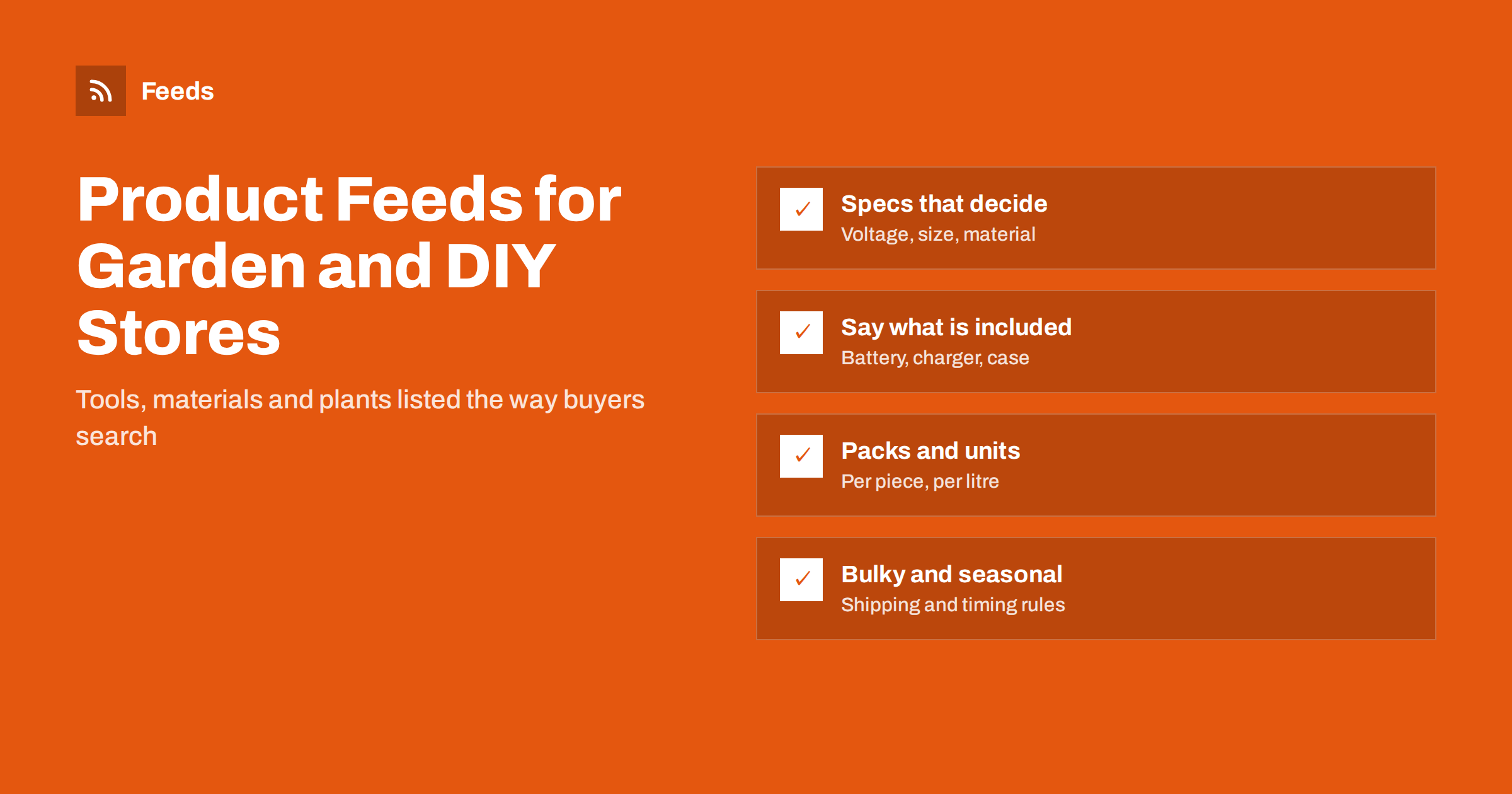
Short answer: Garden, DIY and hardware feeds work when each product states the details that decide a purchase: voltage and battery platform for power tools, dimensions and material for building supplies, pack size for fixings and coverage or volume for paint and treatments. Say clearly whether a battery and charger are included, use unit pricing and multipack data for consumables, set correct shipping for bulky items and check channel policies for chemicals, fuels and plants before listing them.
Why this category needs precise data
Garden, DIY and hardware stores sell an enormous range of products, from a single screw to a ride-on mower. Shoppers in this category usually know exactly what they need: a drill that fits the batteries they already own, a pack of a specific screw size, ten litres of a particular exterior paint or a hose of a certain length. They search with precise terms and compare precise numbers.
A feed that only lists brand and a generic product name loses these shoppers. “Cordless drill” competes with thousands of offers; “cordless drill 18V tool only” from a known brand reaches the buyer who already owns that brand’s batteries. Specific data is not just better for shoppers, it also helps platforms match the right search to the right product.
Compatibility is a related point. Accessories such as drill bits, saw blades, mower blades and spare batteries are bought to fit a particular tool or brand. Put the compatible brand, system or model in the title and description, while keeping the accessory’s own brand in the brand field. A blade that clearly says which mowers it fits sells better and is returned less often than one listed only by its size.
Descriptions should answer practical questions as well: what the product is made of, where it can be used, what tools are needed for installation and what is in the package. These details also help platforms understand the product better than a short marketing sentence.
The category also includes products that are heavy, bulky, seasonal or regulated. Each of those needs some extra attention in the feed to avoid wrong prices at checkout, wasted spend out of season or disapprovals.
Many shoppers are also professionals. Tradespeople buy the same consumables again and again and compare offers by price per unit, so getting pack sizes and unit prices right brings repeat business that casual shoppers alone would not.
Power tools: battery, voltage and what is in the box
Cordless tools are the most common source of confusion. The same model is often sold as a bare tool, with one battery, with two batteries and a charger, or in a kit with a case. These are different products with different prices and usually different identifiers.
- State the voltage and battery platform in the title, for example 18V or the brand’s battery system name.
- Say clearly whether the battery and charger are included; “tool only” or “bare tool” is a common phrase.
- List each kit configuration as its own item with its own GTIN where the manufacturer provides one.
- Include the battery capacity for kits, because shoppers compare it.
Pricing a bare tool and a full kit under one listing, or showing the kit image for the bare tool, leads to disappointed buyers and mismatch problems. Each item’s image should show what the customer actually receives. Kits that combine several tools are bundles and should be marked as such; see bundles and multipacks in product feeds.
Titles for tools, materials and garden products
A useful title follows the order in which shoppers narrow their search: brand, product type, the key specification and size, then colour or finish where relevant.
| Продукт | Useful title pattern |
|---|---|
| Cordless tool | Brand, tool type, voltage, tool only or kit contents |
| Screws and fixings | Type, material or finish, size, pack quantity |
| Paint and coatings | Brand, product, finish, colour, volume |
| Timber and boards | Material, dimensions, grade or treatment |
| Garden hose | Brand, type, diameter, length |
| Lawn mower | Brand, power type, cutting width, model |
Keep titles factual and use units consistently, such as millimetres or inches, as on the product page. For more on structure, see product feed title optimization.
Pack sizes, multipacks and unit prices
Many hardware products are sold in packs: boxes of screws, bags of compost, multipacks of batteries. Shoppers compare price per unit, and in many regions unit prices are expected for products sold by weight, volume or length.
- State the pack quantity in the title, such as “box of 200”.
- Mark store-made packs of identical items as multipacks with the number of units.
- Add unit pricing measures for paint, compost, cable and similar products sold by volume, weight or length.
- Use the manufacturer’s GTIN for packs that have their own barcode.
Unit pricing in feeds is explained in unit pricing in product feeds: measures and base units. Getting it right lets platforms show a fair price comparison, which matters in a category where buyers often look for the best value per unit.
Bulky items and shipping costs
Garden furniture, sheds, ladders, mowers, bags of aggregate and long timber are expensive to deliver, and many stores charge more for them or offer special delivery. If the shipping cost shown in a shopping listing does not match checkout, shoppers abandon the cart and the platform may flag a mismatch.
Use shipping labels to group oversized and heavy products and give them their own shipping rule in the account settings. Include shipping weight where your rules depend on it. For products available only for in-store collection or local delivery, make sure the feed does not suggest standard nationwide shipping. Our guide to shipping in product feeds covers the options, and local inventory feeds explain how to show in-store stock.
Plants, seeds and seasonal products
Live plants, bulbs and seeds bring their own issues. Availability is seasonal, delivery may be limited to certain months or regions, and some plants cannot be shipped to certain areas because of plant health rules. The feed must reflect what can really be ordered and delivered.
- Show plants as out of stock or exclude them when they cannot be shipped.
- Use preorder availability with a date for plants and bulbs sold ahead of the planting season.
- Describe the size or pot size clearly, because plant images often show a mature plant.
- Label seasonal products, such as barbecues, garden furniture and snow shovels, so campaigns can follow the season.
Custom labels for season and margin make it easy to raise and lower campaign priority across hundreds of products at once. See custom labels in product feeds.
Chemicals, fuels and restricted products
Garden and DIY stores often sell products that are regulated or restricted on shopping channels: pesticides and herbicides, fuels, some fertilisers, solvents, gas cylinders and certain tools. Rules vary by country and channel, and some products need specific information or cannot be advertised at all.
- Check each channel’s current policies for dangerous products, chemicals and pesticides.
- Exclude products that cannot be advertised rather than leaving them disapproved.
- Keep safety information consistent with the packaging and product page.
- Do not use vague titles to work around restrictions; misleading listings carry greater risk.
Our guide on which products to exclude from your feed shows how to filter whole categories without removing them from your store.
How RSS Feed Creator helps
RSS Feed Creator (Feeds) creates Google Merchant Center and Meta catalog XML directly from a WooCommerce or Shopify store, or from a CSV link for other platforms, without plugins or code on your site. The feed uses the Google product XML format with id, title, link, image, price, availability and brand, and Meta reads the same file. You can skip out-of-stock products, rewrite titles to add voltage, size or pack quantity and adjust prices with rules, while the currency is detected automatically. Extra attributes, such as unit pricing or shipping labels, can be added in Merchant Center with a supplemental feed. Compare plan limits on the pricing page.
Related reading
- Product feeds for furniture and home goods stores
- Supplemental feeds in Merchant Center: when and how to use them
- Out-of-stock products in your feed: keep, mark or remove?
The bottom line
Garden, DIY and hardware shoppers search with precise specifications, so the feed must provide them. State voltage and kit contents for tools, sizes and pack quantities for fixings and materials, unit prices for products sold by volume or weight, correct shipping for bulky items, seasonal availability for plants and careful handling of chemicals and restricted products. Precise data brings precise buyers.
FAQ
How should I list a cordless drill sold without a battery?
Put “tool only” or “bare tool” in the title, use the image of the bare tool and give it its own item and identifier. Kits with batteries and chargers should be separate items.
Do screws and fixings need unit pricing?
Unit pricing is mainly expected for products sold by weight, volume or length. For packs of screws, state the quantity clearly in the title and mark store-made packs as multipacks.
Can I advertise weed killers and pesticides in shopping ads?
It depends on the channel and the country, and these products are often restricted. Check the current policies and exclude items that are not allowed.
How do I show higher delivery costs for sheds and mowers?
Use a shipping label for oversized products and set a separate shipping rule for that label in your account. The cost in the listing must match checkout.
Should plants stay in the feed out of season?
Only if they can be ordered. Use preorder availability with a date for advance sales, and mark plants out of stock or exclude them when they cannot be shipped.