ENEnglish
 LTLietuviškai
 DEDeutsch
 FRFrançais
 RUРусский
 ESEspañol
 PLPolski
 ITItaliano
 UKУкраїнська
 CSČeština
 PTPortuguês
 JA日本語
JA日本語 LVLatviešu valoda
 ETEesti
 HUMagyar
 IDBahasa Indonesia
 TRTürkçe
 HIहिन्दी
 ELΕλληνικά
 ARالعربية
 THไทย
THไทย VITiếng Việt
 RORomână
 MSBahasa Melayu
 BNবাংলা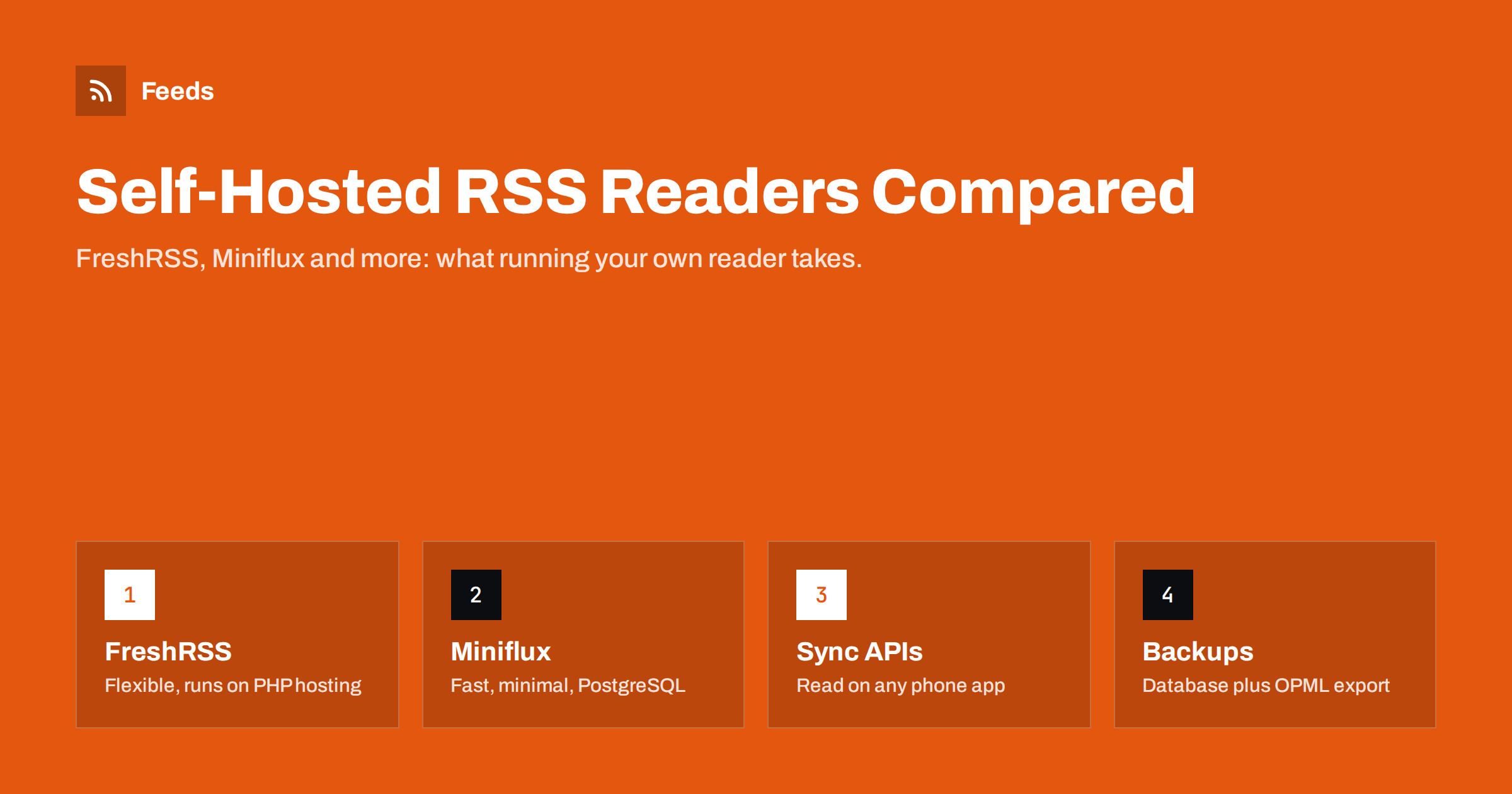
Short answer: A self-hosted RSS reader is a feed reader you run on your own server, so your subscriptions, reading history and refresh schedule are fully under your control. FreshRSS is the most flexible all-rounder, Miniflux is the fastest and most minimal, and apps such as Nextcloud News suit people who already run Nextcloud. Self-hosting is worth it if you are comfortable with basic server maintenance; if not, a hosted reader gives you most of the same benefits with no upkeep.
What “self-hosted” means for an RSS reader
Every RSS reader does two jobs. In the background it fetches your feeds on a schedule and stores new items. In the foreground it shows you those items and remembers what you have read. A hosted reader does both on the provider’s servers. A self-hosted reader does both on a machine you control: a small virtual server, a home server, a NAS or even a spare computer.
The reader itself is usually a web application. You open it in a browser, and most self-hosted readers also expose a sync API so that mobile and desktop apps can use your server as their back end. That combination is what makes self-hosting practical: you keep the data, but you still read on your phone with a polished app.
If you are still deciding what you need from a reader in general, the guide to RSS reader features that actually matter is a good starting point. This article focuses on the self-hosted options and what running one really involves.
Why people self-host their feed reader
Self-hosting is not for everyone, but the reasons people choose it are consistent:
- Ownership of data. Your subscription list, starred items and reading history live in your own database. Nobody can change the terms, raise the price or shut the service down under you.
- Privacy. What you read says a lot about you and your work. With a self-hosted reader, the only party that sees your reading habits is you.
- No artificial limits. Hosted free plans often cap the number of feeds, the refresh frequency or how long items are kept. On your own server, the limits are your hardware and good manners towards the sites you poll.
- Customisation. Open-source readers can be extended with plugins, custom themes and filters, and some can read sites that do not publish a feed at all.
- Team use. Several readers support multiple user accounts, which makes one small server enough for a family, a newsroom desk or an agency team.
The trade-off is responsibility. You install updates, keep backups and fix things when they break. For many people that is a fair deal; for others it is a chore they do not need.
The main self-hosted RSS readers
There are dozens of projects, but a handful cover most needs. All of those below are open source and free to run.
FreshRSS
FreshRSS is a PHP application that runs on almost any ordinary web hosting stack and supports several database engines, including SQLite for small installations. It is multi-user, has a large set of extensions, handles thousands of feeds comfortably and supports both the Google Reader style API and the Fever API for mobile apps. It can also build feeds from web pages using XPath rules, which is handy for technical users. It is the most common recommendation for a first self-hosted reader because it is flexible without being difficult.
Miniflux
Miniflux is a minimalist reader written in Go and distributed as a single binary that uses PostgreSQL. It is deliberately opinionated: a clean, fast, text-first interface, keyboard shortcuts, sensible defaults and few settings to fiddle with. It also supports the Fever and Google Reader APIs and can pass items to read-later and notification services. People who want a quick, quiet reading experience tend to love it.
Nextcloud News
If you already run Nextcloud for files and calendars, its News app adds a feed reader to the same account system. It has its own API with several compatible mobile clients. It is a natural choice when Nextcloud is already part of your setup and a heavy one if it is not.
Other options
Tiny Tiny RSS is one of the oldest self-hosted readers and has a loyal following, although its maintenance arrangements have changed over the years, so check the project’s current status before you commit. CommaFeed offers an interface modelled on the old Google Reader. Small single-binary readers such as yarr suit a single user who wants something that runs on a laptop or a tiny server with almost no setup.
Comparison at a glance
| Reader | Stack | Best for | Mobile app sync |
|---|---|---|---|
| FreshRSS | PHP, SQLite, MySQL or PostgreSQL | Most people; shared hosting; many users | Google Reader API and Fever API |
| Miniflux | Go single binary, PostgreSQL | Fast, minimal reading; keyboard users | Google Reader API and Fever API |
| Nextcloud News | Nextcloud app | Existing Nextcloud users | Own News API |
| Tiny Tiny RSS | PHP, PostgreSQL, usually Docker | Users who want plugins and filters | Own API and plugins |
| Small single-binary readers | One executable, local database | One person, minimal setup | Varies, often Fever API |
Feature sets change between releases, so always read the project’s current documentation before installing. The table is a starting point, not a specification.
What you need to run one
The hardware requirements are modest. A reader for one person with a few hundred feeds runs comfortably on the smallest virtual server most providers sell, or on a Raspberry Pi class device at home. What matters more is the surrounding setup:
- A server or hosting account with the right runtime: PHP for FreshRSS, a PostgreSQL database for Miniflux, or Docker if you prefer containers.
- A domain or subdomain and HTTPS. Mobile apps send your credentials to the server, so a valid certificate is not optional. Free certificates from Let’s Encrypt are the usual choice.
- A scheduled refresh. Readers fetch feeds with a cron job or a built-in scheduler. Refreshing every 15 to 60 minutes is typical; there is rarely a reason to poll more often. The article on how often RSS feeds update explains why.
- Backups. Back up the database regularly and export your subscriptions as OPML from time to time. An OPML file is the portable list of everything you follow, and the guide to OPML files and moving your subscriptions shows how to use it.
- Updates. Subscribe to the project’s release feed, which is a neat use of RSS in itself, and apply security updates promptly.
Reading on your phone: sync APIs and apps
The web interfaces of FreshRSS and Miniflux work well in a mobile browser, but many people prefer a native app. This is where sync APIs matter. A reader that speaks the Google Reader style API or the Fever API can act as the back end for a wide range of third-party apps on iOS, Android, macOS and Windows. You enter your server address and an API password in the app, and it syncs read and starred states both ways.
A few practical tips:
- Create a separate API password where the reader supports it, rather than reusing your main login password.
- Check that the app you like supports your reader’s API before you choose the reader, not after.
- If sync seems slow, remember that the app only shows what the server has fetched. The refresh schedule on the server sets the pace.
Common problems and how to fix them
- Feeds stop updating. Usually the cron job or scheduler has stopped running, or the server’s clock is wrong. Check the reader’s logs and the time of the last successful refresh.
- A particular site fails to load. Some sites block unknown user agents or data-centre IP addresses. Try the feed URL in a browser, check the HTTP status the reader reports, and see the guide to validating a feed and fixing common errors.
- The database grows too large. Set a retention policy so read items older than a few months are purged, keeping starred items.
- Duplicate items appear. The publisher probably changes item identifiers. This is a feed problem, not a reader problem.
- Too many items to read. A self-hosted reader makes it easy to follow hundreds of sources, which is exactly how overload starts. Use categories, filters and fewer, better sources; the advice in organising your RSS reader so it never overwhelms you applies fully here.
When a website has no feed
A self-hosted reader is only as good as the feeds you put into it, and many useful pages, such as company news pages, job boards, public notices and small shop categories, publish no RSS at all. Some readers, FreshRSS included, let technical users write XPath scraping rules per site. That works, but the rules break whenever a site changes its layout, and maintaining dozens of them is tedious.
Feeds offers a simpler route: paste the address of a page, check the preview of the items it found, and get a feed link you can add to any reader, self-hosted or not. It uses an existing feed when a site has one, reads the list of items from the page when it does not, can merge several sources into one feed and keep only items with your keywords. Feeds are refreshed automatically, and paid plans send an alert if a feed stops finding items. You can create a feed from a page on the free plan and see the plan limits on the pricing page.
Related reading
- How to subscribe to RSS feeds: a beginner’s step-by-step guide
- How to create an RSS feed for a website without RSS
- How to set up keyword alerts using RSS feed filters
The bottom line
A self-hosted RSS reader gives you full ownership of your subscriptions, privacy and freedom from plan limits, at the cost of a little server maintenance. FreshRSS is the safe default, Miniflux is the choice for speed and simplicity, and Nextcloud News makes sense inside an existing Nextcloud. Pick one whose sync API your favourite mobile app supports, set up HTTPS, scheduled refreshes and backups, and keep an OPML export so you can always move.
FAQ
What is the best self-hosted RSS reader?
There is no single best one. FreshRSS is the most flexible and easiest to host on ordinary PHP hosting, while Miniflux is faster and more minimal but needs PostgreSQL. Choose based on your server skills and the mobile apps you want to use.
Can I use a self-hosted RSS reader on my phone?
Yes. Most self-hosted readers work in a mobile browser and also support sync APIs such as the Google Reader style API or the Fever API. Many iOS and Android reader apps can connect to them and keep read states in sync.
How much server power does a self-hosted reader need?
Very little for personal use. A few hundred feeds for one person run fine on the smallest virtual server or a small home device. Storage grows over time, so set a retention policy for old read items.
Is self-hosting an RSS reader secure?
It can be, if you use HTTPS, strong passwords, a separate API password for apps and apply updates promptly. An unpatched, publicly reachable web application is the main risk, so treat updates as part of the job.
How do I move from a hosted reader to a self-hosted one?
Export your subscriptions from the hosted reader as an OPML file and import it into the new reader. Starred items and read history usually do not transfer, so save anything important before you switch.