ENEnglish
 LTLietuviškai
 DEDeutsch
 FRFrançais
 RUРусский
 ESEspañol
 PLPolski
 ITItaliano
 UKУкраїнська
 CSČeština
 PTPortuguês
 JA日本語
 LVLatviešu valoda
 ETEesti
 HUMagyar
 IDBahasa Indonesia
 TRTürkçe
 HIहिन्दी
 ELΕλληνικά
 ARالعربية
 THไทย
 VITiếng Việt
 RORomână
 MSBahasa Melayu
 BNবাংলা
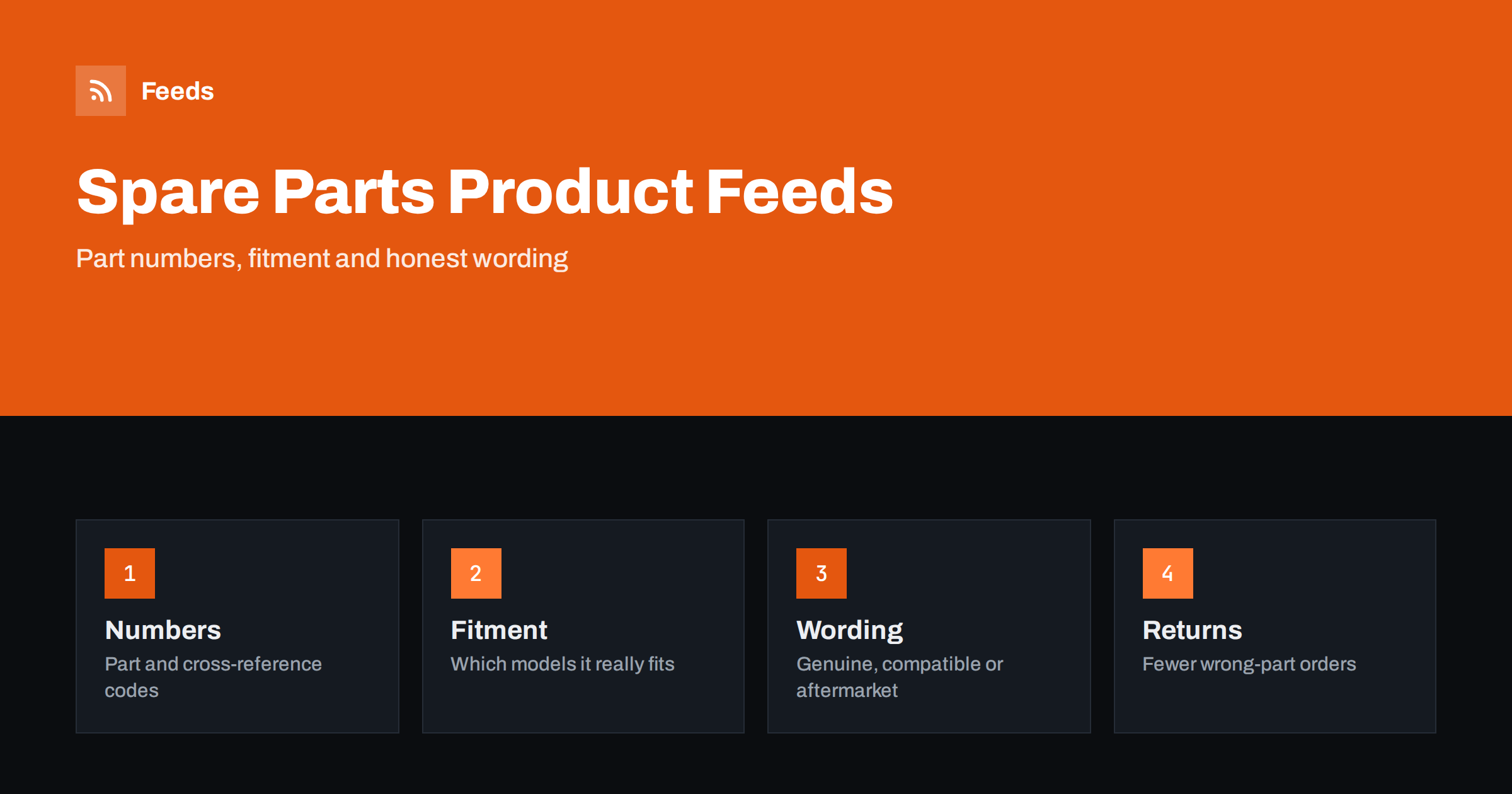
Short answer: A spare part is bought to fit one specific machine, so the feed has to answer the question “will it fit mine?” before anything else. Put the part type and the part number in the title, list the models it fits, say clearly whether the part is genuine, compatible or aftermarket, give each variant its own identifier and keep images and descriptions honest. Shoppers search by part number and model, so these two facts matter more than adjectives, and they are also the main protection against wrong-fit returns.
How people shop for spare parts
Someone buying a replacement door seal, a vacuum filter, a kettle base or a drain pump does not browse. They know what has broken, and often they have the part number from the old part or from a manual. They type it into a search engine, or they type the make and model with the name of the part. If your product is described only as “Premium replacement filter, long life”, it will be invisible to both searches.
The same is true for compatible accessories: chargers, straps, cases, belts, brushes, blades. The shopper wants to know whether the product works with a certain model. A feed that states the compatible models in a clear form turns a vague click into an informed one. Parts of the same logic appear in product feeds for phone accessories and product feeds for auto parts, and this article applies them to household, workshop and garden machines and similar goods.
Titles that match how people search
A reliable pattern is: part type, brand of the part, part number, then the main models or the range it fits. “Door Seal Gasket 4055123456 for Washing Machines WM 7000 Series” works better than “Rubber seal, high quality”. If the part number is long, put it where it will be read, and keep the order the same for the whole catalogue. The title advice in product feed title optimization applies, with the part number in the place that colour or size would take for clothing.
Do not list fifty models in the title. Platforms cut long titles, and the result looks like spam. Put the three or four most common models in the title and the full fitment list in the description and on the product page. If a part fits a whole series, name the series. Where the shop’s own search uses a model selector, make sure the feed text agrees with it.
Part numbers, cross-references and identifiers
Spare parts often have several numbers: the manufacturer’s part number, the original equipment number, a supplier’s number and a barcode. Keep them straight. The manufacturer part number goes in the MPN attribute together with the brand. A GTIN goes in the GTIN attribute where one exists, and should come from the manufacturer or the supplier, never be invented. If the same physical part is sold under another number by another brand, mention the cross-reference in the description, and be careful not to claim that it is an official replacement unless the manufacturer says so. The expectations are explained in GTIN, MPN and brand in feeds.
Keep your own product identifier stable. Suppliers change numbers when a part is revised, and a stable internal identifier lets you keep the history of the product while you update the MPN and the description. When two revisions of a part exist and are not interchangeable, treat them as separate products, with the difference stated in the title or in a clear attribute.
Genuine, compatible and aftermarket: say which
This is the most important honesty rule in the category. A genuine part is made or approved by the manufacturer of the machine. A compatible or aftermarket part is made by someone else to fit. Both are legitimate products, and shoppers choose between them for price and quality, but they must not be mixed up. State the type in the title or the first line of the description: “Genuine”, “Original”, “Compatible with” or “Aftermarket replacement for”.
Use manufacturer names carefully. “Compatible with Brand X models” is a factual statement about use. A product title that begins with another company’s brand as if it were yours, or that uses their logo in the image, can mislead shoppers and breach trademark and platform rules. Where you are unsure, ask for advice and follow the rules of the platform and of your market. In the brand attribute, put the maker of the part you sell, not the brand of the machine.
Variants, packs and kits
Parts come in sizes, lengths, voltages and colours, and in packs: a pack of two filters, a set of four belts, a repair kit with seals and screws. Each of these is its own product with its own identifier, price and stock. Group variants of the same part type with a shared group identifier; the mechanism is described in product variants in feeds. State pack contents exactly in the title: “Pack of 3” is a fact, “Value pack” is not.
For kits, list what is inside, and offer the single items separately if you stock them. A person who needs one seal should not have to buy a kit by accident. The rules for multipacks and bundles in the feed are covered in bundles and multipacks in product feeds.
Images, descriptions and safety
Show the actual part, from the side that helps identification: the connector, the mounting points, the dimensions. Add a photograph with a ruler or a drawing with measurements where possible, and include the part number on the image only if it is a natural part of the product, not as promotional text. The requirements are listed in product feed image requirements.
The description should give dimensions, material, voltage or power where relevant, the fitment list and any limits. Add a short note for safety-critical parts, for instance electrical components, gas fittings and safety devices: say that installation should be done by a qualified person where required and that the part must match the model. Do not claim certifications you cannot show. Where a part contains a battery or a hazardous material, check shipping restrictions before you sell to other countries, and set shipping accordingly; the options are described in shipping in product feeds.
Reducing wrong-fit returns
Wrong-fit returns are the main cost in this category. A few habits reduce them. Show the fitment list high on the page and ask the customer to compare their model number, with a picture of where to find it on the machine. Offer a simple compatibility search on the site. Where the feed has a field for it, keep it consistent with the page. And track the return reasons by product: a part with many “does not fit” returns probably has a wrong or incomplete fitment list.
When a manufacturer discontinues a model, update the fitment. A part that is no longer made may still be needed for years, which makes your accurate information valuable. Remove or mark out of stock products that you cannot supply, as described in out-of-stock products in your feed.
Finally, keep a short list of your fastest-selling parts and check their feed entries first each month. A few products usually account for most of the orders, and a single wrong fitment note on one of them costs more than a dozen errors in the long tail.
How RSS Feed Creator helps
RSS Feed Creator builds Google Merchant Center and Meta catalog XML straight from your store. WooCommerce and Shopify are read automatically, and any other store can use a CSV link. You can skip out-of-stock products, rewrite titles with rules so that the part type, part number and main models appear in the same order every time, and adjust prices. The currency is detected automatically. Before you submit anything, check the preview and the Merchant Center diagnostics to confirm that part numbers, variants and packs arrive as you expect. The free plan includes product feeds with up to 50 products, and the Store plan covers one store with 3 product feeds and up to 2,000 products. The details are on the pricing page.
Related reading
- Home Appliance Product Feeds: Energy Labels and Specs
- Product Feed Checklist: What to Verify Before You Submit
- 12 Product Feed Mistakes That Quietly Cost You Sales
The bottom line
A spare parts feed is a fitment promise. Lead with the part type and the number, list the models honestly, label genuine, compatible and aftermarket clearly, keep identifiers stable and make the page and the feed agree. Customers who get the right part the first time rarely return it, and they remember the shop.
FAQ
Where should the part number go in the feed?
Put it in the MPN attribute together with the brand, and in the title where shoppers will read it. Mention cross-references in the description, not as claims of official equivalence.
How do I describe compatible parts without misleading shoppers?
State that the part is compatible or aftermarket, use another brand’s name only as “compatible with”, keep that brand out of the brand attribute and do not use its logo.
How many models can I list in the title?
Three or four, or the name of the series. Put the full fitment list in the description and on the product page so that titles stay readable and are not cut off.
Should different revisions of a part be separate products?
Yes, if they are not interchangeable. Give each its own identifier and state the difference clearly, so that shoppers and your own staff pick the right one.
What reduces wrong-fit returns the most?
An accurate fitment list placed high on the page, help for finding the model number and a review of return reasons by product. Correct any part with repeated “does not fit” returns.