ENEnglish
 LTLietuviškai
 DEDeutsch
 FRFrançais
 RUРусский
 ESEspañol
 PLPolski
 ITItaliano
 UKУкраїнська
 CSČeština
 PTPortuguês
 JA日本語
JA日本語 LVLatviešu valoda
 ETEesti
 HUMagyar
 IDBahasa Indonesia
 TRTürkçe
 HIहिन्दी
 ELΕλληνικά
 ARالعربية
 THไทย
THไทย VITiếng Việt
 RORomână
 MSBahasa Melayu
 BNবাংলা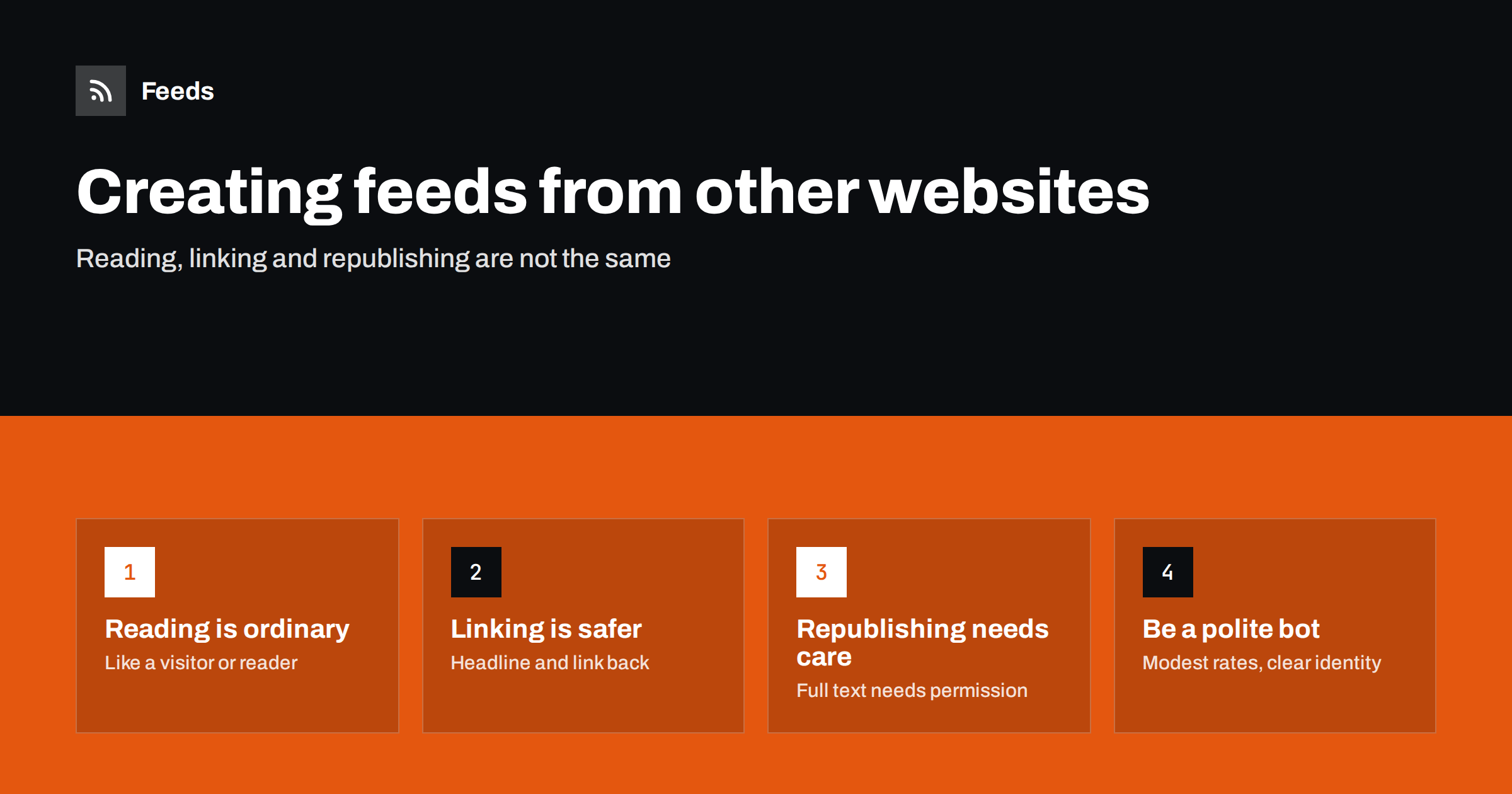
Short answer: Creating a feed from a public web page for your own reading or monitoring is, in most situations, similar to what feed readers and search engines do every day: you read publicly available pages and note headlines and links. Legal risk grows with what you do next. Republishing full articles, images or large amounts of content without permission can infringe copyright or breach a site’s terms, and aggressive automated access can cause other problems. This article is general information, not legal advice; for commercial republishing, ask the rights holder or a lawyer.
People who discover page-to-feed tools often ask the same question: am I allowed to do this? The honest answer is that it depends less on the feed itself and more on how you use it. Reading headlines in your own reader is very different from copying a competitor’s articles onto your own site. Here is a practical way to think about it.
Separate three activities
Most confusion disappears when you separate three things that often get lumped together.
- Accessing the page. An automated visitor downloads a public page, just as a browser does.
- Extracting facts about new items. Headline, link, date and perhaps a short summary are noted in a feed.
- Using the content. The feed is read privately, shared within a team, used to post links elsewhere, or used to republish content.
Each step has different considerations. The first two are the everyday business of feed readers, search engines and link previews. The third is where most legal and ethical questions live.
Reading and monitoring
Using a feed to learn when a site publishes something new, and then clicking through to read it on that site, is the most common use and the least controversial. You are doing what a regular visitor does, only more efficiently. The publisher still receives your visit when you open the article.
Many websites explicitly welcome this by publishing their own feeds. Where they do not, creating a feed from a public list page for personal or internal monitoring is broadly comparable. Still, check the site’s terms of use; some sites prohibit automated access, and respecting that is both courteous and prudent.
Linking and sharing headlines
Sharing headlines with links, for example in an internal digest or on social media, is also widespread. Links send readers to the original, which publishers generally value. A few principles keep this on solid ground:
- Share the headline and link, with at most a brief summary. Let the original page do the telling.
- Attribute clearly, so it is obvious whose content you are pointing to.
- Avoid presenting others’ content as your own or implying endorsement.
- Be aware that images can carry separate rights. Link previews generated by social platforms are one thing; copying images into your own posts is another.
Republishing content
Copying full articles, substantial excerpts or images onto your own website or channels without permission is where the real risk lies. Copyright protects original writing and images in most countries, and short headlines and facts are treated differently from full creative works. Exceptions such as fair use or quotation rights vary by country and depend on specific circumstances, so they are not something to rely on casually for automated republishing.
If you want to republish content from another site, for example partner news on your own site, the straightforward route is to ask. Many organizations are happy to agree, especially when you link back. Some publish their content under licenses that explicitly allow reuse with attribution. Get the permission in writing and keep it.
Polite automated access
Even when your use of content is fine, the way you access a site matters. Automated visits that are too frequent can burden small servers, and site owners are entitled to manage how bots use their resources.
- Keep refresh rates modest. Match them to how often the site publishes. Checking a weekly blog every minute is neither useful nor polite.
- Use a clear user agent. Identifying the bot lets site owners understand the traffic and contact the operator if needed.
- Respect robots rules. The Robots Exclusion Protocol lets site owners express which paths automated clients should avoid. Honoring it is standard good practice.
- Stay out of private areas. Do not try to access content behind logins, paywalls or technical barriers.
- Use conditional requests and caching where possible to avoid downloading unchanged content.
Special cases worth thinking about
Paywalled publications
Many subscription publications show headlines and short teasers publicly while keeping full articles behind a paywall. A feed built from the public list page contains only what any visitor can see, which is usually fine for monitoring. Trying to get past the paywall, or sharing paid content with people who do not subscribe, is a different matter and should be avoided.
Government and public-sector content
Official publications are often published under open licenses or with explicit reuse permissions, and some countries place certain public documents outside copyright entirely. Rules differ, so check the site’s copyright or reuse statement. Even when reuse is allowed, attribution is usually required.
Social media and platforms
Large platforms typically have detailed terms about automated access and offer their own official interfaces. Creating feeds from their pages is more likely to conflict with their terms than reading an ordinary website’s public news page. Where a platform offers official feeds or interfaces, use those.
Personal data
If the pages you follow contain information about individuals, such as names in job postings, forum posts or public registers, data protection rules may apply to how you store and use that information, particularly in Europe. Collect only what you need for your purpose and do not build profiles of people from monitored content.
A quick risk guide
| Use | General risk level | Key considerations |
|---|---|---|
| Personal monitoring in a reader | Low | Site terms on automated access, modest refresh rates |
| Internal team digest of headlines | Low | Link to originals, avoid copying full text |
| Posting headlines and links publicly | Low to moderate | Attribution, no implied endorsement, image rights |
| Republishing excerpts on your site | Moderate | Length of excerpts, local quotation rules, permission |
| Republishing full articles or images | High without permission | Copyright; get written permission or a license |
| Accessing login-protected content | High | Terms of service, access rules; avoid |
This table is a rule of thumb, not a legal opinion. Laws differ between countries, and specific facts matter.
Your own site: what if someone makes a feed from it?
If you run a website, others may already be creating feeds from your pages, which usually means they want to follow you. You have several options:
- Publish your own feed, so followers use the version you control, with the summaries and links you choose.
- Use robots rules or terms of use to restrict automated access to areas you do not want read by bots.
- Watch your server logs for bots that visit too often and contact or block them if necessary.
For most sites, being easy to follow is a benefit: it brings readers back each time you publish. If you do find your articles copied in full on another site, the usual first step is a polite request to remove them or replace them with a headline and link, followed, where necessary, by the takedown procedures that hosting providers and platforms offer.
How Feeds approaches this
Feeds reads public pages from the outside, the way a visitor does, and does not need or attempt any access to private areas. Its bot identifies itself as FeedsBot, so site owners can recognize its visits. When a site already publishes a feed, Feeds uses it rather than reading the page. The feeds it produces carry item titles, links, dates, images and summaries for following new content; how you then use that content is your responsibility, and republishing others’ work should be done with permission. More about the product is on the home page.
Related reading
- RSS vs Web Scraping: Which Should You Use to Track Sites?
- How Page-to-Feed Tools Find the Articles on a Web Page
- How to Track Competitor Blogs and News with RSS Feeds
The bottom line
Creating a feed from a public page to follow new content is normally comparable to what feed readers and search engines already do. The questions that matter are how often you access the site, whether you respect its rules, and what you do with the content afterwards. Read and link freely, republish only with permission, keep your bot polite, and seek proper legal advice for anything commercial or large-scale.
FAQ
Is it legal to make an RSS feed from a website that does not offer one?
For personal or internal monitoring of public pages, it is generally comparable to ordinary browsing and feed reading, though site terms can restrict automated access. Laws vary by country, so this is general information rather than legal advice.
Can I republish articles from a feed on my own website?
Not without permission in most cases, because full articles and images are usually protected by copyright. Headlines with links are far safer; for more, ask the publisher for written permission.
Can I share headlines and links from someone else’s site?
Sharing headlines with links and clear attribution is common and generally low risk. Avoid copying full text or images and avoid implying the source endorses you.
Do I have to follow robots.txt?
Robots rules express how a site owner wants automated clients to behave. Following them is standard good practice and shows respect for the site, even where it is not strictly required.
What can I do if someone makes a feed from my site?
Publish your own feed so followers use the version you control, restrict automated access with robots rules or terms if you wish, and monitor logs for bots that visit too often.