ENEnglish
 LTLietuviškai
 DEDeutsch
 FRFrançais
 RUРусский
 ESEspañol
 PLPolski
 ITItaliano
 UKУкраїнська
 CSČeština
 PTPortuguês
 JA日本語
JA日本語 LVLatviešu valoda
 ETEesti
 HUMagyar
 IDBahasa Indonesia
 TRTürkçe
 HIहिन्दी
 ELΕλληνικά
 ARالعربية
 THไทย
THไทย VITiếng Việt
 RORomână
 MSBahasa Melayu
 BNবাংলা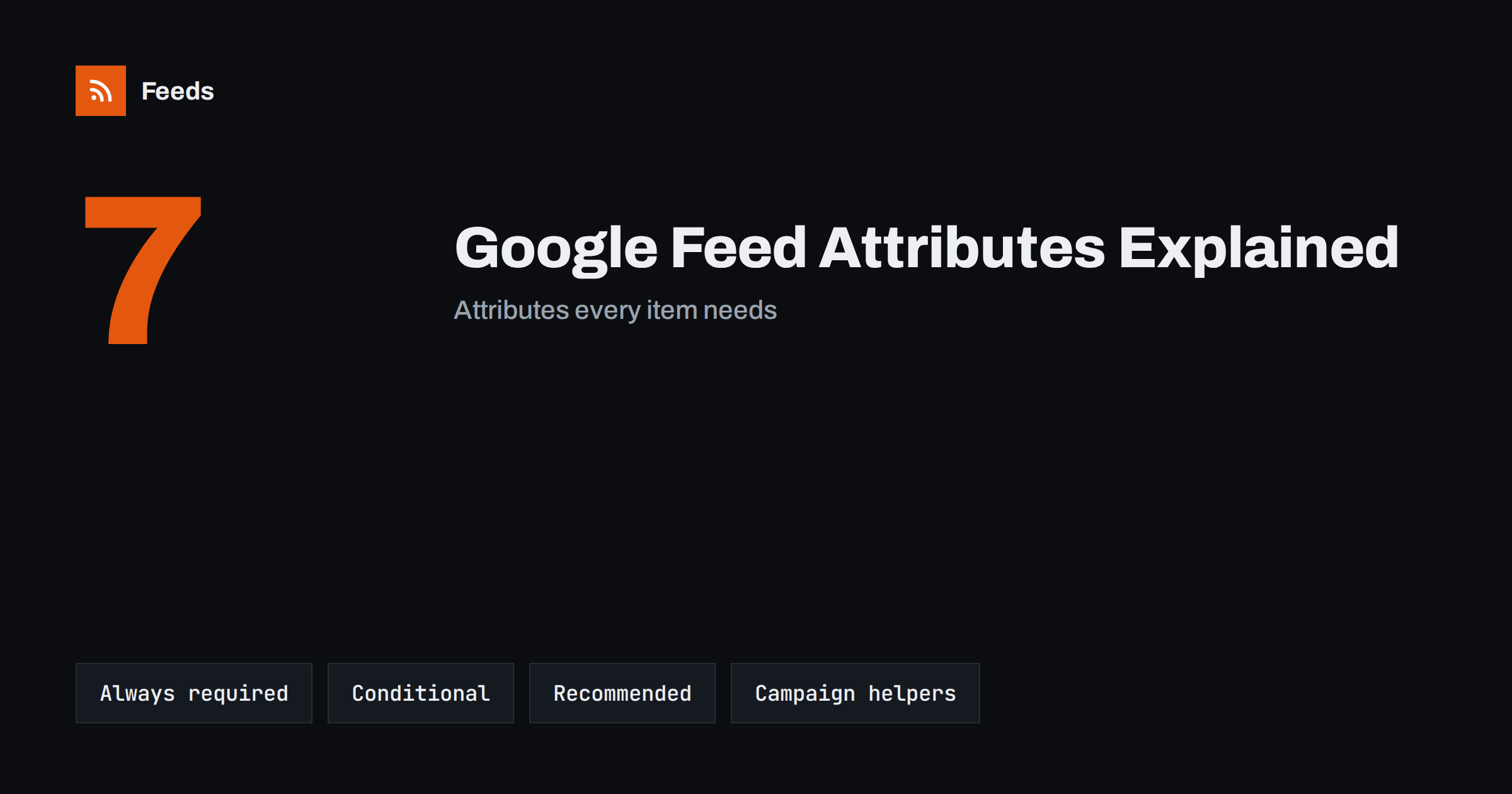
Short answer: Every Google product feed item needs id, title, description, link, image_link, availability and price, and most items also need condition, brand and a GTIN when the product has one. Some categories add conditional requirements, such as color, size, gender and age_group for apparel. Optional attributes like product_type, sale_price, additional_image_link and custom labels do not block approval but improve matching, presentation and campaign control.
How Google groups feed attributes
Google’s product data specification is long, and reading it top to bottom is not the fastest way to build a working feed. It helps to sort attributes into four groups:
- Required for every product. Without these, an item is rejected outright.
- Required for some products. These depend on the category, the country or whether the product has a manufacturer identifier.
- Recommended. They are not needed for approval, but they give Google more information for matching searches and showing rich results.
- Campaign and management attributes. They are never shown to shoppers, but they help you organize bidding, exclusions and reporting.
The specification is updated from time to time, and requirements can differ by country and program. Treat this guide as a map and confirm details in the official Google product data specification before a large launch.
Attributes required for every product
| Attribute | What to send | Common mistakes |
|---|---|---|
| id | A unique, stable identifier, typically the SKU; up to 50 characters | Changing IDs after a platform migration, reusing IDs across variants |
| title | A descriptive product name; up to 150 characters | All caps, promotional text such as “free shipping”, missing key attributes |
| description | Plain text about the product; up to 5,000 characters | HTML markup, store-wide boilerplate, links to other products |
| link | The landing page URL on your verified domain | Redirects to the homepage, links to a different variant |
| image_link | The URL of the main product image | Placeholders, logos, watermarks, promotional overlays |
| availability | in_stock, out_of_stock, preorder or backorder | Showing in stock when the page says sold out |
| price | Amount plus ISO 4217 currency, for example 49.00 EUR | Missing currency, net price where tax-inclusive is required |
Two of these deserve extra attention. The price must match what a shopper sees on the landing page, including tax where the country requires tax-inclusive pricing. The availability must reflect the real stock status; Google compares both against your pages and flags mismatches.
Condition, brand and product identifiers
Product identifiers are how Google recognizes that your item is the same product other retailers sell. That matters for matching searches and for showing product ratings and comparisons.
- condition: new, refurbished or used. It is required when a product is used or refurbished, and it is good practice to always send it.
- brand: required for all new products with a clearly associated brand, except some categories such as movies, books and music. For your own private label, use your store or brand name.
- gtin: the global trade item number (UPC, EAN, JAN or ISBN). Send it for every product that has one assigned by the manufacturer. Never invent one.
- mpn: the manufacturer part number. Send it when there is no GTIN.
- identifier_exists: set to no (or false) only when the product genuinely has no GTIN and no MPN, for example custom-made goods or vintage items.
A frequent cause of warnings is setting identifier_exists to no for branded products that do have barcodes. That hides the problem instead of solving it, and it can limit how well the products perform.
Attributes required for some products
Several attributes become mandatory depending on what you sell and where:
- Apparel and accessories targeting countries such as the US, UK, Germany, France, Japan and Brazil need color, size, gender and age_group.
- item_group_id is required for products that come in variants, such as sizes or colors, so Google can group them.
- Shipping information is required in many countries, either in the account settings or per item with the shipping attribute. Account settings are simpler for most stores.
- Tax is set for the United States, usually in account settings rather than per item.
- Unit pricing attributes may be needed in some countries for products sold by weight, volume or length.
- Energy efficiency and certification attributes apply to certain appliances in regions with labeling rules.
If you only sell hard goods in one country, many of these do not apply. If you sell fashion across several countries, they are the first thing to get right.
Recommended attributes worth adding
Recommended attributes are where a feed moves from “approved” to “competitive”. These are the ones most stores should add once the basics are clean:
- product_type: your own category path, such as “Home > Kitchen > Knives”. It is useful for campaign structure and reporting.
- google_product_category: Google assigns a category automatically, but you can set one when the automatic choice is wrong or when a category triggers specific rules.
- sale_price and sale_price_effective_date: show a discount with the original price, and schedule when it starts and ends.
- additional_image_link: up to several extra images, such as detail shots or the product in use.
- product_highlight and product_detail: short bullet highlights and structured specifications that can be shown to shoppers.
- shipping_weight or dimensions: needed when your shipping rates depend on them.
Custom labels and other campaign attributes
custom_label_0 through custom_label_4 let you tag products with values that mean something to your business: margin band, season, best seller, clearance or price range. Shoppers never see them. Their value comes when you split campaigns or set different bids and targets by label.
Keep a written key for what each label means, and keep the values consistent. A label like “high-margin” is only useful if it is applied by a rule, not by hand to a random subset of products. Other management attributes include excluded_destination, which keeps a product out of a specific program, and ads_redirect, which adds tracking parameters to ad clicks.
Formatting rules that trip up feeds
Even with every attribute present, formatting errors can cause rejections. Watch these details:
- Use the exact attribute names and allowed values. Availability must be one of the listed values, not “yes” or “available”.
- Send prices as numbers with a currency code, using a dot or the format your feed type expects, and without extra symbols.
- Use absolute URLs starting with https:// for links and images.
- Encode special characters correctly. In XML, ampersands must be escaped; in CSV, fields containing commas must be quoted.
- Keep text free of HTML tags, emoji used as decoration and repeated keywords.
A good habit is to validate a sample file in Merchant Center before switching the main source over, especially after changing how the feed is generated.
What a complete item looks like
It helps to picture a single item that covers the essentials. Imagine a stainless steel water bottle sold in two colors. A complete entry for the blue 750 ml variant would carry:
- an id equal to its SKU, for example BTL-750-BLU, which never changes;
- a title such as “Brandname Insulated Steel Water Bottle 750 ml, Blue”, leading with what the product is;
- a plain-text description covering material, capacity, insulation time claims only if the manufacturer states them, and care instructions;
- a link that opens the blue variant preselected, and an image_link that shows the blue bottle on a clean background;
- availability in_stock, a price of 29.00 EUR including VAT, and condition new;
- brand, the gtin printed on the packaging, color Blue and an item_group_id shared with the green variant;
- optionally a product_type such as “Outdoor > Hydration > Bottles” and a custom_label_0 such as “core-range”.
Notice that almost everything in this list already exists in a typical store database. The work of a feed is mostly mapping and cleaning, not inventing new data. When an attribute truly does not exist anywhere in your systems, such as GTINs for older stock, fix it once at the source so every channel benefits.
It is also worth checking how your feed handles edge cases: products with no image yet, bundles, gift cards and digital downloads. Gift cards and some digital items may not be eligible at all, and products without images should simply stay out of the feed until they have one.
How Feeds helps
Feeds generates the Google product XML format from your store and fills the core attributes automatically: id, title, link, image, price, availability and brand. It reads WooCommerce and Shopify data, or a CSV link for other platforms, detects the currency, and lets you skip out-of-stock products, rewrite titles and adjust prices with rules. You check a preview of the products before the feed is created. You can start with a free account on the Feeds home page.
Related reading
- What Is a Product Feed? A Plain-English Guide for Stores
- How to Set Up a Google Merchant Center Product Feed
The bottom line
Start with the seven attributes every item needs, then add condition, brand and real identifiers. Check which conditional attributes apply to your categories and countries, especially for apparel and variants. Once products are approved, recommended attributes and custom labels are where you gain visibility and control.
SSS
What is the minimum set of attributes for a Google product feed?
id, title, description, link, image_link, availability and price are required for every item. Most new products also need brand and a GTIN when one exists.
Is GTIN mandatory in Google Merchant Center?
It is required for products that have a manufacturer-assigned GTIN. If a product genuinely has none, send brand and MPN, or set identifier_exists to no.
Do I need google_product_category?
Not usually. Google assigns a category automatically, but setting it yourself can help when the automatic category is wrong or when category-specific rules apply.
What are custom labels used for?
They let you group products by your own criteria, such as margin, season or best sellers, so you can structure campaigns and bids. Shoppers never see them.
How long can a product title be?
Up to 150 characters. The first part matters most, because Shopping results often show only the beginning of the title.