ENEnglish
 LTLietuviškai
 DEDeutsch
 FRFrançais
 RUРусский
 ESEspañol
 PLPolski
 ITItaliano
 UKУкраїнська
 CSČeština
 PTPortuguês
 JA日本語
JA日本語 LVLatviešu valoda
 ETEesti
 HUMagyar
 IDBahasa Indonesia
 TRTürkçe
 HIहिन्दी
 ELΕλληνικά
 ARالعربية
 THไทย
THไทย VITiếng Việt
 RORomână
 MSBahasa Melayu
 BNবাংলা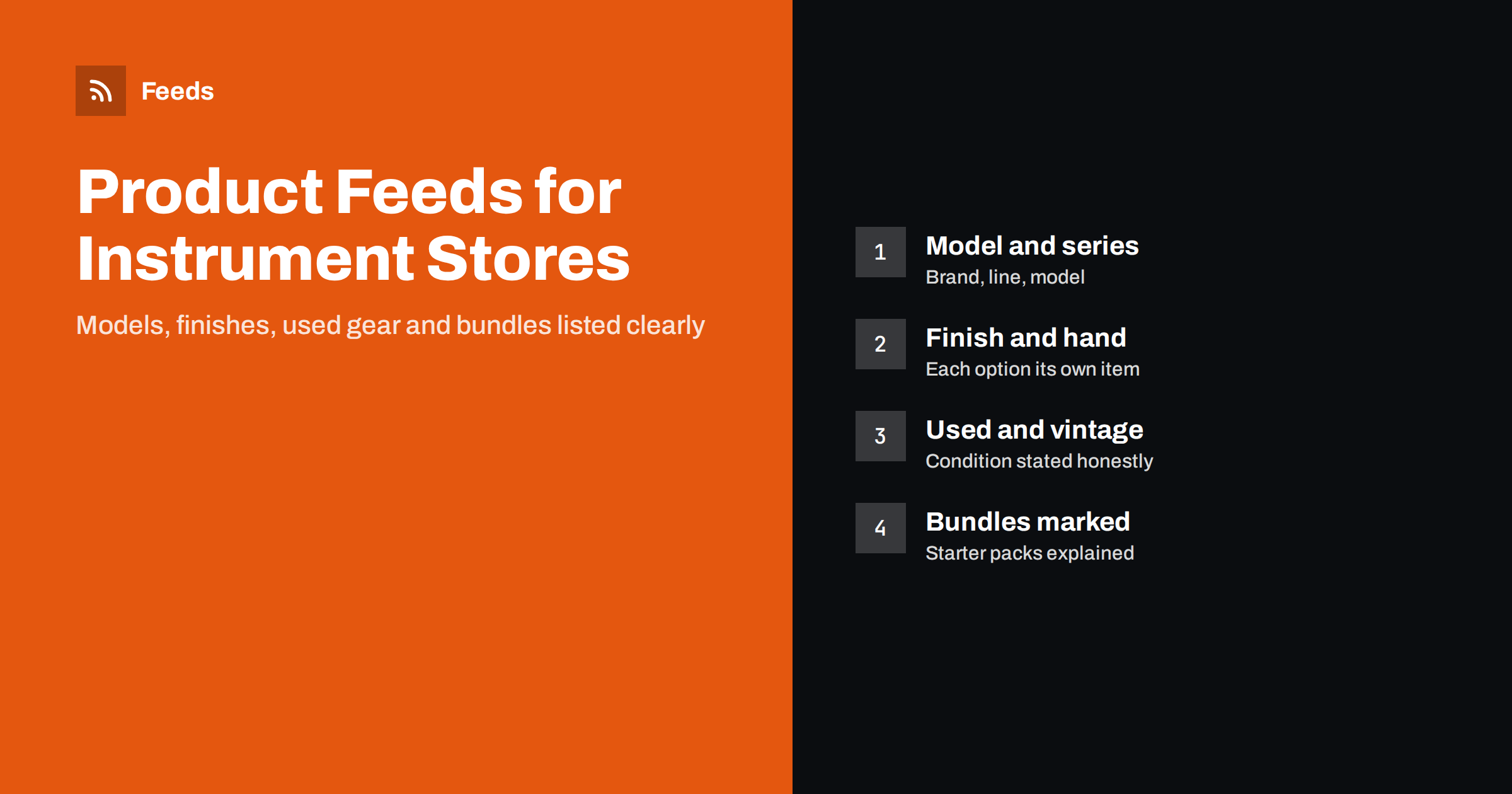
Short answer: Musical instrument feeds work when musicians can recognise the exact model before they click. Lead titles with brand, series and model, add the specification players compare, such as body type, number of strings, scale or key count, and list finishes, sizes and left-handed versions as separate grouped items. Use real GTINs and model numbers for new gear, set condition accurately for used and vintage instruments, describe starter packs and bundles clearly and show the actual instrument in photos.
Why instrument feeds need care
Musicians are some of the most informed shoppers in retail. A guitarist knows the difference between two models that look identical to anyone else; a pianist compares key actions; a drummer knows which shell sizes come in a kit. They search for specific models and series, and they compare offers from several stores before buying, especially for expensive instruments.
A feed that lists “electric guitar black” with a price will not reach those buyers. A feed that names the brand, series, model, finish and key specs appears in the searches musicians actually make and shows them, at a glance, that this is the instrument they want.
The category also has a large market for used and vintage gear, many variants per model and frequent bundles for beginners. Each of these needs specific handling in the feed to avoid misleading listings and disapprovals.
Instruments are also personal purchases. Many players want to see the exact piece they will receive, especially for wood instruments where grain and colour vary. A feed and product page that show the actual instrument, or at least make clear when a photo is representative, build the trust that expensive purchases need.
Titles that name the exact model
A practical title formula is brand, series, model, the specification that distinguishes it and the finish. The right specification depends on the instrument.
| Instrument | Useful title pattern |
|---|---|
| Electric guitar | Brand, series, model, pickup configuration, finish |
| Acoustic guitar | Brand, model, body shape, top wood, electro or not |
| Bass guitar | Brand, model, number of strings, fretted or fretless, finish |
| Digital piano or keyboard | Brand, model, number of keys, key action type, colour |
| Drum kit | Brand, series, number of pieces, shell sizes or configuration, finish |
| Wind and brass | Brand, instrument, model, key or pitch, finish |
Keep titles factual. Avoid “pro quality”, “best beginner guitar” and similar claims; let the model and specs speak. More patterns are in product feed title optimization.
Finishes, sizes and left-handed versions
Many instruments come in several finishes, sizes or orientations. A guitar model may exist in five colours and in a left-handed version; violins come in sizes for different ages; keyboards come with different numbers of keys. Each option is a separate product with its own id, price, availability and usually its own GTIN.
- Give each finish its own item with a photo of that finish.
- List left-handed models as their own items and put “left-handed” in the title.
- Use the size attribute for instruments sold in fractional or age-based sizes.
- Group all options of a model with one item_group_id.
Left-handed buyers in particular search specifically for left-handed models, and a listing that hides the orientation in the description loses them. Grouping is explained in product variants in feeds and how item_group_id works.
Configurations work the same way. A digital piano sold with or without a stand, or a guitar sold with a choice of pickups, should be separate items if the price or identifier changes. If an option is only an add-on chosen at checkout, keep the base product as the feed item and explain the option on the product page.
Identifiers, model numbers and model years
New branded instruments and equipment usually have GTINs, and manufacturers use model or part numbers that musicians search for. Use the real barcode for every variant, the brand as the manufacturer writes it and the model or part number as the MPN.
Model years and revisions matter in this category. Manufacturers update models with new pickups, electronics or finishes while keeping similar names, and older versions remain on the market. Include the model year or revision where it distinguishes versions, and never reuse identifiers between versions. Discounted previous-year models should keep their own identifiers and show the reduction as a sale price.
Handmade instruments from small workshops and boutique builders may have no GTIN. Use the builder’s name as the brand and state that no identifier exists. See GTIN, MPN and brand: product identifiers explained and product feeds for handmade and custom products.
Used and vintage instruments
Used and vintage gear is a significant part of many music stores. These are often unique items: one specific guitar with its own history and condition. The feed must describe them honestly and update quickly when they sell.
- Set the condition to used for pre-owned instruments, even if they have been serviced.
- Use refurbished only for instruments professionally restored to a defined standard, where the channel’s definition fits.
- Mention any repairs, refrets, replaced parts or refinishing, because collectors care about originality.
- Describe the year, modifications, wear, case and any original parts in the description.
- Photograph the actual instrument, from several angles, rather than using stock images.
- Remove sold items promptly, because each unique instrument can only be sold once.
“Vintage” is a description, not a condition value; use it in the title or description where accurate. More on condition values in used and refurbished products in feeds.
Starter packs, kits and accessories
Beginner bundles are popular: a guitar with an amplifier, cable, tuner and gig bag, or a keyboard with a stand, bench and headphones. These are bundles and should be marked as such, with a title that makes clear what is included and the main instrument’s identifiers. A bundle compared against the bare instrument would otherwise look overpriced.
Drum kits are a special case. A complete kit sold by the manufacturer as one product, with its own barcode, is a product in its own right. A kit you put together from separate shells, hardware and cymbals is a bundle. Accessories, such as strings, sticks and reeds, are often sold in packs and should state the quantity; store-made packs are multipacks. See bundles and multipacks in product feeds.
Accessories also need correct branding. A gig bag that fits a particular guitar model should carry its own maker’s brand, with the compatible model named in the title.
Images, shipping and high-value items
Instrument images should show the product clearly on a plain background, with the finish true to life. Wood grain, sunburst patterns and figured tops vary between individual instruments, so if the photo shows a representative example rather than the exact item, say so in the description. For used and high-end instruments, photos of the actual piece are expected.
Large instruments, such as pianos, drum kits and double basses, often have special shipping costs or delivery arrangements. Make sure the shipping cost in your feed or account settings matches checkout, and use shipping labels to group oversized items. Our guide on shipping in product feeds covers the options.
Seasonality is milder than in some categories, but gift periods bring more beginners, and beginner bundles and accessories deserve their own custom labels so campaigns can focus on them at the right time.
How RSS Feed Creator helps
RSS Feed Creator (Feeds) creates Google Merchant Center and Meta catalog XML directly from a WooCommerce or Shopify store, or from a CSV link for other platforms, without plugins or code on your site. The feed uses the Google product XML format with id, title, link, image, price, availability and brand, and Meta reads the same file. You can skip out-of-stock products, which matters for unique used instruments, rewrite titles to put series, model and finish first and adjust prices with rules, while the currency is detected automatically. Attributes such as GTIN, MPN or condition can be added in Merchant Center with a supplemental feed. Compare plan limits on the pricing page.
Related reading
- Supplemental feeds in Merchant Center: when and how to use them
- Product feed image requirements for Google and Meta
- Out-of-stock products in your feed: keep, mark or remove?
The bottom line
Musicians search for exact models, so instrument feeds must name them. Lead titles with brand, series and model, add the distinguishing specs and finish, list finishes, sizes and left-handed versions as grouped items, use real identifiers and model years, describe used and vintage gear honestly with real photos and mark bundles clearly. Accurate data reaches informed buyers and reduces the returns that expensive instruments make so costly.
SSS
Should left-handed guitars be separate items in the feed?
Yes. Left-handed models have their own identifiers, stock and price, so they should be separate items with “left-handed” in the title, grouped with the right-handed versions of the same model.
Which condition should a vintage guitar have?
Used, unless it has been professionally restored to a standard that matches the channel’s definition of refurbished. Describe its age, modifications and wear in the description.
How do I list a beginner guitar package?
Mark it as a bundle and list what is included in the title and description, such as the guitar, amplifier, cable and bag. Use the main instrument’s identifiers.
Do boutique and handmade instruments need a GTIN?
Usually not, because they have no barcode. Use the builder’s name as the brand and state that no identifier exists, instead of inventing one.
Can I use the manufacturer’s photo for a used instrument?
It is better not to. Buyers of used gear expect to see the actual instrument and its condition, so photograph it yourself from several angles.