ENEnglish
 LTLietuviškai
 DEDeutsch
 FRFrançais
 RUРусский
 ESEspañol
 PLPolski
 ITItaliano
 UKУкраїнська
 CSČeština
 PTPortuguês
 JA日本語
 LVLatviešu valoda
 ETEesti
 HUMagyar
 IDBahasa Indonesia
 TRTürkçe
 HIहिन्दी
 ELΕλληνικά
 ARالعربية
 THไทย
 VITiếng Việt
 RORomână
 MSBahasa Melayu
 BNবাংলা
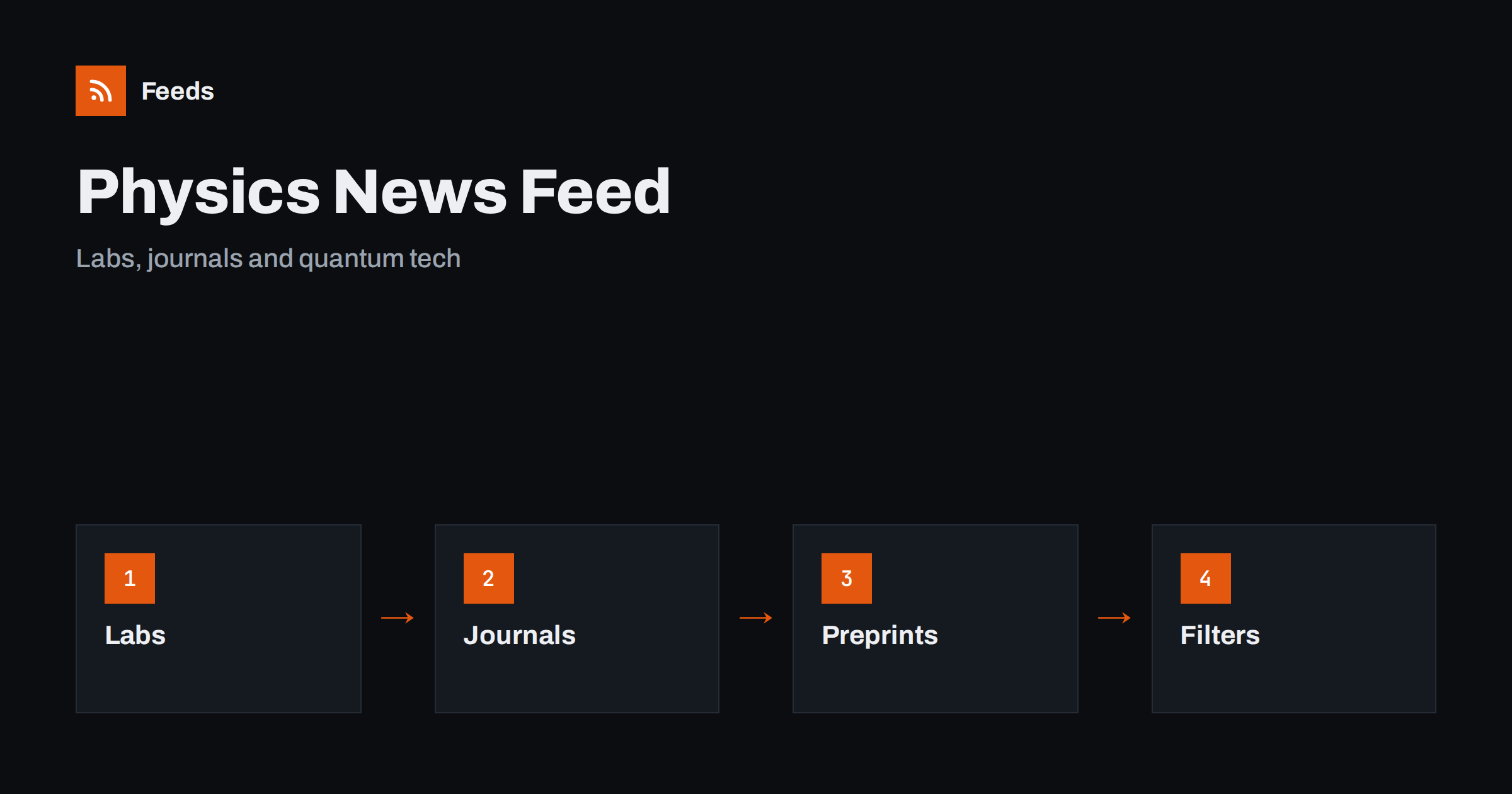
Short answer: Physics and quantum technology news comes from university departments, national laboratories, journals, preprint servers, standards bodies and specialist media. RSS puts these in one reader so you can follow new results, funding calls, conferences and industry announcements. Begin with institutions that publish their own work, filter by topic, treat preprints and press releases with care and read the paper before repeating a headline.
Another trap is the word ‘first’. Many headlines claim a first, but the claim often depends on narrow conditions, such as a certain number of qubits or a certain material. Look for what exactly was new, and whether other groups have reported similar work. A calm reader soon learns that science moves through many small steps.
Why this field needs a careful reading habit
Physics moves fast, and the language is technical. A result described as a breakthrough in a headline may be a small step in a long series of experiments. Quantum technology adds another layer: computing, sensing, communication and materials each have their own claims, and commercial announcements are mixed with academic research. A reader who only sees what social media promotes will meet the loudest claims first.
A feed lets you choose sources and see items in order. You decide how much to read each day, and you can return to older items without losing them. The basic idea is explained in what is an RSS feed, and it suits a subject where context matters more than speed.
Do not forget the people. Researchers often write blogs or share lecture notes, and these pages explain ideas more clearly than press releases. If a physicist whose work you respect has a site with a feed, add it. Personal sources are valuable for context, but remember that they express opinions as well as facts.
Where the news comes from
Start with university physics departments and national laboratories, which publish news about their own experiments and often link to the paper. Add large collaborations and facilities, such as observatories, accelerators and light sources, which announce results and schedules. Learned societies and professional bodies share policy statements, awards and events.
Next come journals and preprint servers. Many journals provide feeds of new articles, and preprint servers allow feeds by subject area. Preprints have not been through formal review, so mark them as early results. Finally, add specialist media and industry news for the commercial side of quantum technology. How to follow science, space and astronomy news with RSS describes sources that overlap with physics.
Test your filters against a month of older news. Search your reader for the same words and see what you would have received. If you find too many irrelevant items or miss a story that mattered, adjust the words. This simple check takes ten minutes and makes your feed much better.
Filters that match the subject
Physics is broad, so build a filter around what you need. A student may follow “condensed matter” and “superconductors”. An engineer may follow “qubit”, “error correction”, “photonic” and “cryogenic”. A teacher may follow “particle physics” and “astrophysics” for classroom examples. Use the terms from the field itself, and add common spelling variants.
Exclude words that bring in unrelated items, such as job adverts or product promotions, if they are not what you need. Set up keyword alerts using RSS feed filters describes the method, and how to reduce RSS alert noise helps when the list grows too fast. Review your terms every few months, since the vocabulary of a young field changes.
Keep a folder for items you want to revisit after six months. Many early results are confirmed, refined or quietly dropped. Looking back teaches you which sources and which kinds of claims tend to hold up, and that experience is more valuable than any rule about what to trust.
Preprints, papers and press releases
There are three levels of information. A press release is written by a communications office, and it aims to attract attention. A news article is written by a journalist, who may add comments from other experts. The paper itself, whether in a journal or as a preprint, contains the method and the data. When an item matters to you, go to the paper and read at least the abstract, the figures and the limitations.
Ask the same questions each time: what was measured, under which conditions, how large was the effect and has anyone repeated it? A result seen at very low temperature in a single laboratory is a different thing from a product that works in an office. How to follow academic journals and research with RSS alerts explains the technical setup.
When you read a company announcement, look for numbers that can be checked: the number of users, the size of a contract, the date of a delivery. Vague claims about being ahead of the market tell you little. Check whether independent experts or customers confirm the story, and give older announcements a second look a year later to see what happened.
Quantum technology and the business side
Quantum computing, sensing and communication attract investment, and companies announce partnerships, funding rounds and roadmaps. Treat these items as business news, not as scientific proof. A roadmap is a plan, not an achievement. Compare claims with independent papers and with statements from several sources.
Government programmes, standards bodies and security agencies publish guidance on topics such as post-quantum cryptography and national strategies. These are valuable for organisations that need to plan. Follow semiconductor and chip industry news with RSS and track regulator updates with RSS show related sources for hardware supply and policy.
Add the pages of the societies and institutes in your own country as well, because many calls are national and are not listed on international sites. For students, summer schools, internships and thesis topics appear on department pages, usually without any feed, so a page-to-feed tool is worth the few minutes of setup.
Conferences, funding calls and jobs
Physicists and engineers depend on deadlines: abstract submissions, travel grants, fellowship calls and PhD positions. Societies, universities and funding agencies announce them on news pages, and the dates are easy to miss. Follow these pages and write each date in your calendar when you see it.
For funding, follow grant funding announcements with RSS explains how to build a feed of calls. For events, call for speakers alerts with RSS helps teachers and researchers who want to present their work. A short monthly check of the calendar prevents missed opportunities.
For group learning, a shared folder works well. Students can each take a subfield, choose one item per week and explain it in two minutes. This builds the habit of reading sources critically, and it shows how a field is connected. Teachers get a living reading list without extra preparation.
Teaching and outreach with a feed
Teachers and science communicators can use a feed as a source of fresh examples. A new measurement, a photo from a laboratory or a simple explanation of an experiment can start a lesson or a post. Save items in folders by topic and add a one-line note about how you could use each of them.
If you share items publicly, add your own sentence that explains why the result matters, and link to the original source. Avoid inflating claims. Saying that a result is promising but early builds more trust than calling it a revolution. Fact-checking with primary sources and RSS shows habits that keep your sharing accurate.
Sources without a feed
Some laboratories, small companies and societies publish news pages without feeds. A page-to-feed tool can read the list of items and turn it into a feed. How to create an RSS feed for a website without RSS explains the process, and the preview lets you check titles, dates and links before you rely on the feed.
Revisit these feeds every few months. Websites are redesigned, and a feed that worked well can start to show odd items. A quick look at the preview solves most problems.
How RSS Feed Creator helps
RSS Feed Creator turns laboratory, society and funding agency news pages into clean RSS feeds, even when the site has no feed of its own. It reads titles, images, summaries and dates, uses an existing feed when there is one, and shows a preview of the items before the feed is created. Keyword filters keep only the items that contain your words, and the paid add-on lets you merge up to 10 sources into one feed with duplicates removed automatically, which suits a feed of results, calls and conferences by topic. Feeds refresh every 3 hours on the free plan and every 30 minutes on paid plans. The free plan allows up to 20 items per feed, and the details are on the pricing page.
Related reading
- How to Follow Science, Space and Astronomy News with RSS
- How to Follow Academic Journals and Research with RSS Alerts
- How to Follow Semiconductor and Chip Industry News with RSS
The bottom line
A feed makes physics and quantum technology news manageable: institutions first, then journals and preprints, then industry. Filter by topic, read the paper behind the headline, separate research from business announcements and keep a calendar of deadlines.
SSS
Are preprints reliable?
They are early results that have not been through formal review, so treat them as work in progress and look for later confirmation.
How do I avoid hype?
Read the original paper, check what was measured and under which conditions, and compare with other independent reports.
Which sources should a student start with?
University department news, a national laboratory, one or two journals in your subfield and a learned society.
Can I follow a laboratory without a feed?
Yes. A page-to-feed tool can create a feed from its news page, and you should check the preview.
How much time should I spend?
About twenty minutes a week is enough for most readers, with more only when you need it for work.