ENEnglish
 LTLietuviškai
 DEDeutsch
 FRFrançais
 RUРусский
 ESEspañol
 PLPolski
 ITItaliano
 UKУкраїнська
 CSČeština
 PTPortuguês
 JA日本語
JA日本語 LVLatviešu valoda
 ETEesti
 HUMagyar
 IDBahasa Indonesia
 TRTürkçe
 HIहिन्दी
 ELΕλληνικά
 ARالعربية
 THไทย
THไทย VITiếng Việt
 RORomână
 MSBahasa Melayu
 BNবাংলা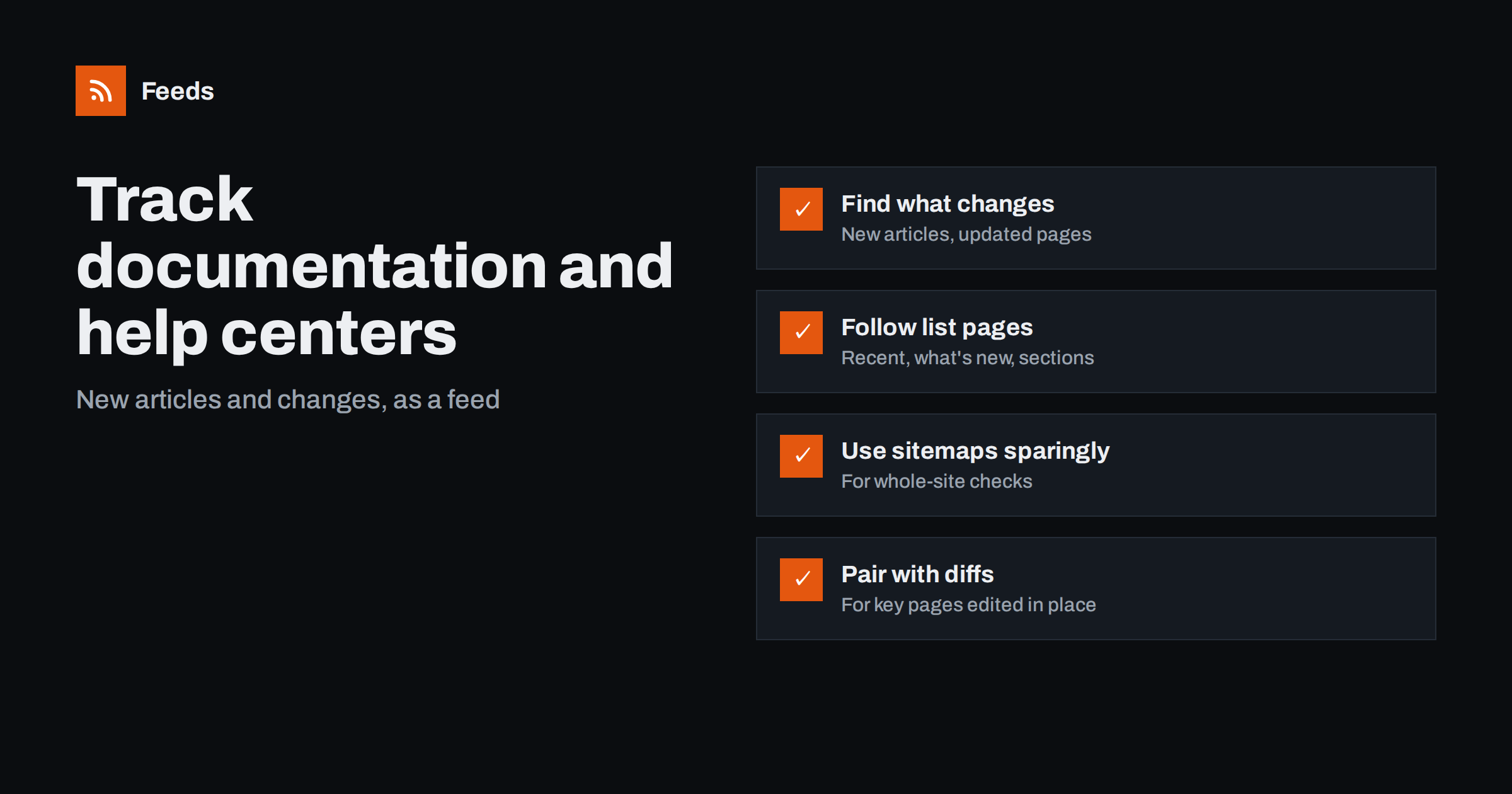
Short answer: Follow the pages in a documentation site or help center that list new or recently updated content: “what’s new” pages, recently updated lists, section indexes and release-specific docs. Use feeds where the platform offers them, and create feeds from these list pages where it does not. For a few critical pages that are edited in place, add a page change monitor. Filter vendor docs for words that signal action, and competitor docs for new features and integrations.
Documentation and help centers are some of the most honest pages a company publishes. Marketing pages describe what a product aims to be; documentation describes what it actually does and how. New help articles often appear when features launch, sometimes before the announcement, and updated pages reveal changed limits, new settings or deprecated options. For teams that depend on a vendor, and for teams that compete with one, following documentation is a quiet source of early information.
Few people do it systematically, because documentation sites are large and change constantly in small ways. The trick is to follow the few pages that summarize change, rather than the thousands of articles themselves, and to filter for what matters to you.
What documentation changes reveal
| Change | What it may mean | Who cares |
|---|---|---|
| New help article for a feature | A launch, possibly before the announcement | Customers, competitors, partners |
| New integration guide | A new partnership or ecosystem move | Competitors, partners |
| Updated limits or quotas | Changed plans or technical constraints | Customers, developers |
| Deprecation notes | Features or API versions going away | Customers, developers |
| New troubleshooting articles | Common problems users are facing | Competitors, support teams |
| New regional or language pages | Expansion into new markets | Competitors |
Step 1: Understand how the docs site is organized
Documentation sites and help centers are built on a wide range of platforms, but most have a few pages that act as indexes:
- “What’s new” or “recent updates” pages that list new and changed articles.
- Section or category pages listing all articles in one area, sometimes with the newest first.
- Release notes or changelog sections inside the documentation.
- Search results sorted by date, if the search page has a stable address.
- A sitemap listing every documentation page, often with last-modified dates.
Spend a few minutes exploring before creating feeds. The best source is the page that changes whenever new content appears, with each article as a separate link.
Developer documentation and customer help centers are often separate sites with different structures. A software company may have a developer portal with API references and release notes, a help center for end users, and a status page. Each tells you something different, so decide which ones matter for your purpose before creating feeds.
Step 2: Use built-in feeds where available
Some documentation and help center platforms provide feeds for new articles, recent activity or specific sections. Developer documentation built with common static site tools may include a feed for release notes or blog-style updates. Check the page source for feed links, and look for “subscribe” or “follow” options on section pages. Some help centers let signed-in users follow sections by email, which you can use alongside feeds. Code hosting platforms also publish release feeds for open source SDKs and libraries, which often accompany documentation changes for developers.
Step 3: Create feeds from list pages
Where there is no feed, create one from the most useful list page with a page-to-feed tool. A “recently updated” page is ideal because it surfaces both new and edited articles. Section pages work well for following a specific area, such as integrations or billing. Check the preview to make sure each item is an article with its own link, not a navigation entry or a breadcrumb. If the preview mixes articles with menus, a narrower section page usually gives a cleaner result.
Remember what a feed can and cannot see. A new article is a new link, so it appears as a new item. An existing article that is edited keeps its link, so it usually does not appear again, unless the site’s “recently updated” page moves it back to the top with a changed link or the list itself is what you follow.
Step 4: Add change monitoring for key pages
Some of the most important documentation pages are edited in place: limits and quotas pages, pricing-related docs, API reference pages, supported browsers or platforms, data retention policies. A feed will not reliably notice these edits. For a short list of critical pages, use a page change monitor restricted to the relevant section of the page. Combined with feeds for new articles, this covers both kinds of change. Keep this list short, perhaps five to ten pages, and restrict monitoring to the part of each page that matters, so that navigation or footer changes do not trigger alerts.
Step 5: Filter and route
Large help centers publish frequently. Filters keep the stream useful:
- Vendor docs you depend on: filter for deprecated, removed, required, limit, migration, new version, and the names of features you use.
- Competitor docs: filter for integration, new, beta, and names of capabilities you track, or read everything if volume is low.
- Partner docs: filter for your own product name, to see when they document integrations with you.
Route vendor changes to the people who maintain your integrations, competitor findings to product and sales, and partner changes to the partnership owner. A short weekly note summarizing what changed, with links, is usually enough for competitor findings; vendor deprecations deserve a ticket in the engineering backlog the day they appear.
A worked example
A company that builds a scheduling tool integrates with two calendar platforms and a video-meeting service, and competes with three similar tools. Its product manager follows the developer documentation “what’s new” pages of the three platforms it integrates with, filtered for deprecated, version, limit and the names of the APIs it uses, and the help center section pages of the three competitors, unfiltered. Only one of the six sources has a feed; the rest are generated from list pages. For two API reference pages that describe rate limits, she adds a page change monitor.
Within a few months, the feeds surface a deprecation notice for an API version the company relies on, giving the engineering team months to migrate, and a competitor’s new help articles describing an integration with a popular CRM, weeks before the competitor announces it publicly. Neither piece of information came from newsletters or press releases; both were in documentation that anyone could read, if they happened to look.
Using sitemaps for occasional full checks
Documentation sites usually have sitemaps listing every page. For a periodic full check, for example monthly, compare the current sitemap with a saved copy to see which pages were added. This catches new articles in sections you do not follow as feeds. It is too heavy and noisy for daily monitoring, but a useful complement for competitor research. Look especially at the addresses of new pages; documentation paths often reveal feature names, product areas and integrations at a glance.
Common mistakes
- Following only the docs home page. It rarely changes. Follow the lists that do.
- Expecting feeds to catch edits. Use change monitoring for pages edited in place.
- Ignoring troubleshooting articles. They reveal real user problems, useful for both support and competitive positioning.
- No owner for vendor changes. Deprecation notes are useless if nobody acts on them.
- Silent feeds after migrations. Documentation platforms are migrated fairly often. Check that feeds still find items.
- Following too many sections. Start with the areas you use or compete in, and expand only when you see a gap.
How Feeds helps
Feeds turns “what’s new” pages, recently updated lists and section indexes into RSS feeds when they have none, and uses existing feeds when they do, with a preview before anything is created. You can merge several documentation sources into one feed and keep only items with your words, with duplicates removed automatically. Feeds refresh on their own, and paid plans alert you if a feed stops finding items. For pages edited in place, pair Feeds with a change monitor. See the plans.
Related reading
- How to Follow Software Changelogs and Release Notes with RSS
- Sitemap vs RSS: Which Is Better for Detecting New Pages?
- Page Change Monitoring vs RSS Feeds: Which Do You Need?
The bottom line
Documentation shows what products actually do, and changes to it are early signals for customers and competitors alike. Follow the list pages that change, use built-in feeds or generated ones, add change monitoring for key pages edited in place, filter for the words that matter to you, and route findings to the right owners. An occasional sitemap check fills the remaining gaps.
SSS
Can I get notified when a help center publishes new articles?
Yes. Use the help center’s own feed or follow options if available, or create a feed from a “recently updated” or section page with a page-to-feed tool.
Will a feed tell me when an existing help article is edited?
Usually not, because the article keeps the same link. Use a page change monitor for important pages that are edited in place.
Why follow competitors’ documentation?
Documentation shows real features, integrations and limits, often before or in more detail than marketing announcements. New troubleshooting articles also reveal common user problems.
Which documentation page is best to follow?
A “what’s new” or “recently updated” page is ideal. Otherwise, follow the section pages for the areas you care about.
Are sitemaps useful for monitoring documentation?
For occasional full checks, yes. Comparing sitemaps monthly reveals new pages, but they are too noisy for daily monitoring.