ENEnglish
 LTLietuviškai
 DEDeutsch
 FRFrançais
 RUРусский
 ESEspañol
 PLPolski
 ITItaliano
 UKУкраїнська
 CSČeština
 PTPortuguês
 JA日本語
JA日本語 LVLatviešu valoda
 ETEesti
 HUMagyar
 IDBahasa Indonesia
 TRTürkçe
 HIहिन्दी
 ELΕλληνικά
 ARالعربية
 THไทย
THไทย VITiếng Việt
 RORomână
 MSBahasa Melayu
 BNবাংলা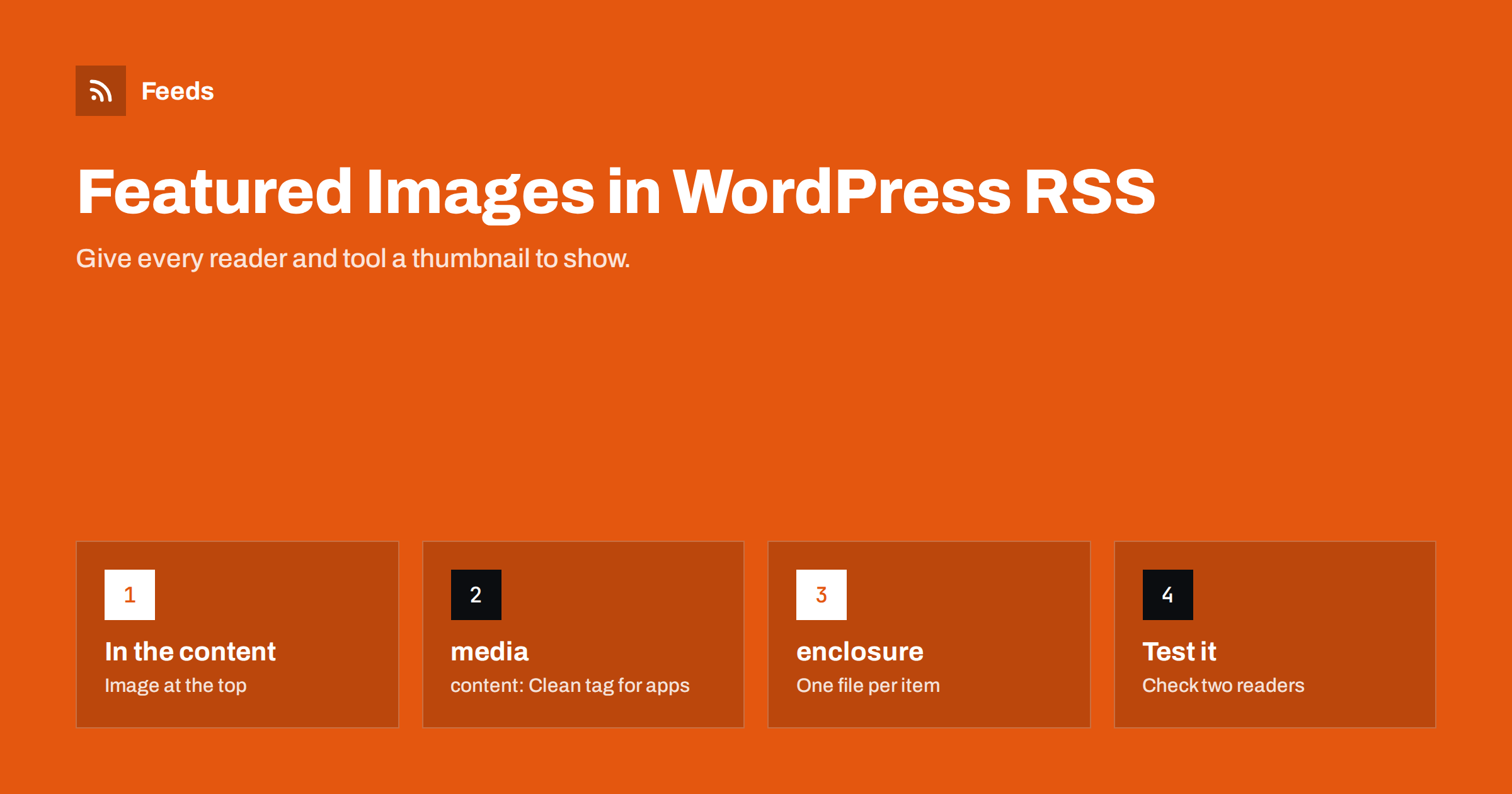
Short answer: WordPress does not include featured images in its RSS feed by default, so many readers and tools show your posts without a picture. You can fix it in three ways: insert the image at the top of the feed content, add a media:content or media:thumbnail tag, or add an enclosure. The most compatible approach is to do both the first and the second, using a large image size and full, absolute URLs.
Images make a big difference in feed readers, news apps, email digests and social posting tools. A post with a thumbnail stands out in a list; a post without one looks unfinished or gets a random image scraped from the page. Yet the default WordPress feed only includes images that happen to be inside the post body, and only when the feed shows full text. This guide explains why, what the options are, and how to implement them without breaking the feed.
Why WordPress leaves featured images out
WordPress’s feed templates were written before featured images, officially “post thumbnails”, became standard in themes. The feed outputs the post title, link, date, categories, excerpt and, if you choose full text, the post content. The featured image is stored separately as post metadata, so it is not part of either.
The practical result:
- If your feed shows full text and your posts contain images in the body, readers may pick the first of those images.
- If your feed shows excerpts, there is usually no image at all.
- If your design relies on a featured image that does not appear in the body, feed users never see it.
Some SEO plugins and themes add featured images to feeds as a setting, so check your plugin options before writing any code. If none does, the methods below are straightforward.
How apps look for an image in a feed
There is no single official “image” element for RSS items, so different apps look in different places. Most check several, in roughly this order:
| Where the image is | Example | Who reads it |
|---|---|---|
| Media RSS tag | media:content or media:thumbnail | Many readers, aggregators and automation tools |
| Enclosure | enclosure with an image MIME type | Some readers and tools; podcasts use it for audio |
| First image in content | An img tag in content:encoded or description | Almost every reader as a fallback |
| The web page itself | og:image on the linked page | Some apps and social tools, if nothing is in the feed |
Because behaviour differs, the safest plan is to provide the image in more than one place: a Media RSS tag for apps that look for structured data, and an image at the top of the content for everything else.
Method 1: add the image to the feed content
This method puts the featured image at the top of each item’s excerpt and content, but only in the feed, not on your website. A short snippet in a child theme’s functions.php or a small custom plugin does it:
function feed_add_featured_image( $content ) {
    if ( is_feed() && has_post_thumbnail() ) {
        $img = get_the_post_thumbnail( null, 'large', array( 'style' => 'max-width:100%;height:auto;' ) );
        $content = '<p>' . $img . '</p>' . $content;
    }
    return $content;
}
add_filter( 'the_excerpt_rss', 'feed_add_featured_image' );
add_filter( 'the_content_feed', 'feed_add_featured_image' );
Notes on this approach:
- Use the large size or a custom size of at least about 1200 pixels wide. Thumbnails of 150 pixels look blurry in modern apps.
- WordPress normally outputs absolute image URLs, but some CDN or optimisation plugins rewrite them. Check that the image address in the feed starts with
https://. - If your excerpts are plain text in some apps, the image in the excerpt may be ignored. That is fine; the content version will still be used.
Method 2: add a Media RSS tag
Media RSS is a widely used extension for describing images, audio and video in feeds. Adding it takes two small steps: declare the namespace on the feed, and output a tag inside each item.
add_action( 'rss2_ns', function () {
    echo 'xmlns:media="http://search.yahoo.com/mrss/" ';
} );
add_action( 'rss2_item', function () {
    if ( ! has_post_thumbnail() ) return;
    $id  = get_post_thumbnail_id();
    $src = wp_get_attachment_image_src( $id, 'large' );
    if ( ! $src ) return;
    printf( '<media:content url="%s" medium="image" width="%d" height="%d" />' . "\n",
        esc_url( $src[0] ), (int) $src[1], (int) $src[2] );
} );
This gives apps a clean, structured image without them having to parse your HTML. Some plugins already declare the Media RSS namespace; declaring it twice makes the feed invalid, so check the feed’s opening rss tag after adding the code.
Method 3: use an enclosure
An enclosure tag attaches a file to an item and requires the file’s URL, size in bytes and MIME type. It is the standard for podcasts, and some readers display image enclosures as thumbnails. There are two drawbacks. First, RSS 2.0 allows only one enclosure per item, so if you ever attach audio, the image competes with it. Second, you must provide the correct file length; a wrong value is a validation error. For most blogs, Media RSS plus an image in the content is simpler and more widely used.
Choosing the right image size and format
Feed images travel to many places: reader lists, full-screen article views, email digests and social posts. A few rules keep them looking good everywhere:
- Width. Aim for at least 1200 pixels wide. Many social platforms and apps display images at that width or larger.
- Aspect ratio. Landscape images around 1.91:1 or 16:9 crop well in most apps. Important text near the edges may be cut off in square thumbnails.
- Format. JPEG and PNG are universally supported. WebP is widely supported by modern apps but not by every older reader or email client, so if your site serves WebP only, check how images appear in email tools.
- File size. Keep images reasonably compressed. Readers load them for every item in a list.
- Alt text. The snippet in Method 1 carries your image’s alt text, which helps accessibility in readers that show it.
Testing the result properly
Do not trust a single view. Test in this order:
- View the raw feed at
/feed/and check that each item has the image tag or the image at the top of the content, with an absolute HTTPS URL. - Validate the feed with the W3C Feed Validation Service to catch duplicate namespaces or malformed tags.
- Add the feed to two different readers, ideally one web-based and one mobile app, and check thumbnails in the list view and images in the article view.
- Check any tool that uses your feed, such as an email platform or social posting tool, with a fresh post. Many tools cache old items and will not reprocess them.
- Purge caches if nothing changes, since feed caching often hides the new output.
Common mistakes to avoid
- Editing the parent theme. Updates erase your changes. Use a child theme or a small plugin.
- Adding images twice. If your posts already start with the featured image in the body, Method 1 duplicates it. Check a few posts first.
- Relative or lazy-loaded URLs. Some lazy-loading plugins replace
srcwith a placeholder and adata-srcattribute. Readers do not run JavaScript, so they see only the placeholder. Exclude feeds from lazy loading. - Forgetting old posts. Readers do not re-fetch old items. The change affects new posts in most apps.
When the source is not your site
If you follow or reuse feeds from other sites that come without images, you cannot change their WordPress settings. Our tool, Feeds, reads a site’s items with titles, images, summaries and dates, using the existing feed and the page’s structured article data where available, and shows you a preview of exactly what it found before you create the feed. It works from the outside, with no plugin on the source site. See how it works on the home page.
Related reading
- WordPress RSS Feed URLs: Every Feed Your Site Already Has
- WordPress RSS Feed Not Working? Common Problems and Fixes
- How to Choose an RSS Reader: Features That Actually Matter
The bottom line
WordPress leaves featured images out of its feeds, but adding them is a small change with a visible payoff in every reader and tool that uses your feed. Put a large image at the top of the feed content for universal support, add a Media RSS tag for apps that look for structured images, use absolute HTTPS URLs, and test in more than one reader. Your posts will look finished wherever they appear.
SSS
Does the WordPress RSS feed include featured images?
Not by default. The feed includes images that are inside the post body when it shows full text, but the separately stored featured image is left out unless a theme, plugin or snippet adds it.
What is the best way to add images to an RSS feed?
Use two methods together: place the image at the top of the feed content, and add a media:content tag from the Media RSS namespace. This covers both apps that parse HTML and apps that look for structured media tags.
Why are my feed images blurry?
The feed probably uses a small image size such as the 150-pixel thumbnail. Switch to the large size or a custom size at least about 1200 pixels wide.
Why don’t images show in my RSS reader even though they are in the feed?
Check that the image URLs are absolute and use HTTPS, and that a lazy-loading plugin has not replaced them with placeholders. Also note that readers do not re-fetch old items, so test with a new post.
Can I use an enclosure for images?
You can, and some readers display it, but RSS 2.0 allows only one enclosure per item and requires the exact file size. For most blogs, Media RSS plus an image in the content is simpler.